Key takeaways
- Pigment quality: Look for a listed Colour Index name, such as PB29 for ultramarine blue or PR101 for synthetic iron oxide. Single-pigment colors are usually easier to control.
- Lightfastness: Choose paints rated ASTM I or II, or an equivalent top permanence category, for work intended to remain stable under normal display conditions.
- Binder type: Linseed oil usually dries to a tough, flexible film and can enhance saturation. Safflower and poppy oils yellow less but dry more slowly, so they are common in whites and pale colors.
- Consistency: A buttery paint suits brushwork and impasto; a softer, more fluid paint can be preferable for glazing and detailed passages.
- Tube value: Compare price by milliliter, not by the number of colors. Cadmiums, cobalts, and some earth colors have very different production costs.
Best Oil Painting Sets for Professionals: Top Kits
The best oil painting sets for professionals are Gamblin Artist’s Oil Colors for a balanced studio palette, Michael Harding for exceptionally dense, traditional color, Old Holland for maximum pigment strength and historical formulation, Winsor & Newton Artists’ Oil Colour for dependable value and broad availability, and Schmincke Mussini when a resin-oil medium and distinctive optical depth suit the working method.
For professional use, tube count is less important than pigment load, lightfastness, binder behavior, and whether the palette contains useful mixing colors in sufficiently large tubes. A 10-color set of artist-grade paint can be more valuable than a 24-color assortment filled with convenience mixtures or small tubes.
Our top picks
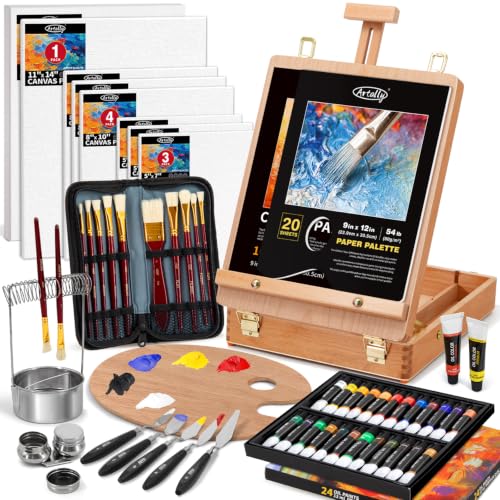


As an Amazon Associate we earn from qualifying purchases at no extra cost to you. Ratings are shown as listed on Amazon.
What separates a professional oil painting set from a student kit?
Professional oil paints generally use higher pigment concentrations, more carefully controlled grinding, and single-pigment colors where possible. They also disclose pigment identities and permanence information more consistently. That matters because two paints with the same color name can mix very differently: a single-pigment iron oxide behaves predictably, while a convenience green may contain several pigments and become dull when mixed with other colors.
- Pigment quality: Look for a listed Colour Index name, such as PB29 for ultramarine blue or PR101 for synthetic iron oxide. Single-pigment colors are usually easier to control.
- Lightfastness: Choose paints rated ASTM I or II, or an equivalent top permanence category, for work intended to remain stable under normal display conditions.
- Binder type: Linseed oil usually dries to a tough, flexible film and can enhance saturation. Safflower and poppy oils yellow less but dry more slowly, so they are common in whites and pale colors.
- Consistency: A buttery paint suits brushwork and impasto; a softer, more fluid paint can be preferable for glazing and detailed passages.
- Tube value: Compare price by milliliter, not by the number of colors. Cadmiums, cobalts, and some earth colors have very different production costs.
Head-to-head comparison of leading professional sets
| Brand or line | Typical set format | Binder and handling | Pigment and permanence profile | Best studio use |
|---|---|---|---|---|
| Gamblin Artist’s Oil Colors | Commonly 9–14 colors; 37 ml tubes are typical | Primarily refined linseed oil, with formulation varying by pigment; buttery and responsive | Strong pigment disclosure; many colors are ASTM I or II | Daily professional painting, controlled mixing, and medium-to-large palettes |
| Michael Harding Artists’ Oil Colours | Commonly 10–14 colors; 40 ml tubes are common | Traditional oil binder system, with handling varying substantially by pigment; rich and dense | Very high pigment concentration in many colors; excellent permanence choices | Artists who want intense color and substantial coverage |
| Old Holland Classic Oil Colours | Often sold as curated sets of 10–12 colors; 40 ml tubes are common | Traditional oil-based formulation; generally firm, concentrated, and slow-changing | Noted for high tinting strength and many highly permanent colors | Layered studio work, strong darks, and restrained historical palettes |
| Winsor & Newton Artists’ Oil Colour | Frequently available in 10–20 color assortments; 21 ml and 37 ml tubes are common | Binder varies by pigment; generally smooth and versatile | Broad range with published permanence information; quality varies by individual color, not just line name | Professionals wanting reliable access and a lower entry cost |
| Schmincke Mussini | Often curated in 8–10 color sets; 35 ml tubes are common | Resin-oil formulation combined with drying oils; fluid, luminous, and suited to layered work | Many highly permanent pigments, but each color should be checked individually | Glazing, luminous transitions, and artists who prefer a more flowing paint |
Tube sizes and set contents vary by country and edition, so verify the individual product specifications before buying. The figures above describe common formats rather than a promise that every current set uses the same size.
Best picks by professional situation
| Your situation | Most suitable choice | Why |
|---|---|---|
| Building a first serious studio palette | Gamblin or Winsor & Newton Artists’ Oil Colour | Both offer broad color ranges, clear pigment information, and practical handling without requiring an all-luxury investment. |
| Maximum pigment strength and large canvas work | Michael Harding or Old Holland | Dense paint can cover more decisively and produce strong mixtures, although their higher prices make selective purchasing sensible. |
| Glazing and luminous, multi-layered painting | Schmincke Mussini | The resin-oil system provides a distinctive flow and optical character; it should be integrated into a consistent medium and drying schedule. |
| Limited storage or frequent travel between studios | A 9–10 color set with 21–37 ml tubes | A compact palette reduces duplicate colors and makes inventory easier. Add specialty colors separately rather than carrying a large assortment. |
| High-frequency professional production | 40 ml-set formats from Michael Harding or Old Holland, where available | Larger tubes usually reduce the cost per milliliter and delay interruptions, especially for white, earth colors, and commonly used blues. |
Palette range matters more than the color count
A useful professional set should cover warm and cool versions of the primaries, a reliable white, and at least one transparent or earth-based color. A practical core palette might include titanium white, yellow ochre, a warm yellow, a cool yellow, a warm red, a cool red, ultramarine blue, a cooler blue such as phthalo or cerulean, burnt umber, and a transparent earth or oxide.
Do not assume that a set containing several greens, violets, and oranges is more versatile. Those convenience colors can be useful for speed, but they may duplicate mixing capabilities while omitting essential neutrals. For portraits, replace some bright colors with additional earth reds and transparent browns. For landscape, prioritize earth yellows, oxide reds, ultramarine, and a useful green only if it matches your method. For abstract work, a broader selection of high-chroma colors may justify more convenience mixtures.
Tube value: a worked comparison
Suppose a 10-color set costs $180 and contains ten 40 ml tubes. Its total volume is 400 ml, producing a nominal cost of $0.45 per ml. A $120 set with ten 21 ml tubes contains only 210 ml, or $0.57 per ml. The smaller set costs less at checkout but is about 27% more expensive by volume.
That calculation still needs adjustment for pigment cost. A 40 ml tube of titanium white may be economical, while a tube of cadmium red or cobalt blue can account for a disproportionate share of the set price. Check which colors are full-size and whether the set replaces expensive pigments with hue mixtures. A “cadmium hue” can be perfectly serviceable, but it is not the same material as genuine cadmium paint and should be assessed for tinting strength and mixing behavior.
Binder differences and how they affect studio workflow
Linseed-oil paints are a dependable general-purpose choice. They typically develop a durable film and work well in direct painting, glazing, and impasto. Their main drawback is that some colors, particularly pale passages, may warm slightly over time.
Safflower- or poppy-oil-based colors can remain paler, but they often dry more slowly and may form a less robust film than linseed-based colors. This is why many painters use them selectively, especially in whites and light tints, rather than building an entire underlayer with them.
Schmincke Mussini uses a resin-oil approach that differs from a conventional linseed-only system. It can be attractive for flowing brushwork and glazing, but avoid mixing unfamiliar products indiscriminately in a thick layer. Follow the manufacturer’s guidance for mediums and observe the fat-over-lean principle: later layers should generally contain relatively more oil or flexibility than earlier layers.
Ownership realities: what wears out first?
- White paint: Titanium white is usually consumed fastest. Buy it in a larger tube or separately from the set.
- Caps and threads: Dried paint on the thread can split caps and cause leaks. Wipe the opening before replacing the cap.
- Slow-drying colors: Some blacks, earths, and pale colors can remain tacky longer than expected. Do not stack panels until the surface is firm.
- Brushes: Solvent, aggressive scrubbing, and leaving brushes in liquid usually damage them before the paint does. Remove excess paint with a rag, then clean with an appropriate soap or brush cleaner.
- Skin formation: Store tubes upright when practical and keep them tightly closed. Do not force a blocked nozzle with a sharp object toward your hand.
- Inventory: Record pigment codes, lightfastness ratings, and purchase dates. This makes it easier to replace a color without accidentally changing the behavior of a finished series.
Bottom line
Choose Gamblin for the most balanced all-around professional set, Michael Harding or Old Holland when pigment density is the priority, Winsor & Newton Artists’ Oil Colour when availability and cost control matter, and Schmincke Mussini for a resin-oil workflow centered on glazing and luminous layers. Before purchasing, compare the actual pigment codes, permanence ratings, binder notes, tube sizes, and cost per milliliter. That checklist is more reliable than choosing the set with the largest color count.