Key takeaways
- Between sizes? Go up a half size for closed-toe models like the Newport and Targhee III. The toe bumper takes up internal space, and hiking downhill pushes your foot forward.
- Narrow feet? Keen’s roomy fit can feel sloppy. Look at the Whisper or Clearwater CNX, which run a bit narrower, and cinch the bungee lace system fully.
- Socks or bare feet? The polyester webbing on the H2 models is designed for bare skin. If you’ll wear socks (common in shoulder season), try them on with socks before committing.
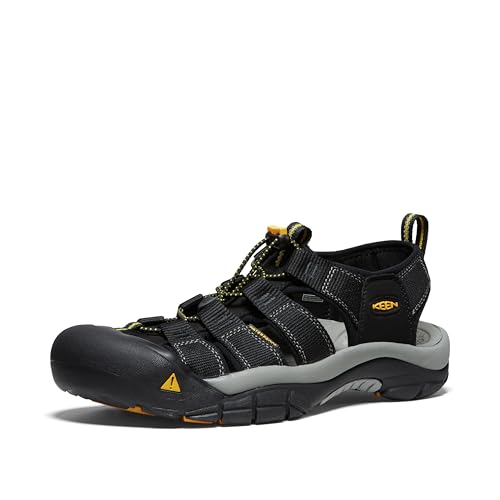
The best Keen hiking sandals for most people are the Newport H2 for all-around trail and water use, the Clearwater CNX for ultralight travel, and the Targhee III Sandal for the most support on rough terrain — which one suits you depends on how much water, weight, and mileage your plans involve. Below is a breakdown by fit, toe protection, grip, drying time, and arch support so you can match the model to your actual use.
Our top picks


As an Amazon Associate we earn from qualifying purchases at no extra cost to you. Ratings are shown as listed on Amazon.
Quick Comparison: Key Specs
| Model | Weight per shoe (approx.) | Toe protection | Best for | Typical price range |
|---|---|---|---|---|
| Keen Newport H2 | ~14 oz / 397 g | Full rubber toe bumper | Day hikes, water crossings, wet trails | $110–135 |
| Keen Newport Leather | ~15 oz / 425 g | Full rubber toe bumper | Dry trails, travel, casual wear | $120–140 |
| Keen Clearwater CNX | ~9 oz / 255 g | Slimmer toe guard | Travel, light trails, packing light | $90–110 |
| Keen Targhee III Sandal | ~15 oz / 425 g | Full rubber toe bumper | Rugged trails, heavier loads | $120–145 |
| Keen Whisper (women’s) | ~9 oz / 255 g | Toe bumper, lighter build | Women wanting a lighter Newport-style fit | $95–115 |
| Keen Astoria West | ~10 oz / 283 g | Open toe (no bumper) | Town-to-trail travel, casual wear | $100–120 |
How Keen Sandals Fit (and How to Size Them)
Keen is known for a wide, anatomical toe box — your toes can splay naturally, which matters on long descents and hot days when feet swell. Most models run true to size, but two practical points:
- Between sizes? Go up a half size for closed-toe models like the Newport and Targhee III. The toe bumper takes up internal space, and hiking downhill pushes your foot forward.
- Narrow feet? Keen’s roomy fit can feel sloppy. Look at the Whisper or Clearwater CNX, which run a bit narrower, and cinch the bungee lace system fully.
- Socks or bare feet? The polyester webbing on the H2 models is designed for bare skin. If you’ll wear socks (common in shoulder season), try them on with socks before committing.
Toe Protection: The Keen’s Signature Difference
Keen’s wraparound rubber toe bumper is why most hikers choose the brand over open-toe competitors. On rocky trails, root-covered paths, and slippery river crossings, it prevents the stubbed toes and gouged forefeet that send people back to shoes.
Not every Keen has it equally. The Newport and Targhee III have the full, chunky bumper; the Clearwater CNX has a lower-profile guard that still protects but sheds weight; open-toe models like the Astoria West have none — fine for city travel, a real drawback on talus or forest trails.
Grip and Traction
All the hiking-oriented models use razor-siped rubber outsoles — the thin slits flex and channel water on wet surfaces, similar to boat-shoe soles. In practice:
- Newport H2 / Targhee III: Multi-directional lug pattern grips wet rock, muddy banks, and boat decks well. Best of the lineup on algae-slick stones during crossings.
- Clearwater CNX: Lower-profile sole with less lug depth — adequate for gravel paths and firm trails, less confidence on loose or steep terrain.
- Newport Leather: Same sole as the H2 but the leather upper isn’t meant for repeated dunking; better for dry conditions.
Expect roughly 300–500 trail miles before lug edges round off noticeably. The siping still works when worn, but deep mud traction degrades first.
Drying Time and Water Performance
The H2 (hydro) models use hydrophobic polyester webbing that sheds water in about 30–60 minutes of walking in warm conditions. The leather Newport takes several hours to dry fully and shouldn’t be your pick for paddling trips or daily stream crossings — wet leather also stretches slightly, loosening the fit until it dries back.
One ownership reality: after crossings, sand and grit get trapped between the webbing and your foot. Rinse the sandals when you can — grit grinding into the footbed accelerates wear on the EVA midsole texture and causes hot spots on bare skin.
Support and Cushioning for Longer Days
Keen sandals use compression-molded EVA midsoles with a metatomical footbed — a modest arch, not orthotic-level. For most day hikes up to 10 miles that’s sufficient, especially in the Targhee III, which has the stiffest, most supportive platform and a shank-like structure underfoot. If you carry a pack over ~20 lbs or have high-arch support needs, the Targhee III is the clear choice; the featherweight Clearwater CNX’s thin sole transmits more trail feel, which some hikers like and others find fatiguing past 6–7 miles.
Decision Matrix: Which Model for Your Situation
| Your situation | Best pick | Why |
|---|---|---|
| Mixed trail + frequent stream crossings | Newport H2 | Full toe bumper, fast-drying webbing, siped sole |
| One-bag travel, warm climates, light hiking | Clearwater CNX | ~9 oz, packs flat, still toe-protected |
| Rocky terrain, heavy day pack, max stability | Targhee III Sandal | Stiffest midsole, deepest lugs, most support |
| Mostly dry trails and town wear | Newport Leather | More polished look, same sole, better durability off-trail |
| Women wanting lightweight water capability | Whisper | Lighter, narrower-cut version of the Newport concept |
| Beach, sightseeing, minimal trail time | Astoria West | Lighter and sleeker — but no toe bumper on trails |
Durability and Ownership Realities
- What wears first: The bungee lace and cord-lock system (replaceable) and the footbed texture. The outsole rubber typically outlasts the straps’ elastic rebound.
- Cleaning: Hose off mud and salt, then air dry out of direct sun — UV degrades the webbing. Leather models benefit from occasional leather conditioner; never machine-dry any of them.
- Odor: Machine-washable in cold water on gentle (H2 models), air dry. The Cleansport NXT treatment helps but isn’t permanent.
- Common mistakes: Sizing too small (toes hitting the bumper on descents), wearing leather versions through rivers, and expecting arch support comparable to hiking boots — these are sandals with structure, not boots with holes.
- Cost per use: At ~$120 and a realistic 3–5 seasons of regular use, that’s roughly $25–40 per season — competitive with trail shoes, and they double as water and camp footwear.
FAQ
Are Keen sandals good for actual hiking, not just water?
Yes — the Newport H2 and Targhee III handle 10+ mile day hikes on maintained trails well. Where they fall short is loose scree, cold weather, and terrain needing ankle support.
Newport H2 vs. Targhee III — what’s the real difference?
The Targhee III has a stiffer, more supportive midsole and deeper lugs for rugged terrain; the Newport H2 is more flexible, dries faster, and feels better in and around water. Rougher trail = Targhee; wetter trail = Newport.
Do Keen sandals work for wide feet?
They’re among the widest-fitting sandals on the market — a major reason people choose them. Narrow-footed hikers should try the Whisper or cinch-adjust models carefully.
Can I wear them for storm-season travel and flooding?
The H2 models are excellent for wet, debris-strewn conditions — the toe bumper protects against submerged hazards and they drain instantly. Just note open sandals offer no protection against contaminated water on bare skin elsewhere on the foot.