Key takeaways
- Inspect casters first. Wheel tread, swivel plates, axle hardware, and bearings usually show wear before the frame does. Replace a caster that wobbles, binds, develops flat spots, or has a loose fastener.
- Watch the swivel path. Wrapped plastic, wire, gravel, and absorbent fibers can enter the swivel race and make one caster drag. Remove debris before adding lubricant, and use only a lubricant compatible with the bearing and work environment.
- Clean after spills. Rinse or wipe the frame and wheels according to the chemical’s handling guidance. Leaving residue on casters can degrade rubber, polyurethane, coatings, or floor finishes.
- Check retention. A ring dolly is not a substitute for a strap when the route includes a ramp, threshold, or vehicle movement. Use a rated restraint that does not crush the drum.
- Do not tow a standard dolly. Most are designed for controlled manual pushing, not forklifts, vehicles, or powered towing unless the manufacturer explicitly permits it.
- Keep the load low and centered. A top-heavy drum is more likely to tip during a turn, even if the dolly’s total capacity is not exceeded.
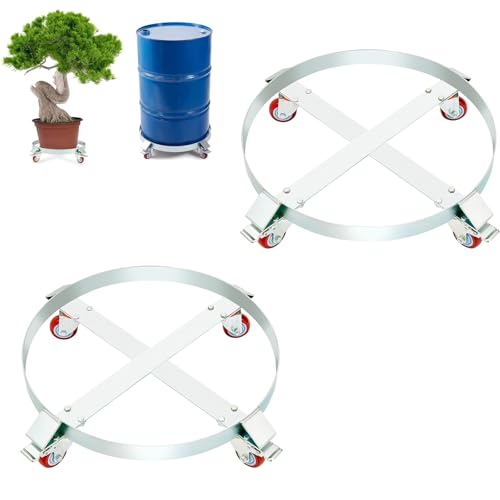
The best drum dollies are usually steel or molded-polyethylene units with a load rating of at least 600 pounds, casters matched to your floor, and a ring or platform sized specifically for your 30- or 55-gallon drum.
For most workplaces, choose a four-caster steel dolly for frequent movement on smooth concrete, a polyethylene dolly for corrosion resistance and spill-prone areas, or a low-profile two-wheel drum truck when you must pass through narrow aisles or move one drum over thresholds. Do not select by load rating alone: a dolly can support the weight yet roll poorly if its casters are too small, too soft, or poorly matched to the floor.
Our top picks


As an Amazon Associate we earn from qualifying purchases at no extra cost to you. Ratings are shown as listed on Amazon.
Quick picks by situation
| Situation | Best dolly type | Useful specification | Why it fits |
|---|---|---|---|
| One 30-gallon drum, occasional indoor use | Compact four-caster drum dolly | 600-800 lb capacity; 3-inch casters; 18-20 inch inside diameter | Small footprint and adequate capacity without excessive cost |
| One 55-gallon steel or plastic drum | Full-size ring or platform dolly | 1,000-1,200 lb capacity; 3-4 inch casters; 23-25 inch drum opening | Supports the wider base and leaves a useful stability margin |
| Rough concrete, expansion joints, or outdoor loading areas | Heavy-duty steel dolly with larger wheels | 4-5 inch semi-pneumatic or resilient wheels; 1,000 lb or higher capacity | Larger wheels climb small obstacles more easily |
| Wet, salty, or chemically exposed floor | Molded-polyethylene dolly or corrosion-resistant metal dolly | Noncorroding body; sealed or stainless hardware; 600-1,000 lb capacity | Reduces rust and simplifies cleanup after leaks |
| Narrow aisles and frequent repositioning | Two-wheel drum truck with retaining strap | 10-inch or larger wheels; positive strap; rated for the drum’s full weight | Turns in less space, but requires controlled tilting and better operator technique |
30-gallon versus 55-gallon fit
A nominal drum size does not guarantee a universal outside diameter. A typical 30-gallon drum is approximately 18-20 inches in diameter and 27-30 inches tall. A typical 55-gallon drum is approximately 22-24 inches in diameter and 33-36 inches tall. Plastic drums, salvage drums, and drums with molded ribs can vary considerably.
Measure the actual drum before ordering. For a ring dolly, the inside diameter should be slightly larger than the drum’s outside diameter, commonly by about 1/2 to 1 inch total clearance. Too little clearance makes loading difficult and can trap debris; too much lets the drum shift while turning. A platform dolly should be wide enough for the complete base, not merely the center of the drum.
Check the drum’s bottom rim as well. Some ring dollies contact only a narrow chime, while others support the lower body on a platform. A dolly that bears against a thin or damaged rim may become unstable even when its advertised capacity is high.
Load rating: calculate the margin, not just the match
Estimate the total moving load as the drum’s filled weight plus the drum itself and any accessories. Then add a practical margin for starting, stopping, thresholds, and uneven surfaces.
For example, suppose a filled 55-gallon drum contains a liquid weighing 8 pounds per gallon. The contents weigh about 440 pounds. Add a 45-pound steel drum and a 25-pound dolly:
440 + 45 + 25 = 510 pounds total moving load.
A 600-pound dolly technically exceeds that number, but it leaves only 90 pounds of spare capacity. For frequent movement or imperfect floors, a 1,000-pound-rated dolly is the more sensible choice. The rating is normally a maximum under stated conditions, not a promise that the dolly will remain easy to steer at the limit.
Never assume that a 55-gallon drum contains 55 gallons when it is filled to the working level. Also account for denser liquids: an equal volume of thick syrup, brine, or certain industrial liquids can weigh much more than water. If the contents are unknown, obtain the safety data or container specification before choosing equipment.
Casters and wheels: the floor decides
Hard concrete and sealed industrial floors
Polyurethane wheels are a strong all-purpose choice for smooth concrete. They roll more quietly and resist many common oils and solvents better than ordinary rubber, while avoiding the floor marking associated with some black rubber wheels. Steel or cast-iron wheels carry heavy loads but can be noisy, transmit shock, and damage coatings or tile.
Tile, epoxy, and finished floors
Nonmarking rubber or polyurethane is generally safer for finished surfaces. Choose a wheel with enough tread compliance to cross grout lines without hammering the drum. Small 2- or 3-inch casters may fit under a compact dolly, but they require more pushing force over joints and debris.
Rough concrete, ramps, and thresholds
Larger wheels matter more than an impressive static capacity. A 4-inch wheel rolls over small cracks more easily than a 2-inch wheel because it encounters a shallower obstacle angle. Semi-pneumatic wheels provide better shock absorption outdoors, but they need inflation checks and can lose stability if underinflated. Avoid ordinary pneumatic tires where punctures, sharp scrap, or chemical exposure are common unless you are prepared to inspect and replace them.
Wet or contaminated floors
Wheel material alone does not make a dolly safe on spills. Water, oil, and chemical residue reduce traction and may affect bearings or wheel cores. Use sealed bearings where available, clean the travel path, and address the spill according to the product’s safety instructions before moving the drum.
Steel, polyethylene, or a low-profile platform?
Steel ring dollies are often the value choice for indoor warehouses. They are rigid, available with high capacities, and easy to inspect for bent members or broken welds. Painted steel can rust where coating is chipped, especially after stormwater exposure or repeated washdowns.
Molded-polyethylene dollies resist rust and are useful around water, salt, and many corrosive environments. Their integrated containment features can help manage minor drips, but polyethylene can crack after severe impact or prolonged exposure to incompatible chemicals. Verify chemical compatibility rather than treating “chemical resistant” as universal protection.
Platform dollies accommodate more than one container shape, but they do not automatically prevent sliding. A drum should sit fully on the platform, and a rim, strap, chock, or other retention method may be necessary. A platform that is too large can also consume valuable aisle space.
Two-wheel drum trucks are efficient in tight spaces and over modest thresholds. They are less forgiving than four-caster dollies: the operator must control the tilt angle, keep the drum secured, and avoid turning quickly on a slope. For storm-response storage, a four-caster dolly is usually the steadier option when floor space permits.
Ownership details that affect safety
- Inspect casters first. Wheel tread, swivel plates, axle hardware, and bearings usually show wear before the frame does. Replace a caster that wobbles, binds, develops flat spots, or has a loose fastener.
- Watch the swivel path. Wrapped plastic, wire, gravel, and absorbent fibers can enter the swivel race and make one caster drag. Remove debris before adding lubricant, and use only a lubricant compatible with the bearing and work environment.
- Clean after spills. Rinse or wipe the frame and wheels according to the chemical’s handling guidance. Leaving residue on casters can degrade rubber, polyurethane, coatings, or floor finishes.
- Check retention. A ring dolly is not a substitute for a strap when the route includes a ramp, threshold, or vehicle movement. Use a rated restraint that does not crush the drum.
- Do not tow a standard dolly. Most are designed for controlled manual pushing, not forklifts, vehicles, or powered towing unless the manufacturer explicitly permits it.
- Keep the load low and centered. A top-heavy drum is more likely to tip during a turn, even if the dolly’s total capacity is not exceeded.
How to choose without overbuying
- Measure the drum’s outside diameter, base shape, and height.
- Determine the heaviest filled contents, then add the container and dolly weights.
- Choose a capacity at least 25 percent above that total for smooth indoor floors; use a larger margin for thresholds, slopes, rough concrete, or frequent movement.
- Match the wheel material to the floor and the wheel diameter to the obstacles.
- Confirm the dolly’s overall width against doors, aisle clearance, spill pallets, and storage locations.
- Choose a retaining method if the route includes slopes, vehicle beds, or repeated sharp turns.
As a general market guide in 2026, compact basic dollies commonly fall around $50-$120, heavier steel or polyethylene models around $120-$300, and specialized corrosion-resistant or high-capacity units can cost more. The cheapest model is rarely the lowest-cost choice if its small casters require extra force, damage the floor, or need early replacement.
Final recommendation
For a typical emergency-storage area moving full 55-gallon drums across sealed concrete, choose a four-caster dolly with a 23-25 inch drum opening, polyurethane or nonmarking wheels, 4-inch casters where thresholds are present, and at least a 1,000-pound capacity. For 30-gallon drums in a tight indoor space, a 600-800-pound compact dolly with a correctly fitted 18-20 inch opening is usually sufficient. If water, salt, or corrosive residue is the main concern, prioritize a corrosion-resistant or polyethylene body and sealed hardware. Fit, floor compatibility, and a realistic load margin matter more than the largest number printed on the label.