Key takeaways
- Pro: Lowest price point among all eight options, making multi-unit coverage affordable.
- Pro: Compact and portable, useful in hotel rooms, RVs, or vacation properties.
- Con: No plug-in option means total reliance on AA batteries and your own replacement discipline.
Every home needs at least one carbon monoxide alarm for home, and most need more. The silent threat of CO gas means a detector must be reliable, loud enough to wake a sleeping household, and positioned in every bedroom cluster and on every level of the house. The stakes are straightforward: when CO accumulates from a faulty furnace, a running generator in the garage, or a blocked chimney, there is no smell, no irritation, no warning except the alarm itself.
What separates a dependable detector from a mediocre one comes down to a handful of practical decisions. Battery-only units are cheaper but require disciplined replacement schedules. Plug-in models with battery backup give continuous power plus resilience during outages, which matters during storms. Loudness matters at a distance from sleeping quarters. And the cheapest option is not always the worst choice if it meets UL-listing standards and sits in the right location. The eight models below span the full price range and power configurations, and each one has a clear case for or against ownership depending on your home’s layout and your tolerance for maintenance.
Our top picks


As an Amazon Associate we earn from qualifying purchases at no extra cost to you.
Quick Picks
| Product | Best for | Price |
|---|---|---|
| Kidde AA Battery Portable (3rd Ed.) | Budget backup or travel use | $19.89 |
| First Alert Battery CO Alarm (Premium) | Rooms without outlets | $34.99 |
| First Alert CO605 Plug-in | Continuous power with backup | $23.99 |
| Kidde Plug-in AA Backup (3rd Ed.) | Overall value in plug-in form | $27.99 |
| First Alert Battery CO Alarm (Standard) | Low-cost bedroom coverage | $21.95 |
| Kidde AA Battery Portable | RV or rental property use | $27.79 |
| Kidde Plug-in 9V Digital (3rd Ed.) | Digital CO reading at a glance | $38 |
| Kidde AA Battery COB | Compact spaces and hallways | $24.97 |
How We Picked
Four criteria drove the ranking for these carbon monoxide alarms for home: power configuration and backup reliability, alarm volume (whether the unit meets the common 85 dB threshold at ten feet), overall cost of ownership including battery type and expected replacement frequency, and published owner feedback on false alarms and longevity. We also factored in whether a model suits specific placement scenarios such as bedrooms, garages, or travel use.
The 8 Best Carbon Monoxide Alarms For Home in 2026
Kidde AA Battery Portable, 3rd Edition
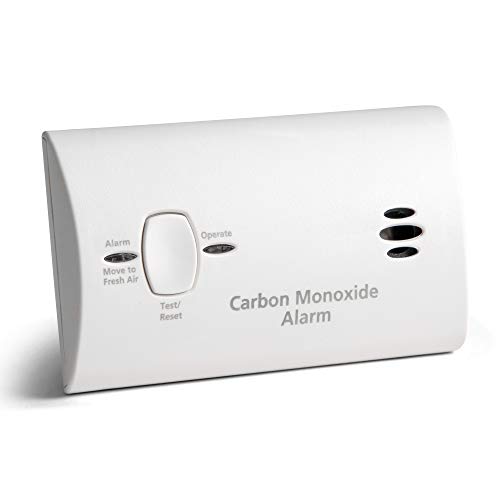
The least expensive entry in this roundup, this battery-only Kidde unit suits renters, travelers, or anyone who needs an immediate stopgap detector without wiring considerations. Its 85 dB alarm is loud enough for a single room, and LED status indicators let you confirm operation at a glance without pressing a test button.
- Pro: Lowest price point among all eight options, making multi-unit coverage affordable.
- Pro: Compact and portable, useful in hotel rooms, RVs, or vacation properties.
- Con: No plug-in option means total reliance on AA batteries and your own replacement discipline.
Skip this if your household tends to forget battery changes; a plug-in with backup removes that single point of failure.
First Alert Battery CO Alarm (Premium)
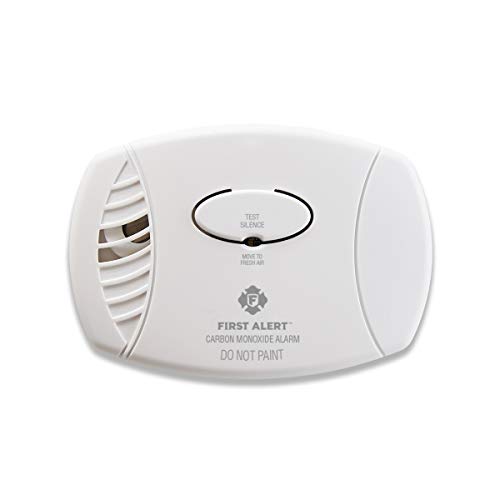
First Alert’s higher-priced battery-only model appeals to buyers who trust the brand’s smoke alarm pedigree and want the company’s electrochemical sensing in a self-contained unit. It carries a premium over comparable battery-only Kidde units, justified partly by the manufacturer’s longer track record in consumer safety devices.
- Pro: Backed by First Alert’s reputation and UL-listing across their full CO line.
- Pro: Battery-only design gives placement flexibility in rooms without accessible outlets.
- Con: At the top of this group’s price range for a battery-only device, you pay a premium without gaining plug-in convenience.
Skip this if you can plug in and want continuous power; the Kidde plug-in with battery backup costs less and eliminates battery-anxiety risk.
First Alert CO605 Plug-in with Battery Backup
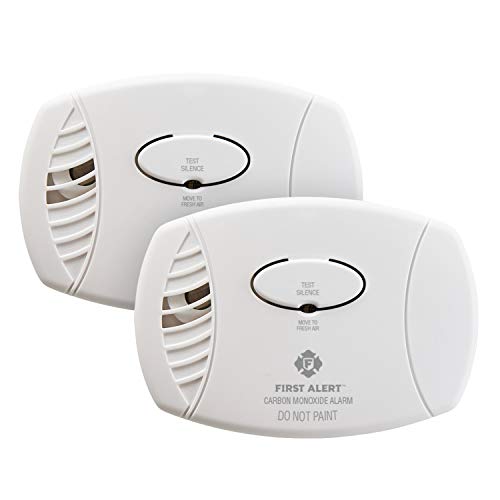
The CO605 is a dedicated plug-in detector with battery backup, drawing power from an outlet while retaining a battery to cover outages. Its compact footprint and white casing make it unobtrusive near a hallway outlet or above a nightstand.
- Pro: Dual power means the unit stays active during storms or power cuts without manual intervention.
- Pro: At under $24, it is the most affordable plug-in option in this lineup.
- Con: Owner feedback notes the alarm is slightly quieter than 85 dB-labeled Kidde competitors at longer range.
Skip this if your bedroom is far from the detector and you need maximum decibel output to wake a sleeper.
Kidde Plug-in AA Battery Backup, 3rd Edition
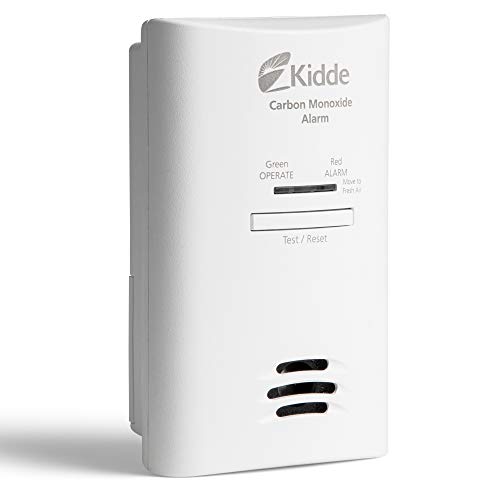
This Kidde unit balances price and features in the plug-in category. The 85 dB alarm is rated at ten feet, LED indicators provide constant status visibility, and AA batteries serve as backup rather than primary power. For most households, this is the configuration that reduces maintenance while maximizing reliability.
- Pro: Plug-in plus battery backup removes both the single-battery failure risk and the power-outage vulnerability.
- Pro: Priced under $28, it undercuts the premium First Alert battery model while offering more robust power.
- Con: Requires an outlet in or near the installation spot, limiting placement to code-compliant rooms with power access.
Skip this only if your home lacks nearby outlets in key coverage zones, in which case a battery-only unit is the practical alternative.
First Alert Battery CO Alarm (Standard)
The mid-tier First Alert battery model under $22 gives you brand recognition and a straightforward alarm at a competitive price. It is essentially the no-frills version of the premium First Alert unit above, with a smaller price difference that may not justify paying more unless a specific feature matters to you.
- Pro: Affordable price from an established safety-brand name.
- Pro: Simple operation with minimal setup steps, appealing to first-time buyers.
- Con: Lacks plug-in capability, so coverage depends entirely on battery life and your replacement habits.
Skip this if the price gap to the Kidde plug-in ($6 difference) is manageable; dual power is worth the small upgrade.
Kidde AA Battery Portable with Test-Reset
Slightly larger and more feature-rich than the 3rd Edition portable, this Kidde unit adds a dedicated test-reset button and low-battery indicator. It targets buyers who want clear operational feedback without plugging into a wall.
- Pro: Test-reset button lets you verify function and silence false alarms without removing batteries.
- Pro: Low-battery indicator provides proactive maintenance warning rather than a chirp-and-hope approach.
- Con: Costs more than the simpler 3rd Edition portable while remaining battery-only.
Skip this if you already have plug-in coverage; its added features primarily benefit users who need a standalone unit.
Kidde Plug-in 9V Battery Backup, Digital Display
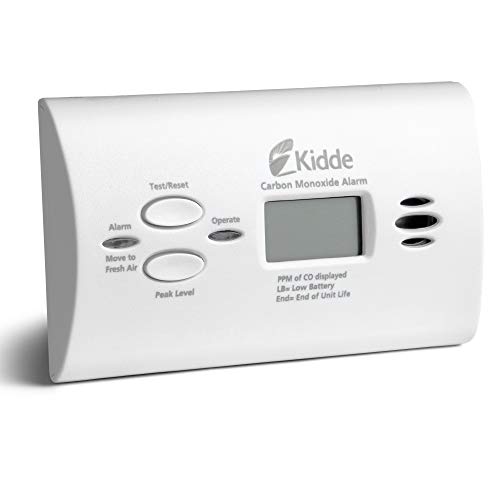
The most expensive unit in this roundup earns its price with a digital display that shows ambient CO concentration in ppm rather than only alarming at threshold. That real-time reading gives you context about air quality and helps identify low-level buildup before it becomes dangerous.
- Pro: Digital ppm display provides actionable information beyond a binary alarm-and-no-alarm response.
- Pro: Plug-in with 9V backup covers power outages while the display remains visible.
- Con: Nearly $38 for a single detector means multi-room coverage costs significantly more.
Skip this if budget is the primary constraint; a $28 plug-in with backup still protects you at the alarm threshold.
Kidde AA Battery COB (Compact)
Kidde’s compact battery-only model, often sold under the COB designation, is designed for small or confined spaces where a bulkier unit looks out of place. It covers hallways, closets, or small bedrooms without dominating wall space.
- Pro: Small footprint makes it easy to mount in awkward or visible locations.
- Pro: Mid-range price for a battery-only Kidde, cheaper than the premium First Alert equivalent.
- Con: Compact size correlates with a smaller speaker, which some owners note is less piercing than larger units.
Skip this for primary bedroom coverage where alarm loudness is critical; reserve it for hallway or secondary locations.
Buying Guide
Power Source: Battery-Only vs. Plug-in with Backup
Battery-only units offer unrestricted placement but introduce a single failure point: a dead battery means a dead alarm. Plug-in models with battery backup eliminate that risk because the outlet provides continuous power while the battery covers outages. If your budget allows even a small upgrade, a plug-in with backup consistently outperforms battery-only units in real-world reliability.
Alarm Volume and Bedroom Coverage
Codes in most U.S. jurisdictions require CO alarms audible from sleeping areas. The 85 dB threshold measured at ten feet is the industry standard. If your bedroom is a long hallway away from the detector, prioritize a unit explicitly rated at 85 dB rather than one listed at a lower figure or unspecified. Placement height also matters: CO mixes with air at room temperature, so mounting at breathing height (roughly bed level) beats ceiling placement.
Digital Display and ppm Readout
A digital display showing parts-per-million readings transforms a detector from a binary alarm into a diagnostic tool. You can see whether your furnace produces trace CO after startup or whether a generator in the garage is accumulating dangerous levels indoors. For $38, the Kidde digital model provides that transparency. If your household includes a gas furnace or attached garage, the readout is a practical safety upgrade.
Our Verdict
The Kidde Plug-in AA Battery Backup, 3rd Edition is the top pick overall. It balances price, power reliability, and 85 dB output in a way that suits the majority of homes without compromise. The budget pick is the Kidde AA Battery Portable, 3rd Edition at just under $20, which delivers a verified loud alarm and clear status indicators for renters or anyone adding supplemental coverage cheaply. The condition under which another product wins: if you need real-time CO readings to monitor a gas-burning appliance, the Kidde Plug-in with Digital Display is the only option here that provides that visibility.
FAQ
How many carbon monoxide alarms does a home need?
Most safety guidelines recommend at least one detector on every sleeping level plus one on each additional floor, including the basement. A typical two-story home with a basement needs a minimum of three units, positioned at breathing height near sleeping areas rather than clustered together.
Do plug-in CO alarms need batteries too?
Yes. Plug-in models include a battery as backup so the alarm continues to function during power outages, which are common during storms and other emergencies. A plug-in without battery backup is not recommended by any major safety organization.
How often should I replace batteries in a CO alarm?
Manufacturers generally recommend replacing AA batteries once a year and 9V batteries at the same interval or when the low-battery indicator triggers. Some owners adopt a seasonal habit, such as replacing batteries when switching to heating season in the fall.
Are digital CO alarms worth the extra cost?
They are worth it if you have a gas furnace, attached garage, or wood-burning appliance, because the ppm readout lets you spot gradual buildup before the alarm threshold is reached. For a well-maintained electric-heat home with no fuel-burning appliances, a standard plug-in detector is sufficient protection.