Our Short List of 3
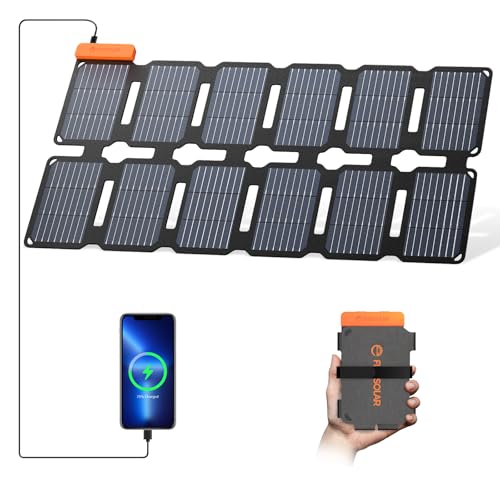
- Best for: Backpackers charging two devices at camp who want the shortest charging stops.
- Maximum power: 36W
- Ports: USB-A and USB-C
- Item weight: 1.54 lb in the product information table; the title and description publish different figures
- Product dimensions: 8.26 x 5.3 x 1.7 in
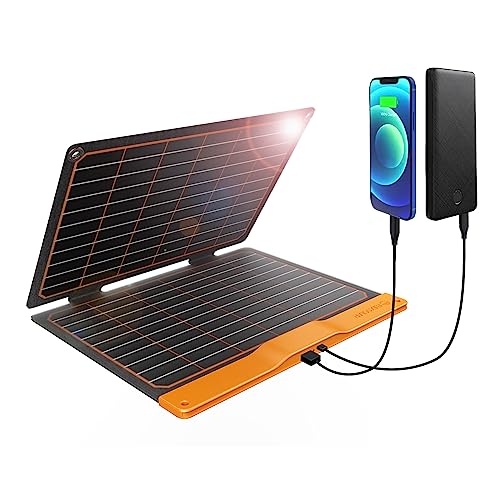
- Best for: Section hikers who want to charge a phone from the back of the pack while walking.
- Maximum power: 20W
- Output: USB-A and USB-C, up to 15W from one port or 10W per port when both are used
- Maximum voltage: 5V
- Item weight: 0.99 lb (450 g)

- Best for: Overnight hikers with small packs who still want a full 20W panel.
- Maximum power: 20W
- Outputs: USB-A and USB-C, 5V/3A maximum
- Conversion efficiency: Up to 24 percent
- Weather rating: IP67
All 4 Picks at a Glance
| Product | Specs | Action |
|---|---|---|
| FlexSolar Portable 36W Solar Panel Charger (E36mini) |
| Check price on Amazon |
| FlexSolar 20W Small Solar Panel Charger (LY-S20-US) |
| Check price on Amazon |
| FlexSolar 20W Solar Panel Charger (YL-E20pro-US) |
| Check price on Amazon |
 FlexSolar 10W Foldable Solar Charger (E10 Mini) |
| Check price on Amazon |
Key takeaways
- Five lightweight folding solar chargers for ultralight backpacking, compared by panel wattage, packed weight, output ports and weather sealing.
The real decision with a backpacking solar charger is how much panel you can justify carrying. Every extra watt shortens the time your phone spends tethered to a sunlit rock, but every extra ounce works against the whole point of an ultralight kit. A panel that is too small leaves a navigation phone dead on day three; one that is too large quietly turns into the heaviest single item in your pack.
This roundup serves three groups: weekend section hikers who charge one phone, thru-hikers and fastpackers counting grams across multi-day routes, and preparedness-minded readers who want a trail charger that doubles as backup power at home. Every pick below was chosen from the product names and specifications published on the Amazon product pages, with weights and port layouts taken from those listings rather than from brand marketing.
Quick Picks
As an Amazon Associate we earn from qualifying purchases.
| Product | Best for | Key spec from title |
|---|---|---|
| FlexSolar Portable 36W Solar Panel Charger (E36mini) | Charging two devices at camp on longer trips | 36W output with USB-A and USB-C ports |
| FlexSolar 20W Small Solar Panel Charger (LY-S20-US) | Topping up a phone while it hangs on your pack | 20W panel at 0.99 lb |
| ALLPOWERS SP002 21W Solar Charger with Built-in Battery | Saving daylight power for use after dark | 10,000mAh built-in battery |
| FlexSolar 20W Solar Panel Charger (YL-E20pro-US) | The smallest folded footprint in the 20W class | Folds to 8.7 x 8.5 in |
| FlexSolar 10W Foldable Solar Charger (E10 Mini) | Gram counters charging a phone and a headlamp | 10W panel with a single USB-A port |
How to Choose
Match Panel Wattage to Your Devices
Wattage decides how patient you have to be. A 10W panel is a trickle source suited to topping up a headlamp or adding a partial phone charge across a sunny lunch stop. A 20W panel is the practical middle ground for one phone charged daily. Step up toward 36W when a satellite communicator, camera batteries or a partner’s phone join the charging queue. Remember that the printed rating is a laboratory maximum: angle, heat and thin cloud all pull real output below it, so buy for your hungriest charging day rather than your average one.
Count Every Ounce, Including the Cable
Ultralight buyers weigh systems, not panels. Add the cable, any carabiners you actually use, and the power bank the panel feeds, because most panels store nothing themselves. A 20W panel at 0.99 lb plus a small battery can outweigh a heavier panel with storage built in. Folded size matters just as much: a panel that folds to 8.7 x 8.5 in disappears into a pack lid, while a wider fold may only ride strapped outside. Check the listing’s folded dimensions against the pocket or panel you plan to carry it in.
Check the Ports Against Your Kit
List your devices before you shop. A single USB-A port is enough for an older phone and a headlamp, but newer phones, watches and communicators increasingly expect USB-C. Two ports sound generous until you read the fine print: on the FlexSolar 20W below, one port alone delivers up to 15W, while using both drops each to 10W. If your phone supports fast charging over USB-C, confirm the panel offers a USB-C output rather than only an input, because several small panels still ship with USB-A as the sole way out.
Look at Weather Sealing and Mounting
Trail weather does not respect charging sessions. An IP67 rating, carried by three picks here, means the panel tolerates heavy rain and brief immersion; IPX4, on the battery model, covers splashes only and calls for a dry bag in sustained downpours. Mounting matters as much as sealing: grommets and included carabiners let a panel hang from a pack and keep harvesting while you walk, which can double its daily yield compared with a panel that only works when spread on the ground at camp.
The 5 Best Options
FlexSolar Portable 36W Solar Panel Charger (E36mini)
- Best for: Backpackers charging two devices at camp who want the shortest charging stops.
- Maximum power: 36W
- Ports: USB-A and USB-C
- Item weight: 1.54 lb in the product information table; the title and description publish different figures
- Product dimensions: 8.26 x 5.3 x 1.7 in
Backpackers charging two devices at camp who want the shortest charging stops.
The listing publishes three different weights (1.3 lb in the title, 1.54 lb in product information, 1.7 lb in the description), so confirm the figure on the Amazon page before counting it into your base weight.
This is the output leader of the group and the pick for backpackers who charge more than a phone. A 36W rating means a handset and a satellite communicator can recover during a single camp stop instead of competing for the same sunny hour. At 1.54 lb it is not a minimalist’s panel, but it folds into a flat 8.26 x 5.3 x 1.7 in package that slides against a pack frame. Choose it for basecamp-style trips, two-person kits and longer routes where charging stops are planned rather than improvised.
FlexSolar 20W Small Solar Panel Charger (LY-S20-US)
- Best for: Section hikers who want to charge a phone from the back of the pack while walking.
- Maximum power: 20W
- Output: USB-A and USB-C, up to 15W from one port or 10W per port when both are used
- Maximum voltage: 5V
- Item weight: 0.99 lb (450 g)
Section hikers who want to charge a phone from the back of the pack while walking.
With no storage, charging pauses under tree cover and ends at dusk, so pair it with a small power bank if your route runs through forest.
At 0.99 lb, this 20W panel is the balanced pick for hikers who charge while moving. The included carabiners clip it to the back of a pack, so a phone in the lid pocket gains charge through the walking day instead of only at camp. It offers both USB-A and USB-C, with up to 15W from a single port. There is no battery inside, so output stops when the sun does, but as a featherweight daylight harvester for one phone it hits the sweet spot of this category.
ALLPOWERS SP002 21W Solar Charger with Built-in Battery
The SP002 solves the biggest weakness of panel-only chargers by adding a 10,000mAh battery behind its 21W panel. Sun collected during a midday break stays available inside the tent at night, and the battery also smooths out passing clouds that would otherwise interrupt a phone mid-charge. Outputs include USB-C with 18W power delivery plus two USB-A ports, the widest selection here. The trade-offs are weight, at 0.8 kg the heaviest system in this roundup, and IPX4 splash resistance that trails the sealed panels.
Specs
- Peak power: 21W
- Built-in battery: 10,000mAh lithium polymer
- Outputs: USB-C PD 18W and two USB-A ports at 5V/3A
- Inputs: USB-C and Micro-USB
- Conversion rate: 22 to 25 percent per the product manual
- Cell type: Monocrystalline
- Weather rating: IPX4
- Item weight: 0.8 kg
Best for: Backpackers who want to bank solar power during the day and charge devices inside the tent at night.
Watch out for: IPX4 is splash resistance only, the lowest rating in this roundup, so the unit needs a dry bag or a tent vestibule in sustained rain.
ASIN: B0B45TFZ51
FlexSolar 20W Solar Panel Charger (YL-E20pro-US)
- Best for: Overnight hikers with small packs who still want a full 20W panel.
- Maximum power: 20W
- Outputs: USB-A and USB-C, 5V/3A maximum
- Conversion efficiency: Up to 24 percent
- Weather rating: IP67
Overnight hikers with small packs who still want a full 20W panel.
FlexSolar sells two different 20W models, this compact-fold version and the LY-S20-US above, so check the model number on the listing before ordering.
This second FlexSolar 20W model earns its place on folded size rather than raw numbers. It packs down to 8.7 x 8.5 x 1.2 in at 13.9 oz, noticeably smaller than its sibling above, which makes it the easier carry in a compact overnight pack or a large daypack. The manual rates conversion efficiency at up to 24 percent, and the panel pairs USB-A with USB-C at a 5V/3A maximum. Pick it when the 20W class is right for your devices but pack volume, not weight, is your binding constraint.
FlexSolar 10W Foldable Solar Charger (E10 Mini)
- Best for: Fastpackers and gram counters who need emergency top-ups for a phone and a headlamp.
- Maximum power: 10W
- Output: One USB-A port, 5V/2A maximum
- Weather rating: IP67
- Item weight: 9.12 oz per the listing product details
Fastpackers and gram counters who need emergency top-ups for a phone and a headlamp.
Published weights for this model vary between listings, from about 7 oz to 9.12 oz, so confirm the weight on the Amazon page if every gram matters.
The E10 Mini is the insurance policy of the group: a 10W, four-fold panel light enough to forget in a pack lid until a phone drops into the red. Its single USB-A port delivers up to 5V/2A, enough for a headlamp, a watch or a slow partial phone charge during a long sunny break. It will not sustain a heavy phone habit on its own, and it stores nothing, but as a backup layer for fast-and-light trips it adds real capability for well under a pound.
Which One Fits Your Situation
You Charge Several Devices at Camp
Pick the FlexSolar 36W E36mini. A phone, a satellite communicator and camera batteries can share its output during one stop, and its flat fold rides against a pack frame without eating lid space. It is the heaviest panel here, but for two-person or gadget-heavy kits the shorter charging sessions repay the ounces.
Your Route Stays Under Tree Cover
Pick the ALLPOWERS SP002. Broken sunlight starves a panel-only charger, yet the SP002 banks whatever its 21W panel gathers into a 10,000mAh battery whenever a clearing appears. You then charge from storage at camp, at your pace, instead of chasing sun patches with a cable. That buffer also suits high routes where weather changes by the hour.
Your Pack Is Small but Your Phone Is Hungry
Pick the FlexSolar 20W YL-E20pro-US. It folds to 8.7 x 8.5 in, the tightest package in the 20W class here, so it fits daypacks and compact overnight packs that cannot swallow a wider panel. You still get USB-C output and IP67 sealing for daily phone charging on exposed ridges and open valley floors alike.
Every Gram Is Already Argued Over
Pick the FlexSolar 10W E10 Mini. Treat it as a backup layer rather than a primary supply: a headlamp, a watch and emergency phone top-ups across sunny breaks. If your phone is your only navigation tool, step up to a 20W pick instead, because 10W harvests too slowly to guarantee a full charge.
Common Mistakes
- Buying on wattage alone and forgetting that angle, heat and partial shade pull real output well below the printed rating.
- Assuming the panel stores power: four of these five chargers stop delivering the moment sunlight fades.
- Leaving a panel flat on the ground at camp instead of angling it toward the sun or hanging it from a pack.
- Weighing the panel but not the cable and power bank it has to work with, then wondering why the kit feels heavy.
- Trusting one published weight when the listing itself prints conflicting figures for the same model.
Frequently Asked Questions
How many watts does a backpacking solar charger need?
For one phone charged once a day, 20W is the practical floor, because real output runs below the rating whenever the sun is angled or thin cloud passes. A 10W panel only trickles, adding partial charges across hours. Multi-device kits and winter trips with short days should look at 30W and above.
Can a solar panel charge a phone directly, or do I need a power bank?
Direct charging works in steady, strong sun, and all five picks here can feed a phone through their USB ports. A power bank still helps: it smooths out passing clouds, and it lets a panel without storage, like the FlexSolar models, keep value from midday sun for use after dark.
Do folding solar panels still work on cloudy days?
They produce power, but far less than their rating. Monocrystalline panels keep generating under bright overcast, while dark storm cloud can cut output to a small fraction of the label figure. On trips where weather is unreliable, treat the panel as a supplement and start with devices and batteries fully charged from home.
How should I carry a folding panel while hiking?
Hang it from the back of the pack with the included carabiners, cells facing outward, and run a short cable to a phone or battery in the lid pocket. At stops, prop it angled toward the sun rather than flat. Keep the junction box out of puddles, and fold the panel away before bushwhacking through dense brush.
More from Amazon
Programs that pair well with the guide above. Offers and eligibility are set by Amazon and may change.
Free shipping on eligible items, Prime Video and more. Eligible new members can start with a free trial.
Start a Prime free trialAudiobooks and podcasts to listen to on the go. Eligible new members can start with a free trial.
Try Audible freeAd-free music streaming. Eligible new subscribers can start with a free trial.
Try Music Unlimited freeA free business account with business pricing and bulk-buying tools for work, shop or home office.
Create a business accountAs an Amazon Associate we earn from qualifying purchases.