Key takeaways
- Basic voice prompts: Suitable for a quiet home or small office, especially when the unit has large pictograms and only a few controls.
- Text and color display: Helpful in noisy gyms, factories, and public buildings where a responder may not hear every instruction.
- CPR feedback: Devices such as the ZOLL AED Plus and AED 3 provide feedback intended to guide compression depth or rate. It should supplement, not replace, CPR training.
- Automatic shock delivery: Can simplify use for an untrained responder, but the responder must still attach pads correctly and keep everyone clear.
- Remote readiness monitoring: Useful for organizations with multiple cabinets, provided someone is assigned to respond to alerts and replace expired supplies.
The best AED defibrillators for most buyers are the Philips HeartStart FRx for mixed adult-and-child readiness, the ZOLL AED 3 for frequent public or workplace use, the LIFEPAK CR2 for rapid, low-interruption rescue, and the Philips HeartStart OnSite for a compact, budget-conscious home kit.
An automated external defibrillator (AED) is designed to analyze a cardiac rhythm and deliver a shock only when its programmed criteria indicate that a shock is appropriate. It does not replace emergency services, CPR training, or professional medical care. Before purchasing, confirm that the model is approved for use in your country and ask a qualified clinician or local emergency-response organization about placement and training.
Our top picks


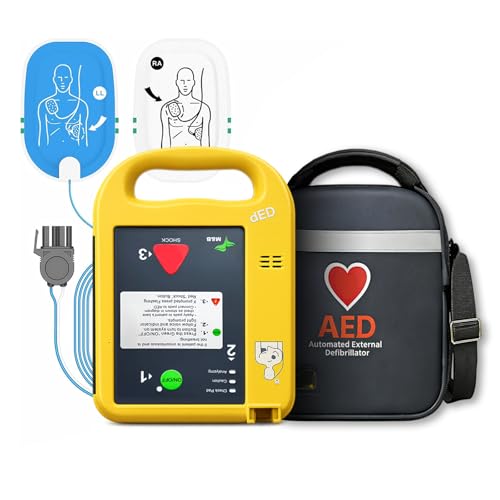
As an Amazon Associate we earn from qualifying purchases at no extra cost to you. Ratings are shown as listed on Amazon.
Best AED defibrillators by situation
| Situation | Best fit | Why it stands out | Main compromise |
|---|---|---|---|
| Family home with children | Philips HeartStart FRx | Adult pads, optional infant/child key, simple spoken instructions, compact design | Child accessory adds cost and must be stored with the unit |
| Home with mainly adults | Philips HeartStart OnSite | Lightweight, widely recognized operating sequence, relatively modest ownership cost | Less flexible than child-capable models unless a separate pediatric solution is purchased |
| Office, gym, school, or public building | ZOLL AED 3 | Clear color display, CPR feedback, adult and pediatric pad options, long-life battery | Usually costs more and is heavier than basic home models |
| Large site or many occasional users | Physio-Control LIFEPAK CR2 | Fast analysis, clear voice prompts, automatic or semi-automatic versions, strong public-access orientation | Check pad and battery pricing carefully; configurations differ |
| Very inexperienced responders | ZOLL AED Plus or ZOLL AED 3 | Step-by-step prompts and visible CPR guidance can reduce uncertainty | CPR feedback works best when pads and the responder’s technique are used as instructed |
Head-to-head comparison of leading AED types
| Model | Shock delivery | Pediatric compatibility | Prompts and feedback | Typical battery life* | Approx. weight |
|---|---|---|---|---|---|
| Philips HeartStart OnSite | 150 joule biphasic shock | Infant/child pads available in some markets | Voice prompts; visual icons; CPR coaching | Up to 4 years standby, depending on battery | About 1.5 kg with battery and pads |
| Philips HeartStart FRx | 150 joule biphasic shock | Optional infant/child key; no separate pediatric pads required with that configuration | Voice prompts; CPR timing and coaching | Up to 4 years standby | About 1.6 kg with battery and pads |
| ZOLL AED Plus | Escalating biphasic energy, commonly 120, 150, then 200 joules | Separate pediatric pads available | Voice prompts, text/graphic display, CPR depth feedback | About 5 years for the lithium battery pack in specified conditions | About 3.1 kg |
| ZOLL AED 3 | Biphasic, approximately 120–200 joules depending on analysis | Universal adult/pediatric pads or pediatric configuration, market dependent | Color display, voice prompts, CPR depth and rate feedback | About 5 years for battery; pads generally last 2 years | About 2.5 kg |
| LIFEPAK CR2 | Escalating biphasic energy, commonly 150–360 joules | Adult and pediatric pad options | Voice prompts; CPR guidance; some models support remote monitoring | Up to about 4 years for battery in specified conditions | About 2.0 kg |
*Standby figures are manufacturer-rated estimates under specified storage conditions, not a guarantee of service life. Temperature, inspections, battery age, and self-test results affect readiness. Shock energy is not a simple quality score: the key buying question is whether the device is approved, maintained, and easy for a responder to operate.
Shock delivery: what should buyers compare?
Most modern consumer and public-access AEDs use biphasic electrical waveforms. Rather than asking which unit has the largest joule number, compare whether it automatically analyzes the rhythm, provides clear instructions, and minimizes unnecessary pauses. Semi-automatic models tell the rescuer when to press a shock button. Fully automatic versions announce that a shock is about to occur and deliver it without requiring that button press.
Fully automatic operation may suit a location where users are unlikely to have formal AED experience. Semi-automatic operation can feel more familiar to trained responders. Neither type removes the need to follow the spoken “stand clear” instruction and ensure nobody is touching the person during analysis or shock delivery.
Pediatric compatibility is a practical storage decision
Do not assume that an adult AED can be used on a small child in the same way as on an adult. Pediatric pads or a pediatric key change the device’s operating instructions or energy delivery, depending on the model. If children regularly use the building, select a model with a clearly supported pediatric option and keep that accessory beside the AED, not in a remote office or locked cupboard.
For a family home, the FRx’s child key can reduce the need to stock a second set of pediatric pads. The OnSite can also support children with the appropriate accessory, but buyers should verify the exact regional configuration. For schools, childcare settings, and sports facilities, separate pediatric pads may be easier to audit because their expiry date is visible on the pad package.
Voice prompts, displays, and ease of use
- Basic voice prompts: Suitable for a quiet home or small office, especially when the unit has large pictograms and only a few controls.
- Text and color display: Helpful in noisy gyms, factories, and public buildings where a responder may not hear every instruction.
- CPR feedback: Devices such as the ZOLL AED Plus and AED 3 provide feedback intended to guide compression depth or rate. It should supplement, not replace, CPR training.
- Automatic shock delivery: Can simplify use for an untrained responder, but the responder must still attach pads correctly and keep everyone clear.
- Remote readiness monitoring: Useful for organizations with multiple cabinets, provided someone is assigned to respond to alerts and replace expired supplies.
Ownership costs: pads and batteries matter more than the purchase price
General market pricing for a new AED is often about $1,000–$2,500, with advanced display, monitoring, and pediatric configurations at the higher end. Replacement adult pads commonly cost roughly $100–$300 per set, while batteries often cost about $150–$450. Exact prices vary substantially by country, distributor, warranty, and whether the battery is sold as a combined battery-and-pad package.
A simple five-year ownership estimate illustrates why consumables deserve attention. Suppose an AED costs $1,500, has a $250 battery replaced once, and requires two $180 pad sets during five years. The equipment-and-consumables total is:
$1,500 + $250 + (2 × $180) = $2,110
If the AED is never used, that is $422 per year of readiness, before cabinet, signage, training, or monitoring costs. If it is used once, do not assume the same pads can be returned to service: replace used pads and inspect the battery and device according to the manufacturer’s instructions. A lower purchase price can become expensive if its proprietary pads have short service intervals or limited availability.
Setup and maintenance checklist
- Choose an accessible location. Mount or place the AED where it can be reached quickly, ideally near a phone, reception point, or other known emergency equipment. Avoid a locked cabinet unless authorized users can obtain it immediately.
- Record the serial number and expiry dates. Track the battery, adult pads, pediatric pads, and any CPR mask separately.
- Inspect the readiness indicator monthly. A green or ready symbol generally means the self-test passed; a warning indicator requires the manual and manufacturer support, not guesswork.
- Keep it within its storage temperature range. Cars, unheated sheds, and direct sunlight can expose the battery and pads to damaging heat or cold.
- Replace damaged or opened pads. Pads dry out after opening, and adhesive can fail if the pouch is torn or stored in moisture.
- Clean the case safely. Use only the method approved by the manufacturer. Do not pour liquid into openings or immerse the unit.
- Train and rehearse. Practice opening the case, turning on the device, attaching pads to a training manikin, and locating the pediatric accessory. Use a trainer, not a live AED, for drills.
Common buying mistakes
- Buying an AED and leaving it in an inaccessible manager’s office.
- Choosing a pediatric-capable unit but storing the pediatric accessory separately.
- Ignoring expiry dates because the readiness light is still green.
- Assuming a waterproof or rugged case eliminates the need for temperature control.
- Purchasing replacement pads from an incompatible model or region.
- Expecting an AED to diagnose every collapse; responders should also contact emergency services and follow dispatcher instructions.
Bottom line
Choose the Philips HeartStart FRx when a compact, child-capable home or small-office AED is the priority. Choose the Philips HeartStart OnSite when adult use, low weight, and a simpler budget are more important. Choose the ZOLL AED 3 when a busy public site benefits from a display, CPR feedback, and strong visibility. Choose the LIFEPAK CR2 when rapid prompts and public-access operation matter across a larger facility. In every case, the best AED defibrillator is the one that is approved locally, reachable within minutes, compatible with the people at risk, and maintained with documented battery and pad replacements.