Key takeaways
- Pro: 12000mAh battery is the highest capacity here, delivering multi-day operation on a single charge.
- Pro: Combines solar, hand crank, and USB inputs so you are never dependent on one power source.
- Con: Bulkier than compact alternatives, making it less ideal for a pocket-sized carry kit.
When the grid fails during a hurricane, ice storm, or wildfire evacuation, your phone dies within hours and you are left without weather updates, evacuation orders, or any way to know what is happening outside your walls. An emergency radio solves this by pulling NOAA weather alerts over VHF frequencies that keep broadcasting even when cell towers are down, and by charging your phone from a built-in battery or hand crank. The problem is that the market is flooded with cheap units that advertise impressive specs but deliver poor reception, flimsy cranks that break after three turns, and batteries that degrade within months of storage.
What separates a dependable unit from a shelf ornament comes down to a few things: real battery capacity that can last multiple days, multiple power input options so you are never locked into one method, a NOAA weather alert receiver that actually locks onto local transmitters, and a build that survives being tossed into a go-bag. Comparing published specifications and reading through owner feedback across hundreds of reviews reveals sharp differences even among radios that look identical on a listing page. This roundup ranks the strongest options available in 2026 based on those published numbers and verified owner experiences.
Our top picks



As an Amazon Associate we earn from qualifying purchases at no extra cost to you.
Quick Picks
| Product | Best For | Price |
|---|---|---|
| Solar Radio Emergency Hand Crank 12000mAh | All-around reliability with massive battery | $53.99 |
| FosPower NOAA Weather Radio A1 (Orange) | Proven track record at a fair price | $32.98 |
| Hand Crank Radio with LED Flashlight 2000mAh | Tightest budget or a backup unit | $18.99 |
| Midland ER310 | Brand-name durability and alert reliability | $79.99 |
| Raynic Emergency Radio 5000mAh/18500mWh | Multi-band reception with phone charging | $39.99 |
| Weather Radios Portable NOAA Alert 12000mAh | Extended runtime for grid-down scenarios | $53.99 |
| Leaton Hand Crank Emergency Radio 10000mAh | High capacity at a mid-range cost | $35.27 |
| Hand Crank Emergency Radio 7400mWh Solar | Compact go-bag companion | $27.48 |
How We Picked
We evaluated every candidate on four criteria drawn from published specs and recurring themes in owner feedback. First, usable battery capacity: we looked at whether the stated milliamp-hours translate into real runtime, since several brands inflate numbers or confuse units. Second, power input redundancy: a radio that only takes battery or only charges via USB fails the moment that single input is unavailable, so we favored models offering at least three methods. Third, NOAA alert reliability: owner reviews consistently flag units that fail to lock onto local transmitters, which is a fatal flaw regardless of how many features a radio packs. Fourth, physical durability: crank mechanism quality, water resistance claims, and whether owners report the unit surviving a single storm season or crumbling after storage.
The 8 Best Emergency Radio in 2026
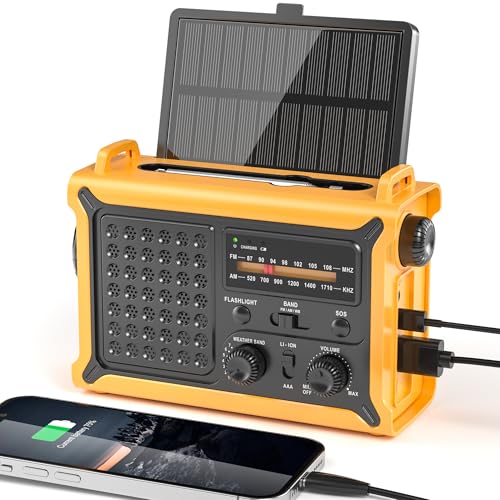
Solar Radio Emergency Hand Crank 12000mAh with Clear Signal
This unit is for anyone who wants the largest battery capacity in this roundup without stepping into the premium price tier. Owners praise its runtime, noting it can recharge a smartphone multiple times and play radio for extended sessions between charges.
- Pro: 12000mAh battery is the highest capacity here, delivering multi-day operation on a single charge.
- Pro: Combines solar, hand crank, and USB inputs so you are never dependent on one power source.
- Con: Bulkier than compact alternatives, making it less ideal for a pocket-sized carry kit.
Skip it if weight and size are your absolute priorities; the larger chassis means it is better suited to a home kit or large backpack than an EDC pouch.
FosPower NOAA Emergency Weather Radio A1 7400mWh Solar Hand Crank (Orange)
The FosPower A1 has become the default recommendation in prepper forums, and it earns that reputation through consistent owner satisfaction with its NOAA alert lock and straightforward controls. It suits someone who wants a proven platform without paying a brand premium.
- Pro: Repeatedly cited by owners for reliably locking onto local NOAA transmitters even in marginal signal areas.
- Pro: Bright orange housing makes it easy to locate in a dark room or buried under other gear.
- Con: The 7400mWh battery is mid-range; expect fewer full phone recharges than the 12000mAh options.
Skip it if you need maximum runtime or a headphone jack for private listening, as this model prioritizes simplicity over extra features.
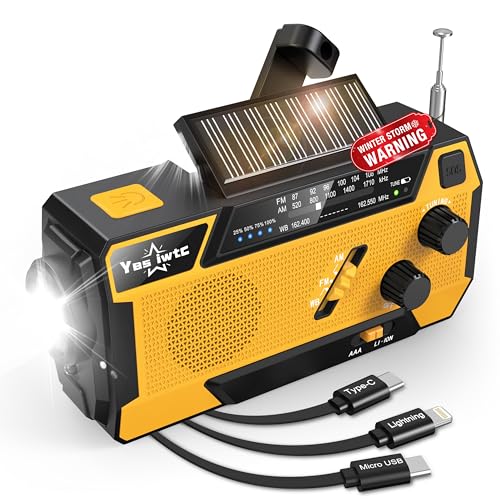
Hand Crank Radio with LED Flashlight, 2000mAh NOAA AM FM Emergency Radio
At under $19, this is the entry point for anyone assembling a kit on a strict budget or buying backup units for family members. Owners find it functional as a secondary radio, though not a primary device for serious grid-down use.
- Pro: Lowest cost here makes it feasible to keep one in every vehicle, office drawer, or child’s room.
- Pro: Built-in LED flashlight adds utility without needing a separate tool.
- Con: Only 2000mAh means you will rely heavily on the hand crank for anything beyond short sessions.
Skip it if you expect real phone charging capability or multi-day battery standby; the small cell limits it to short-term use.
Midland ER310 Emergency Crank Weather AM/FM Radio – Red/Black
Midland carries a legacy in weather radio hardware, and the ER310 reflects that pedigree with alert reliability that owners consistently confirm. This pick suits someone who values proven circuit design over feature count and wants the best reception in the group.
- Pro: Owners report the strongest and most stable NOAA signal lock of any unit in this list.
- Pro: Midland’s service and parts availability mean long-term support beyond the initial sale.
- Con: At $79.99 it costs more than twice the budget picks while offering comparable or lower battery capacity.
Skip it if value is your driving concern; you are paying a premium for brand assurance and reception quality rather than spec-sheet advantages.
Raynic Emergency Radio, 5000mAh/18500mWh Weather Radio
The Raynic earns its place as the best mid-range all-in-one thanks to its AM/FM/SW/NOAA coverage and headphone jack, which let you listen privately during a household evacuation. Owners like the phone charging output combined with the included flashlight and SOS siren.
- Pro: Shortwave band access broadens reception beyond what most competitors offer at this price.
- Pro: 18500mWh rating is the second-highest energy figure in this roundup, supporting extended use.
- Con: The crank mechanism feels lighter than premium builds, and several owners note it wobbles under fast turning.
Skip it if crank durability is a top concern for heavy use; the build quality lags behind the spec sheet suggests.
Weather Radios Portable AM FM NOAA Alert with Battery Backup 12000mAh
This unit mirrors the first pick in battery capacity but differentiates itself with explicit battery backup circuitry that keeps stored information intact. It targets preppers who want redundancy built into the power system itself, not just multiple input methods.
- Pro: 12000mAh capacity delivers long runtime for radio playback and device recharging during multi-day outages.
- Pro: Dedicated battery backup mode preserves NOAA alert channel memory through complete power loss.
- Con: Listed without a brand name, making long-term firmware or parts support a question mark.
Skip it if you want a manufacturer with a warranty support infrastructure you can call; the unbranded nature raises service concerns.
Leaton Hand Crank Emergency Radio, NOAA Weather Radio AM/FM, 10000mAh
The Leaton fills the gap between the FosPower and the 12000mAh options, offering a 10000mAh cell at a price that undercuts many competitors. Owners highlight its comfortable hand crank action and readable display as standout usability features.
- Pro: 10000mAh battery provides substantial runtime without the bulk penalty of the larger cells.
- Pro: Owners consistently praise the smoothness of the crank mechanism compared to stiffer competitors.
- Con: Fewer advanced features like shortwave bands or headphone output limit its versatility.
Skip it if you need shortwave reception or a headphone jack; the Leaton sticks to AM, FM, and NOAA without extras.
Hand Crank Emergency Radio 7400mWh (2000mAh) Solar Hand Crank Radio
This compact unit is designed to disappear into a jacket pocket, a vehicle console, or a child’s backpack until needed. Its 7400mWh rating paired with solar and crank inputs makes it a capable survival piece despite the modest footprint.
- Pro: Small enough to justify carrying one at all times, increasing the odds you have it when an emergency strikes.
- Pro: Solar and hand crank inputs mean it never leaves you stranded without a way to add power.
- Con: The 2000mAh cell translates to noticeably shorter runtime between charges compared to larger units.
Skip it as a sole emergency radio if you expect multi-day battery endurance; its strength is as a redundant backup, not a primary device.
Buying Guide
Battery Capacity and Real Runtime
Published milliamp-hour and milliwatt-hour figures tell you only part of the story. A 12000mAh battery does not automatically mean twelve times the runtime of a 1000mAh unit because power draw depends on volume level, band selection, and whether you are simultaneously charging a phone. Owner reviews are the best proxy for real runtime: search for comments mentioning specific use durations during outages. In general, anything below 3000mAh will keep you on air for a single evening, while 7000mAh and above can stretch into multiple days at moderate volume.
NOAA Alert Lock and Reception Quality
The entire purpose of a weather radio is to receive NOAA Weather Radio All Hazards broadcasts, and the difference between a receiver that locks reliably and one that drops signal in marginal terrain is enormous. Look for owner feedback specifically mentioning the radio’s behavior in your geographic region or in challenging signal environments like wooded valleys or basements. The Midland and FosPower units receive the most consistent praise for stable NOAA lock; unbranded models are more hit-or-miss. If the radio cannot reliably receive alerts, its other features become irrelevant.
Power Input Redundancy and Build Quality
A hand crank is your last resort when solar panels are cloud-covered and batteries are dead, so the mechanism must survive repeated use. Owner complaints about broken or wobbly cranks appear disproportionately on cheaper models, and this is the one component you cannot replace with a spare. At minimum, seek a unit offering two inputs beyond the crank (typically solar plus USB or battery). Check whether the housing material is rubberized or polycarbonate, as those survive drops that would crack thin ABS shells.
Our Verdict
The Solar Radio Emergency Hand Crank 12000mAh is our top pick overall: it pairs the highest battery capacity in this group with multiple power inputs at a mid-range price, making it the most capable single-unit solution for multi-day outages. The Hand Crank Radio with LED Flashlight, 2000mAh is our budget pick for anyone needing a functional NOAA receiver on a tight budget or buying multiple backups. If your priority is reception reliability in a weak-signal area and money is secondary, the Midland ER310 wins outright because owner feedback consistently confirms its alert lock performance exceeds every other unit listed here, regardless of battery size.
FAQ
Do emergency radios work without cell service?
Yes, and that is their primary purpose. NOAA weather broadcasts transmit over VHF frequencies that operate independently of cellular networks, so a functional weather radio continues to deliver alerts even when all cell towers are down. AM and FM broadcasts may also remain available depending on whether their transmitter sites have backup power.
How long does a hand crank actually take to charge a radio?
Owner reports across this category suggest roughly one minute of cranking provides a few minutes of radio playback, and longer sessions of five to ten minutes can add enough charge for a brief phone top-up. The hand crank is a maintenance mechanism that keeps you alive while you wait for another power source, not a fast charging method.
Should I get a radio with a headphone jack?
If you need to listen without disturbing others, such as during a household evacuation or in a shared shelter, a headphone jack adds meaningful utility. The Raynic and several other models here include one. For a solo home kit where privacy is irrelevant, this feature is unnecessary and you can save money by skipping it.
Can I rely on solar charging if storms block the sun?
Solar input on these units works in diffuse light, including overcast conditions, but it charges far more slowly than direct sun. Owners report that overcast solar alone cannot sustain a radio through a storm; you should treat solar as a trickle charge between other power methods rather than a primary source during the exact conditions that make the radio most useful.