Key takeaways
- Pick the power source first: a corded pump needs live power or a generator, a 12-volt pump needs a battery, and a gas pump needs fuel and open air.
- Rated GPH assumes little lift. Every foot you raise the water cuts output, so choose a pump with some headroom (about double what you think you need).
- A pump that leaves about 1/8 inch or 1 inch of water behind (the “residual”) may not finish the job; check the listing for how low it can run.
- Sump-style float switches can jam in debris; for flood cleanup, use a manual unit you can watch, or an automatic unit with a vertical float.
- Shut off power at the panel and call an electrician before entering a flooded space with energized outlets.
The best utility and flood pumps for storm season fall into three jobs: an automatic or manual submersible for basements and window wells, a pool cover pump for rain-loaded covers, and a gas-powered semi-trash pump for when the electricity is out and the water is deep. For a typical basement, a 1/3 to 1/2 HP submersible such as the Little Giant 6-MSP or the Superior Pump 91570 covers most small floods; for a pool cover, the Little Giant APCP-1700 shuts itself off; for a long outage, the Westinghouse 2-inch gas pump does not need the grid at all.
Pump flow figures in gallons per hour (GPH) are measured with almost no lift and a short, wide hose, so real-world output is lower. This guide ranks seven pumps by the situation they fit, shows how to convert GPH into minutes of pumping for a flooded room, and explains how the power source (cord, generator, 12-volt battery or gasoline) changes which flood pump is the right one.
Our top picks


As an Amazon Associate we earn from qualifying purchases at no extra cost to you.
Key takeaways
- Pick the power source first: a corded pump needs live power or a generator, a 12-volt pump needs a battery, and a gas pump needs fuel and open air.
- Rated GPH assumes little lift. Every foot you raise the water cuts output, so choose a pump with some headroom (about double what you think you need).
- A pump that leaves about 1/8 inch or 1 inch of water behind (the “residual”) may not finish the job; check the listing for how low it can run.
- Sump-style float switches can jam in debris; for flood cleanup, use a manual unit you can watch, or an automatic unit with a vertical float.
- Shut off power at the panel and call an electrician before entering a flooded space with energized outlets.
Quick comparison: best utility and flood pumps
| Pick | Type and size | Rated flow | Best for | Price tier |
|---|---|---|---|---|
| Superior Pump 91250 | 1/4 HP submersible, thermoplastic | 1,800 GPH | Budget basement cleanup | Low |
| Little Giant 6-MSP | 1/3 HP submersible, epoxy-coated aluminum | 2,130 GPH | Durable all-round utility pump | Low-mid |
| Little Giant APCP-1700 | 1/3 HP automatic pool cover pump | 1,745 GPH | Rain on pool covers | Mid |
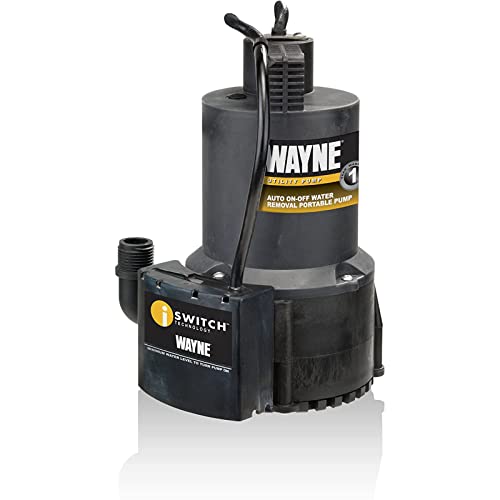
| Wayne WaterBug AUTO | 1/6 HP automatic submersible | 1,350 GPH | Window wells, shallow water | Mid |
| Superior Pump 91570 | 1/2 HP submersible, thermoplastic | 3,300 GPH | Faster flood removal | Low-mid |
| Wayne PC4 | 1/2 HP cast iron transfer pump, non-submersible | See maker page | Moving water between tanks, barrels, ponds | Mid |
| Westinghouse 2-inch gas pump | Gas-powered semi trash pump | 158 GPM (about 9,500 GPH) | Deep floods, no power | Mid |
1. Superior Pump 91250: Best budget pump for basement cleanup
- 1/4 HP submersible utility pump, thermoplastic body
- Rated 1,800 GPH with a 10-foot cord
- Manual design: you plug it in and unplug it, with no float switch to jam
- Works with a garden hose adapter for easy drainage
Best for: a flooded utility room, a water heater leak or a few inches of storm seepage where you can stand by and watch the pump.
Skip if: you want it to run unattended, or you need to lift water more than about 10 to 15 feet.
Pros: inexpensive; light enough to carry down stairs; no switch to fail.
Cons: thermoplastic housing is less heat-tolerant than metal for long runs; it leaves a thin film of water; not for gritty or muddy water.
2. Little Giant 6-MSP: Best durable all-round utility pump
- 1/3 HP, 115V submersible with a 10-foot cord
- 2,130 GPH rated flow
- Epoxy-coated cast aluminum housing; no switch
- Fits a 3/4 inch garden hose for general water transfer and circulation
Best for: the one pump you keep in the basement cabinet for flood cleanup, hot tub drains, and moving water from a stock tank.
Skip if: you need to remove water to the last quarter-inch, or you want a float that starts it automatically.
Pros: aluminum body dissipates heat better than plastic; a respected name in utility and sump pumps; a mid-size motor for the price.
Cons: manual only; garden-hose fitting caps real flow; pricier than generic thermoplastic pumps.
3. Little Giant APCP-1700: Best for rain-loaded pool covers
- 1/3 HP automatic pool cover pump, 1,745 GPH rated
- 25-foot cord, shuts off automatically when the cover is clear
- Fits a 3/4 inch garden hose
- Submersible design intended to remove water from pool covers
Best for: pool owners who want to protect a winter cover during hurricane rains without standing out there with a bucket.
Skip if: you need a multi-purpose basement pump; it is tuned for shallow cover water.
Pros: automatic shut-off prevents dry running; long cord reaches across a pool deck; purpose-built for covers.
Cons: needs a GFCI-protected outdoor outlet; cord length may not reach every pool; not a flood pump for basements.
4. Wayne WaterBug AUTO: Best for window wells and shallow water
- 1/6 HP automatic submersible, 1,350 GPH
- Automatic on/off, top and side discharge, clog resistant
- Marketed for basements, flood cleanup, window wells and yards
- Small, light unit
Best for: homes with a window well or a low spot that collects water during storms, where an automatic pump can run while you are asleep.
Skip if: you need to move a large volume fast; a 1/6 HP motor is the small end of this list.
Pros: automatic operation; light and quick to deploy; designed to handle small debris.
Cons: lower flow than the 1/3 and 1/2 HP picks; automatic switches should be checked each season.
5. Superior Pump 91570: Best for faster flood removal
- 1/2 HP submersible, thermoplastic, 10-foot cord
- 3,300 GPH rated flow
- Manual operation with a garden hose adapter (check the listing for fittings)
Best for: a larger flooded area such as a finished basement, where speed matters more than residual depth.
Skip if: your generator is small; a 1/2 HP motor draws more power at start-up than a 1/4 HP unit does.
Pros: about 1.8 times the rated flow of the 1/4 HP version for a small step up in price; manual design.
Cons: the garden hose fitting limits the rated flow; thermoplastic body; start-up draw can trip an undersized generator.
6. Wayne PC4: Best transfer pump for barrels, tanks and ponds
- 1/2 HP cast iron multi-purpose transfer pump, non-submersible
- Suction strainer included; model 55832 per the listing
- Sits above the water and draws it in, which keeps the motor dry
- Check the maker page for the full flow and head curve
Best for: moving water from a rain barrel, a stock tank, a pond or a pool to somewhere else, and for situations where you do not want a motor in a flooded space.
Skip if: the water is too shallow for the suction line to reach, or the water carries gravel.
Pros: cast iron holds up outdoors; the motor stays dry; handles suction lift from a source below the pump.
Cons: may need priming; heavier; not a clean-up tool for a thin film of water.
7. Westinghouse 2-inch Gas Semi Trash Pump: Best when the power is out
- Gas-powered, 4-stroke engine, 2-inch ports
- 158 GPM rated (about 9,500 GPH), up to 91 feet of lift and 25 feet of suction lift per the listing
- Semi-trash design for dirty storm water
- Runs without an electrical supply; operate outdoors only
Best for: deep or fast flooding, a flooded crawl space or yard, and any scenario where the grid is down and you have no generator capacity for a corded pump.
Skip if: you do not want to manage fuel and engine upkeep, or the only access is indoors.
Pros: several times the flow of any electric pump on the list; no dependence on electricity; larger solids passage.
Cons: needs fuel and a pull start; exhaust makes it an outdoor-only tool; hoses and a strainer sold separately.
Also consider
- Superior Pump 91012 12 Volt Utility Pump: a battery-style pump with a 20-foot cord, useful for boats, cabins and power-out transfer jobs.
- Tsurumi HS2.4S Submersible Trash Pump: 1/2 HP, 39 GPM, 2-inch discharge for dewatering sandy or debris-laden water.
- Cleartide 1/4 HP Submersible Utility Pump: 2,160 GPH with an auto water sensor for pool and basement draining.
- AQUASTRONG 1 HP Submersible Pump: 4,500 GPH, a high-flow option for large volumes.
How We Chose
We did not personally use these pumps. The list comes from reading maker specifications and product listings, then sorting pumps by the flood scenarios storm households run into: basement seepage, window wells, rain-loaded pool covers, deep outdoor flooding and power outages. We included only current whole pumps, no more than two per brand, and left out parts and kits. We prioritized stated horsepower, GPH or GPM, port size, cord length and whether the unit shuts off automatically. Price tiers are general, because street prices move.
Buying guide: how to choose a flood or utility pump
Step 1: Match the power source to the storm
A corded pump is useless without electricity, so storm planning starts with the power supply. If you have a generator, check that its running watts can handle the pump’s start-up surge; a 1/3 HP submersible commonly needs roughly 800 to 1,200 starting watts, but read the pump’s nameplate. If you do not have a generator, either choose a gas pump, or a 12-volt pump powered from a car battery with the right clamps.
Step 2: Size the pump to the water
Estimate the volume: area in square feet times depth in feet times 7.48 gives gallons. A 20 by 30 foot basement with 2 inches of water holds 600 sq ft times 0.167 ft times 7.48, about 750 gallons. A 1,800 GPH pump would, in theory, clear that in under 30 minutes. In practice, with a hose run up stairs and a long discharge, expect to take at least twice as long.
| Water depth | Approx. gallons | 1,800 GPH pump (about 900 GPH real) | 3,300 GPH pump (about 1,650 GPH real) |
|---|---|---|---|
| 1 inch | 375 | about 25 min | about 14 min |
| 2 inches | 750 | about 50 min | about 27 min |
| 6 inches | 2,245 | about 2.5 hours | about 1.4 hours |
| 12 inches | 4,490 | about 5 hours | about 2.7 hours |
Step 3: Account for head (lift) and hose
The more vertical height you lift the water, the less flow you get. Many utility pumps list a maximum head around 20 to 25 feet, but flow at that height is a fraction of the rated GPH. A 3/4 inch garden hose will also cap the flow well below the pump’s rated figure, so use the largest hose the pump allows and keep it short and straight, with no kinks.
Step 4: Choose automatic versus manual
An automatic pump with a float switch is ideal for window wells and sump pits that fill unattended. For flood cleanup, a manual pump gives you control; floats can jam in sediment, and an unattended pump can burn out if the water runs low. A vertical float is less likely to stick than a tethered one.
Step 5: Material and debris handling
Thermoplastic is light and fine for occasional use. Cast iron and aluminum shed heat better and last longer for repeat floods. If the water carries sand, silt or leaves, pick a semi-trash or trash pump with a larger solids capacity, because a standard utility pump’s intake can clog or wear quickly.
Step 6: Cord, discharge and fittings
Check the cord length, the discharge size and the fittings in the listing. Most utility pumps accept a 3/4 inch garden hose thread; larger flows need an adapter for 1-1/4 or 1-1/2 inch discharge. Buy a short length of rigid or lay-flat hose and the right adapter ahead of time, so you are not hunting for fittings during a storm.
Flood-night safety and the order of operations
- Cut the power first. If water is near outlets, cords or the panel, shut off power at the main and call an electrician. Do not wade into standing water with energized circuits.
- Use a GFCI. Plug corded pumps into a GFCI-protected outlet or a GFCI cord, and keep connections above the waterline.
- Run gas pumps outdoors only. Place them well away from windows, doors and vents because carbon monoxide builds up fast.
- Pump slowly if the ground is saturated. Common flood-recovery guidance from agencies such as FEMA and the Red Cross suggests removing about one third of the water per day when the surrounding soil is soaked, to avoid putting stress on foundation walls. Check with your local officials.
- Treat the water as contaminated. Floodwater can carry sewage and chemicals. Wear waterproof boots and gloves and keep children and pets away.
- Do not discharge near the foundation. Run the hose well away from the house and downhill so the water does not flow back.
Pump types explained: submersible, transfer, trash and 12-volt
Four pump families show up in storm-season shopping, and they are not interchangeable.
- Submersible utility pumps (Superior Pump, Little Giant 6-MSP, Wayne WaterBug) sit in the water and push it out through a hose. They are quiet, self-priming and the easiest choice for basements, but the motor shares the flooded space, so they depend on a good cord and a GFCI outlet.
- Non-submersible transfer pumps (Wayne PC4) sit outside the water and pull it through a suction hose. They are better for moving large volumes between tanks or ponds, and they keep the motor dry, but they need a primed suction line and a source of water at least a few inches deep.
- Trash and semi-trash pumps (Westinghouse gas pump, Tsurumi HS2.4S) have larger impeller clearances for sand, silt and small debris. After a storm, runoff is rarely clean, so these are the pumps built for the mess.
- 12-volt pumps (Superior Pump 91012) run off a battery or a vehicle. Their flow is lower than a 115V pump, but they work when there is no grid and no generator, and they are a sensible backup for a boat, a cabin or a car-battery emergency.
If you can own only one pump, a 1/3 HP submersible with a cast or aluminum body is the most versatile. If your property floods from the outside, such as a yard or a crawl space that fills from runoff, a gas semi-trash pump earns its space in the garage.
Hose, fittings and discharge: the part most people forget
A pump is only as good as what it is attached to. Before the storm, lay out the discharge path: where will the water go, how far, and uphill or downhill? Buy a hose that matches the pump discharge size, plus the thread adapter for it. Lay-flat discharge hose is cheap and rolls up small, but it needs a hose clamp; rigid hose resists kinking on the stairs. Add a short length of hose that reaches at least 20 to 30 feet beyond the foundation, and check that the end drains away from the house. For a gas pump, you will also need a suction hose with a strainer, and the fittings for the intake and discharge ports; most 2-inch pumps are sold as the bare machine.
Which pump for which scenario?
| Your situation | Best pick | Why |
|---|---|---|
| Small basement leak, power is on | Superior Pump 91250 | Cheap, manual, light |
| You want one durable pump for years | Little Giant 6-MSP | Aluminum housing, mid-size motor |
| Pool cover fills in rain | Little Giant APCP-1700 | Auto shut-off, 25-foot cord |
| Window well or low spot, unattended | Wayne WaterBug AUTO | Automatic on/off |
| Larger basement flood | Superior Pump 91570 | 3,300 GPH rated |
| Barrel, pond or tank transfer | Wayne PC4 | Non-submersible, cast iron |
| No electricity, deep water | Westinghouse 2-inch gas pump | 158 GPM, fuel only |
Maintenance and ownership realities
- Run it once each spring. Run the pump in a bucket or sink for a minute to make sure it still moves water, and check the cord for cracks.
- Clean the intake. Sand and leaves wear the impeller and can stall a motor; rinse the screen after each use.
- Do not run dry. Many submersibles overheat when the water level drops below the intake. Unplug as soon as the water stops flowing.
- Store drained and dry. Freezing water in the housing can crack it.
- Keep fuel fresh for gas pumps. Use stabilizer or drain the tank at the end of the season, and keep a spare spark plug.
Frequently Asked Questions
What is the best flood pump for a basement?
For most basements, a 1/3 to 1/2 HP submersible utility pump is the right size. The Little Giant 6-MSP is a durable all-round pick, and the Superior Pump 91570 moves more water for a faster clear-out. If the power may fail, add a gas pump or a generator large enough to start the pump.
What is the difference between a utility pump and a sump pump?
A sump pump sits in a pit and switches on automatically as water rises, to keep the pit from overflowing. A utility pump is a portable pump for moving water from one place to another, usually manual, and is meant for jobs such as flood cleanup, draining a pool cover or emptying a tank.
Can a utility pump remove all the water?
Most leave a thin film behind, because the intake sits above the floor. Some listings quote a residual of about a quarter inch to an inch; check the listing for the exact figure. You can finish the job with a wet vacuum or a low-profile pump.
How many GPH do I need for a flood pump?
Calculate the gallons to remove, decide how many hours you can wait, and divide. Then double the result to allow for hose and lift losses. A 750-gallon basement that you want empty in an hour needs a pump rated around 3,000 GPH or more, not 1,800.
Can I run a pump on a generator?
Yes, if the generator’s running watts can carry the pump and its starting surge. A 1/3 HP pump commonly needs roughly 800 to 1,200 starting watts, so a 3,000 running-watt unit is a safe match, but check the nameplate. Start the generator first, then plug in the pump.
Are gas-powered pumps worth it?
If you face deep flooding or long outages, yes. A gas pump moves several times more water than an electric utility pump and does not rely on the grid. The trade-off is fuel, engine upkeep and outdoor-only use.
What is the best pump for a pool cover during a hurricane?
A dedicated automatic cover pump such as the Little Giant APCP-1700 is the simplest choice, because it shuts off when the water is gone and runs on a standard outlet. Make sure the cord reaches a GFCI-protected outlet before the storm arrives.
Which one should you buy?
- Budget basement pump: Superior Pump 91250.
- Single, long-lived utility pump: Little Giant 6-MSP.
- Pool cover during storms: Little Giant APCP-1700.
- Window well or unattended shallow water: Wayne WaterBug AUTO.
- Bigger basement floods: Superior Pump 91570.
- Barrel and pond transfer: Wayne PC4.
- Deep flooding with no power: Westinghouse 2-inch gas pump.
If you can afford two, pair a small electric pump with a gas pump: the electric unit handles routine seepage, and the gas pump is your answer when the water rises and the grid fails.
Sources
- Little Giant Pump and Wayne product pages and spec sheets
- Superior Pump product pages
- Westinghouse Outdoor Power Equipment gas water pump product page
- FEMA and American Red Cross flood-recovery guidance
- Manufacturer owner’s manuals for pump curves and electrical requirements
Last updated: November 2026
More from Amazon
Programs that pair well with the guide above. Offers and eligibility are set by Amazon and may change.
Free shipping on eligible items, Prime Video and more. Eligible new members can start with a free trial.
Start a Prime free trialAudiobooks and podcasts to listen to on the go. Eligible new members can start with a free trial.
Try Audible freeAd-free music streaming. Eligible new subscribers can start with a free trial.
Try Music Unlimited freeA free business account with business pricing and bulk-buying tools for work, shop or home office.
Create a business accountAs an Amazon Associate we earn from qualifying purchases.