Key takeaways
- Pick by outage length first: 1-3 days is a fridge-and-lights job, 4-7 days needs real fuel logistics, 8+ days points toward natural gas or a very large propane reserve.
- Add up running watts, then plan for the starting surge of the single biggest motor (a well pump or AC compressor), which can briefly draw two to three times its running load.
- Tri fuel models (gas, propane, natural gas) are the most flexible hurricane choice because you can switch fuels when one runs short.
- Never run a generator in a garage, carport or near a window or door; keep it outdoors and at least 20 feet from the house, as manufacturers and safety agencies advise.
- Connect it through a transfer switch or interlock installed by a licensed electrician, not by back-feeding a dryer outlet.
The best generators for hurricanes and power outages are the ones sized to the days you expect to be without grid power, not the biggest engine you can afford. A small inverter such as the Honda EU2200i covers a fridge, lights and phone chargers for a few days; a 3,000 to 4,000 running-watt dual or tri fuel unit adds a window AC or a furnace fan; and a 10,000 running-watt tri fuel such as the Champion 12,500-watt covers most of a house through a transfer switch or interlock.
This guide ranks seven portable generators by outage length and fuel flexibility, because after a hurricane the real problem is often fuel supply, not watts. Gas stations lose power, lines form, and roads flood. Propane and natural gas inputs change that math, so the picks below lean toward dual fuel and tri fuel designs, plus one quiet gasoline inverter for the lightest load.
Our top picks


As an Amazon Associate we earn from qualifying purchases at no extra cost to you.
Key takeaways
- Pick by outage length first: 1-3 days is a fridge-and-lights job, 4-7 days needs real fuel logistics, 8+ days points toward natural gas or a very large propane reserve.
- Add up running watts, then plan for the starting surge of the single biggest motor (a well pump or AC compressor), which can briefly draw two to three times its running load.
- Tri fuel models (gas, propane, natural gas) are the most flexible hurricane choice because you can switch fuels when one runs short.
- Never run a generator in a garage, carport or near a window or door; keep it outdoors and at least 20 feet from the house, as manufacturers and safety agencies advise.
- Connect it through a transfer switch or interlock installed by a licensed electrician, not by back-feeding a dryer outlet.
Quick comparison: best generators for hurricanes and power outages
| Pick | Output | Fuel | Best for | Price tier |
|---|---|---|---|---|
| Honda EU2200i | 2,200 W starting, about 1,800 W running | Gasoline | Fridge, lights, phones | Premium small |
| Generac 3,800 Watt Dual Fuel Inverter | 3,800 W starting, 3,000 W running | Gas and propane | Fridge plus one big load | Mid |
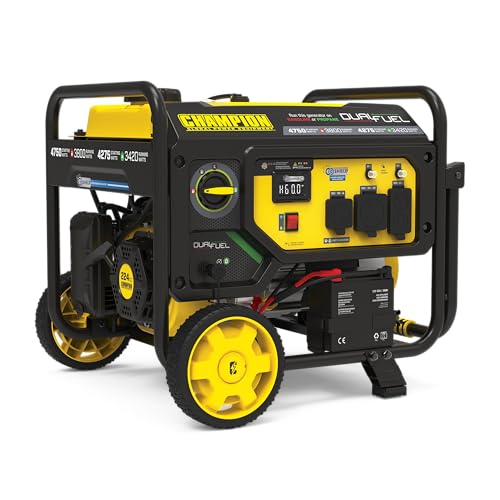
| Champion 5000-Watt Tri Fuel | 5,000 W starting, 4,000 W running | Gas, propane, natural gas | Budget tri fuel | Mid |
| Westinghouse 8200 Peak Watt Tri-Fuel Inverter | 8,200 W peak | Gas, propane, natural gas | Quiet, electronics-safe power | Upper mid |
| Generac 8,250 Starting Watt Dual Fuel | 8,250 W starting | Gas and propane | Long runtime per tank | Mid |
| Champion 12,500-Watt Tri Fuel | 12,500 W starting, 10,000 W running | Gas, propane, natural gas | Most of a house | Upper mid |
| DuroMax XP13000EH | 13,000 W | Gas and propane | Whole-home backup on a budget | Upper mid |
1. Honda EU2200i: Best for fridge, lights and a long quiet outage
- 2,200-watt inverter generator, 120V, gasoline (listing quotes up to 8.1 hours of run time)
- Honda lists about 1,800 running watts; one of the lighter units in the 2,000-watt class (check the maker page for the current weight)
- Inverter output suits phones, laptops, a modem and a CPAP-style device that needs clean power
- Parallel-capable with a second unit using the companion cables (check the maker page)
Best for: apartments, townhouses and condos where the goal is a refrigerator, a few LED lights and device charging, and where neighbors will hear the generator all night.
Skip if: you need to run a well pump, a central AC or an electric range.
Pros: very quiet for its class; light enough to move without help; clean sine-wave output; sips fuel at low load.
Cons: gasoline only, so no propane fallback; premium tier price for 1,800 watts.
2. Generac 3,800 Watt Dual Fuel Inverter: Best step up from a fridge-only unit
- 3,800 starting watts, 3,000 running watts
- Gas and propane operation; parallel capable
- Inverter design marketed as ultra quiet with clean, stable power
- Listed as 50 state compliant, which matters for California and other strict-emissions states
Best for: homeowners who want a fridge, freezer, lights and either a window AC or a furnace blower running together, with propane as a storm-proof fuel.
Skip if: your well pump or central AC compressor is larger than a small motor; 3,000 running watts leaves little headroom for starting surges.
Pros: propane means no gasoline degradation in storage; inverter output is safe for electronics; easy to carry compared with open-frame units.
Cons: propane output is lower than gasoline output on most dual fuel engines (check the manual); no natural gas option.
3. Champion 5000-Watt Tri Fuel: Best budget way to get natural gas capability
- 5,000 starting watts, 4,000 running watts
- Runs on gasoline, propane and natural gas; LPG and NG hoses are included per the listing
- Electric start, wheels, RV-ready outlet, 3-year warranty per the listing
- Open-frame design, so it is louder than an inverter
Best for: households with a natural gas line near the patio who want an outage plan that does not depend on a gas station.
Skip if: you live close to neighbors and need low noise, or your electronics are sensitive and you want inverter-quality power.
Pros: the cheapest practical entry to tri fuel; natural gas removes refueling during a multi-day event; electric start helps in wet weather.
Cons: noticeably louder than inverter models; natural gas output is lower than gasoline output (check the maker page for the derate); heavier to move.
4. Westinghouse 8200 Peak Watt Tri-Fuel Inverter: Best quiet tri fuel for electronics
- 8,200 peak watts, tri fuel: gasoline, propane, natural gas
- Remote electric start, transfer-switch ready, CO sensor
- Low THD output marketed as safe for electronics; parallel capable
- Inverter build, so quieter than open-frame tri fuel units in the same output class
Best for: homes with a connected natural gas supply and a work-from-home setup where routers, computers and a modern HVAC control board need clean power.
Skip if: you want the lowest price per watt; inverter tri fuel units cost more than open-frame ones.
Pros: remote start from inside the house; CO sensor adds a safety layer; three fuel options.
Cons: a heavier, more expensive unit than 3,000-watt inverters; running watts are lower than the peak figure, so read the full spec sheet.
5. Generac 8,250 Starting Watt Dual Fuel: Best for a long runtime between refills
- 8,250 starting watts, gas and propane, electric start
- Listing quotes an 11 hour runtime and COsense carbon monoxide detection
- Includes an adapter cord per the listing; 49 state compliant
- Open-frame, wheeled portable layout
Best for: a mid-size house where the plan is to run fridge, freezer, sump pump, lights and a few circuits through a transfer switch.
Skip if: you live in California or another state where the 49-state listing blocks sale.
Pros: a long runtime means fewer overnight refills; CO shutdown helps if wind or flooding forces you to place it close to the house.
Cons: not an inverter, so it is louder; no natural gas input.
6. Champion 12,500-Watt Tri Fuel: Best for powering most of a house
- 12,500 starting watts, 10,000 running watts
- Gasoline, propane and natural gas with hoses included per the listing
- Electric start, wheel kit, 3-year warranty per the listing
- Designed for transfer-switch use with a 30 or 50 amp connection (check the maker page for the outlet layout)
Best for: homes with an electric range or dryer, a well pump and central AC that want to ride out a week-long outage using natural gas from the house line.
Skip if: your needs are a fridge and a few lights; this much generator wastes fuel at light load.
Pros: 10,000 running watts handles a well pump plus a central AC with staggered starts; natural gas feeds it indefinitely if the utility stays up.
Cons: large and heavy; loud; needs a proper transfer switch or interlock.
7. DuroMax XP13000EH: Best value for whole-home backup power
- 13,000-watt dual fuel, gasoline and propane, electric start
- Marketed as whole-home backup and transfer-switch ready, RV and emergency ready
- Open-frame generator on a wheel kit
- Check the maker page for running-watt figures on gas versus propane
Best for: buyers who want the highest watt count at an upper-mid price and are comfortable with propane tanks rather than natural gas.
Skip if: you want a natural gas input or a quiet unit.
Pros: large capacity for the price tier; electric start; propane storage is simple.
Cons: propane output is lower than gasoline output; plan on several 20-pound tanks or a larger one.
Also consider
- Westinghouse 12500 Watt Dual Fuel Home Backup: gas and propane, remote electric start, transfer-switch ready; a sibling to the DuroMax in size.
- Generac 5,200 Watt Dual-Fuel Inverter: 3,900 running watts, parallel capable; a quieter mid-size option.
- WEN 4800-Watt Dual Fuel Inverter: electric start, RV-ready, with a CO Watchdog; check the listing for details.
- Honda EU7000iS: 7,000-watt 120/240V inverter, the quiet whole-circuit option; it sits at the top price tier of this list.
How We Chose
We did not personally use any of these generators. This list comes from reading maker spec sheets, listing details and published safety guidance, then grouping models by the outage lengths hurricane households actually plan for. We filtered for current, whole-machine models from established brands and kept no more than two per brand. We prioritized fuel flexibility, a clearly stated running watt figure, electric start, and carbon monoxide protection. Prices are described by tier only because they change often.
How long will you be without power? Match the generator to the outage
Hurricane outages are not all the same. Use these thresholds as a starting point, then adjust to your own utility’s history.
| Outage length | What to power | Typical running watts needed | Fuel plan |
|---|---|---|---|
| 1-3 days | Fridge, lights, phones, router | 600-1,500 | Gasoline inverter, 5-10 gallons stored |
| 3-7 days | Add freezer, window AC or furnace fan, sump pump | 2,500-4,500 | Dual fuel; two 20-pound propane tanks plus gasoline |
| 7-14 days | Add well pump, water heater or central AC | 7,000-10,000 | Tri fuel on natural gas, or a large propane reserve |
The watt ranges are typical figures for common household loads, so check each appliance nameplate before you buy. A refrigerator commonly runs in the low hundreds of watts but can briefly draw several times that when the compressor starts. A well pump and a central AC compressor are usually the heaviest starting loads in the house.
Worked example: sizing for a 5-day hurricane outage
- List the loads: refrigerator (about 150 running watts), chest freezer (about 100), sump pump (about 800), lights and router (about 150), window AC (about 900). Total: about 2,100 running watts.
- Find the biggest starting surge: the sump pump or AC motor, which may need two to three times its running watts for a moment. Add roughly 1,500 watts of headroom.
- Target: about 3,600 watts or more. A 3,000 running-watt inverter is a tight fit; a 4,000 running-watt unit such as the Champion 5000-watt tri fuel leaves room.
- Estimate fuel: use the maker’s runtime at half load, then multiply by the hours per day you plan to run. Always confirm numbers in the owner’s manual.
Buying guide: what matters most for a hurricane generator
Fuel type and storage
Gasoline degrades in storage and is hard to find during an evacuation or outage. Gasoline stored in approved containers with stabilizer lasts longer, but rotating stock each season is still wise. Propane stores for years and a standard 20-pound grill tank holds about 4.7 gallons of fuel. Natural gas has no storage burden, but it only works while the utility gas line stays pressurized, and some jurisdictions or builders require specific connections, so check local code and the manual.
Inverter versus open frame
Inverter generators run quieter and produce cleaner power for laptops and modern HVAC boards. Open-frame units give more watts per dollar and are the common choice above 7,000 watts. If your outage plan centers on electronics and sleeping near the unit, favor an inverter; if the plan centers on well pumps and AC, favor an open-frame tri fuel.
Start type and safety features
Electric start matters when you are running it in rain, after dark, or when a family member with limited hand strength must start it. Look for a CO sensor or automatic shutoff, a low-oil shutoff and an outlet panel that matches your transfer switch (L14-30, 14-50 or a 120V duplex).
Noise and neighbors
Open-frame units are typically louder than inverter models. Many municipal rules set decibel limits, but those rules are often relaxed during declared emergencies; confirm with your city or county.
Parallel capability
Two small inverters of the same model, linked with parallel cables, can match a mid-size unit while giving you two machines to carry and a backup if one fails. The Honda EU2200i, Generac 3,800-watt and Westinghouse 8200 models all list parallel capability; check the maker page for the exact kit.
Connecting to the house
Extension cords can feed a few appliances. To power hardwired circuits such as a well pump or furnace, you need a transfer switch or an interlock kit with a generator inlet. Never plug a generator into a wall outlet, which can send power back onto utility lines and endanger line workers. Have a licensed electrician install the connection and pull any permit your area requires.
Hurricane-specific placement and safety
- Run the generator outdoors only, on a dry, level surface, at least 20 feet from the house, with the exhaust pointed away from windows, doors and vents.
- Use a generator tent or a purpose-built cover designed for running in rain; do not run it under a tarp pressed against the exhaust.
- Install battery-powered or plug-in CO alarms with battery backup on every level before the season starts.
- Let the engine cool before refueling and store fuel in approved containers away from living space.
- Dry-run your connection and cord layout ahead of time, following the manufacturer’s instructions, not for the first time during the storm.
Your pre-landfall fuel and setup checklist
Most hurricane generator failures are preparation failures. Work through this list in the weeks before the season, not in the 48 hours before landfall, when stores run out of propane tanks, oil and extension cords.
- Run it once under load. Start the generator, plug in a lamp and a space heater or hair dryer, and confirm it carries a real load for 15 minutes. A unit that starts but stalls under load is a repair job, not a storm plan.
- Change the oil and check the air filter. Many engines need a first oil change after a short break-in period; check the owner’s manual for the schedule and keep a spare quart on hand.
- Stabilize or swap your gasoline. Fuel older than a few months can gum a carburetor. Use stabilizer, or burn the old fuel in a car and refill the cans.
- Stock propane. A 20-pound tank does not last long at high load, so plan on several tanks, store them upright, outdoors and shaded, and never inside the house or garage.
- Buy the right cord. Match the cord’s amperage and wire gauge to the generator outlet and the load; a thin cord on a long run overheats. Check the cord label and the generator manual.
- Stage a dry, ventilated spot. Decide in advance where the generator will sit, how the exhaust will point, and how the cord will reach the house without running through a closed door or window.
- Add a CO alarm. Install one with battery backup on every sleeping level.
- Label your circuits. If you have a transfer switch or interlock, list which breakers to turn on first so the generator is not overloaded when it starts.
Common mistakes that cost hurricane households a generator
- Buying by peak watts. Starting watts last for seconds. Running watts decide what the machine can carry for hours.
- Turning everything on at once. Start the biggest motor first, then add smaller loads one at a time.
- Running it all night with no check. Many families turn the generator off overnight if the fridge stays closed, then run it during the day to bring everything back to temperature. Follow food-safety guidance from your local health department.
- Refueling a hot engine. Let it cool before opening the cap; spilled fuel on a hot exhaust is a fire risk.
- Skipping the flood plan. Place and anchor the unit above expected storm-surge water if your area floods, and do not store fuel in a place that can float away.
- Forgetting the neighbors. A quiet inverter near a bedroom window is far easier to live with than an open-frame unit placed in a rush.
Frequently Asked Questions
What size generator do I need for a hurricane?
Add the running watts of everything you need and plan for the biggest motor’s starting surge. A fridge, freezer, lights and router fit within 1,500 watts. Adding a sump pump and a window AC pushes you to 3,500 to 4,500 watts, and a well pump with central AC points to 7,000 to 10,000 running watts.
Is dual fuel or tri fuel better for hurricanes?
Tri fuel is more flexible because you can switch among gasoline, propane and natural gas depending on what is available. Dual fuel is simpler and usually cheaper, and propane keeps well in storage. If your home has natural gas and you can install a safe connection, tri fuel is the better long-outage choice.
How much fuel should I store?
Estimate runtime at about half load from the owner’s manual, then multiply by the hours you plan to run per day. Many households plan for 8 to 12 hours of running time a day, with the generator off overnight if the fridge can be left closed. Store gasoline in approved containers with stabilizer and rotate it each season.
Can I run a generator in my garage during a storm?
No. Never run a generator in a garage, carport, basement or near a window or door, even with the door open, because carbon monoxide can build up in minutes. Use a purpose-built generator tent or covered, ventilated outdoor spot, at least 20 feet from the house.
Do I need a transfer switch?
If you only plan to power a few appliances through extension cords, you do not. If you want to power hardwired loads such as a well pump, furnace or sump pump, you need a transfer switch or an interlock kit installed by a licensed electrician, which also prevents back-feeding the utility grid.
How long does a portable generator last in a long outage?
Consumer portables are typically designed for several hundred hours of life with proper maintenance, but they need regular oil changes during continuous use. Check the owner’s manual for the oil change interval, and keep a spare oil bottle and air filter on hand before the season starts.
Should I pick a generator or a solar power station?
A battery power station is silent and safe indoors, but its capacity limits you to a day or two of fridge-sized loads unless you can recharge with solar. A fuel generator wins for multi-day hurricane outages with larger loads; many households keep a small power station for phones and a generator for the heavy lifting.
Which one should you buy?
- Fridge, lights and phones in a small home: Honda EU2200i.
- A fridge plus one big load, with propane as a fuel option: Generac 3,800 Watt Dual Fuel Inverter.
- Cheapest route to natural gas capability: Champion 5000-Watt Tri Fuel.
- Quiet tri fuel with clean power for electronics: Westinghouse 8200 Peak Watt Tri-Fuel Inverter.
- Longer runtime with a transfer switch: Generac 8,250 Starting Watt Dual Fuel.
- Most of the house on natural gas: Champion 12,500-Watt Tri Fuel.
- Whole-home capacity on propane: DuroMax XP13000EH.
If you are still unsure, choose the unit that matches your longest realistic outage and your most important motor load, then buy the cord, cover and fuel containers at the same time so the whole setup works the first night.
Sources
- Honda Power Equipment EU2200i product specifications
- Champion Power Equipment tri fuel generator product pages
- Generac and Westinghouse portable generator product pages
- U.S. Consumer Product Safety Commission generator carbon monoxide guidance
- Manufacturer owner’s manuals for fuel, runtime and placement guidance
Last updated: November 2026
More from Amazon
Programs that pair well with the guide above. Offers and eligibility are set by Amazon and may change.
Free shipping on eligible items, Prime Video and more. Eligible new members can start with a free trial.
Start a Prime free trialAudiobooks and podcasts to listen to on the go. Eligible new members can start with a free trial.
Try Audible freeAd-free music streaming. Eligible new subscribers can start with a free trial.
Try Music Unlimited freeA free business account with business pricing and bulk-buying tools for work, shop or home office.
Create a business accountAs an Amazon Associate we earn from qualifying purchases.