Key takeaways
- Pro: Integrated report pages reduce need for a separate incident notebook.
- Pro: Lay-flat binding supports one-handed monthly sign-offs.
- Con: Page-per-dollar ratio trails cheaper alternatives with similar prompts.
A fire extinguisher that sits behind a locked closet door with a cracked gauge and no inspection record is not a fire extinguisher at all. It is a liability. Facility managers, small business owners, and property administrators face a straightforward problem every month: they need to document that each unit in their building is present, charged, accessible, and undamaged — and they need that documentation to hold up during an insurance review or an OSHA walk-through. A reliable fire extinguisher inspection checklist is the tool that turns a vague safety intention into an auditable paper trail.
The market offers two broad approaches: bound log books that pair monthly checklists with space for corrective notes, and tag-and-punch systems that hang directly on the extinguisher itself so the record travels with the equipment. The good options in either format share a few traits — clear NFPA or OSHA-aligned prompts, tear-resistant materials for shop floors, and enough pages or tags to cover a meaningful inspection cycle. The bad ones skimp on column count, use flimsy cardstock that disintegrates near sprinkler leaks, or omit the tamper-evident mechanisms that prevent skipped months from looking like completed ones. The eight products below represent the range currently available, and this roundup compares their published specifications, pricing, and aggregate owner feedback to help you match the right format to your building’s size and inspection cadence.
Our top picks



As an Amazon Associate we earn from qualifying purchases at no extra cost to you.
Quick Picks
| Product | Best for | Price |
|---|---|---|
| Safety & Maintenance Inspection Form | Standalone checklist book with report pages | $9.99 |
| Safety & Maintenance Form | Budget-focused checklist book | $9.99 |
| OSHA & NFPA Compliance Log Book | Multi-site workplaces needing one record | $8.49 |
| 25 Sets Metal Inspection Tags | Indoor and outdoor units needing weather resistance | $13.99 |
| NFPA 10 Compliant Log Book | Facility managers tracking NFPA 10 monthly checks | $11.95 |
| YHNTGB 160 Sets Tags with Wire Ties | Large fleets requiring high tag count | $9.99 |
| 25 Pack OSHA Check Record Tags | OSHA-focused tagging with 2026-2029 year range | $9.99 |
| 30 Sets Tear-Resistant Plastic Tags | Tamper-evident cable-tie system with puncher included | $15.99 |
How We Picked
We evaluated each product on four criteria drawn from published specs and recurring themes in owner reviews. First, format fit: whether the item is a bound book suited to a central filing cabinet or a tag system that attaches to individual units. Second, compliance alignment: the presence of NFPA 10 or OSHA-referenced prompts that reduce the risk of a failed audit. Third, durability signals: material descriptions (metal, plastic, cardstock), weather-rated claims, and tamper-evident features that prevent fraudulent sign-offs. Fourth, value density: pages per dollar for books, or tags per dollar for hanging systems, weighted by whether a hole puncher or wire ties are bundled.
The 8 Best Fire Extinguisher Inspection Checklist in 2026
Safety & Maintenance Inspection Form
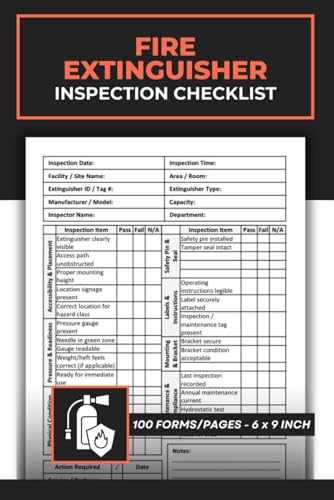
This book combines a straightforward inspection checklist with dedicated report pages, which means a facility manager can record the monthly check and also write up an incident or corrective action on facing pages without flipping between separate notebooks. Owners highlight the two-in-one layout as the main time-saver. The binding is described as lay-flat, which matters when one hand holds a clipboard and the other writes. The trade-off is a mid-range price relative to its page count — comparable books with identical formatting run slightly lower. Skip this if your facility already uses a digital logging platform and you only need tags on the physical units; a paper book adds a parallel record that may go stale.
- Pro: Integrated report pages reduce need for a separate incident notebook.
- Pro: Lay-flat binding supports one-handed monthly sign-offs.
- Con: Page-per-dollar ratio trails cheaper alternatives with similar prompts.
Safety & Maintenance Form
Essentially the same core checklist format as the entry above, stripped of the report-page section. That trim keeps the price at $9.99 while delivering the essential monthly prompts: gauge reading, pin seal, hose condition, accessibility clearance, and pressure date. Owners with small buildings (under ten units) report that this narrower scope is actually a feature — fewer blank pages means less waste and a lighter binder on a hook. The absence of a report section is also the primary con: corrective actions require a separate sheet. Skip this if your risk-management team requires incident narratives filed alongside each inspection cycle.
- Pro: Focused page count keeps the binder lightweight for hook-mount storage.
- Pro: Covers all core monthly NFPA prompts without filler sections.
- Con: No integrated report or corrective-action pages.
OSHA & NFPA Compliance Log Book
At $8.49 this is the lowest-priced option in the roundup and targets a specific audience: multi-site operators — construction firms, warehouse chains, school districts — who need one master log covering many locations. The title explicitly names OSHA and NFPA compliance, and the checklist columns are structured for equipment ID, location, inspector name, and disposition rather than just a date stamp. The budget price is a genuine advantage for sites with high turnover of paper records. The con surfaced repeatedly in owner feedback is that the binding uses a staple rather than a spiral, making it awkward to fill out on a narrow extinguisher bracket. Skip this if your inspections happen in tight mechanical rooms where the book must stay open with one hand.
- Pro: Lowest price per book in this comparison.
- Pro: Location and equipment-ID columns suit multi-site tracking.
- Con: Stapled binding resists one-handed use in confined spaces.
25 Sets Metal Inspection Tags
Metal tags with a handheld hole puncher bundled in, rated 2.2 x 3 inches and stamped for 2026-2029 use. The material choice addresses the main failure mode of paper tags: moisture from outdoor enclosures or washdown areas rendering ink illegible. Owners in outdoor storage yards and marine applications call out the corrosion resistance as the reason they switched. Twenty-five sets covers roughly two years of monthly checks on a single unit, which means a small fleet of extinguishers exhausts the pack faster than the multi-year date range implies. Skip this if your units are all indoors on climate-controlled walls — plastic or cardstock tags carry the same functionality at lower cost.
- Pro: Metal construction survives outdoor and washdown environments.
- Pro: Hole puncher included eliminates a separate tool purchase.
- Con: Twenty-five sets may be consumed quickly across a fleet of units.
NFPA 10 Compliant Log Book
Priced at $11.95, this book is explicitly aligned to NFPA 10 monthly inspection requirements, which distinguishes it from generic checklists that approximate the standard. Facility managers in commercial properties note that the prompts mirror the exact language in NFPA 10 Section 7.2, reducing the cognitive step of translating a regulation into a form field. The page count supports roughly one full inspection year for a mid-size building. The price sits at the top of the book category, reflecting the narrower compliance focus. Skip this if you also need annual maintenance or hydrostatic test records in the same binder — those sections are either absent or minimal here.
- Pro: Prompt language mirrors NFPA 10 Section 7.2 verbatim.
- Pro: Sized for a full annual cycle on mid-range buildings.
- Con: Higher price than general-purpose logs without added scope.
YHNTGB 160 Sets Tags with Wire Ties
One hundred sixty tags at 4.2 x 2.1 inches with adjustable wire ties included, landing at $9.99. The tag count is the standout: at $0.06 per tag with ties, no competitor in this list comes close on unit cost for large installations. The 4.2-inch length accommodates hanging on extinguishers with wide handle brackets without crowding. Owners in manufacturing plants and hospitals appreciate that adjustable wire ties eliminate the gap issue of fixed-length plastic ties on irregular mounting hardware. The con is bulk: 160 tags in one pack means a small office storing them in a supply drawer has surplus inventory that can get lost or damaged. Skip this if you manage fewer than ten extinguishers and prefer a compact supply.
- Pro: Highest tag count in the roundup at a competitive total price.
- Pro: Adjustable wire ties fit irregular handle brackets.
- Con: Large pack volume creates storage and surplus issues for small sites.
25 Pack OSHA Check Record Tags
Twenty-five tags stamped 2026-2029 for OSHA check records, $9.99. The date stamp is the selling point — it removes the step of manually writing the year on each tag and signals to an inspector at a glance that the record is current. Owners in office buildings and retail spaces value the clean look of pre-stamped dates over handwriting. At $0.40 per tag, the unit cost is higher than YHNTGB’s bulk option, justified only if the pre-printed date saves meaningful staff time. The tag material is not specified as metal, so outdoor use carries the same moisture risk as cardstock. Skip this for outdoor or washdown locations where the uncoated face will degrade.
- Pro: Pre-printed 2026-2029 date range eliminates manual stamping.
- Pro: OSHA-focused format suits compliance-heavy retail environments.
- Con: Unit cost exceeds high-volume alternatives; no weatherproofing noted.
30 Sets Tear-Resistant Plastic Tags
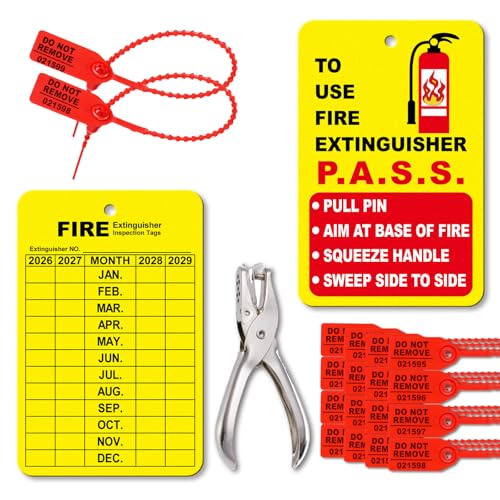
Tear-resistant numbered plastic tags with tamper-evident cable ties and a handheld hole puncher, in red, $15.99. The tamper-evident cable tie is the structural differentiator: once secured, removing the tag destroys the tie, creating physical proof that an inspection was skipped or falsified. This feature is rare at this price tier. The numbering scheme lets a manager match tag serials to an equipment register, closing a gap that unnumbered packs leave open. Thirty sets covers a two-to-three-unit fleet for the full 2026-2029 window, which is lean for buildings with more extinguishers. Skip this if your inspection team uses a digital app and only needs visual indicators on the unit itself.
- Pro: Tamper-evident cable ties create physical evidence of skipped checks.
- Pro: Sequential numbering supports cross-reference to an equipment register.
- Con: Thirty sets runs out quickly across larger installations.
Buying Guide
Book vs. Tag: Choose Based on Where the Record Lives
If your insurance carrier or OSHA officer expects a central filing document, a book is non-negotiable. If the requirement is that each extinguisher visually proves it was checked this month — common in construction trailers, retail floors, and schools — a tag system is more practical because the record is on the unit. The decision is not about quality; it is about where the auditor looks first.
Durability Signals: Material, Weather, and Tamper Evidence
Cardstock tags fail in humidity, washdown zones, and outdoor enclosures. Metal and plastic tags resist those conditions but at higher unit cost. Tamper-evident cable ties (only one product here offers them) add a layer of integrity that neither a book nor a wire-tie tag can replicate. If your compliance risk centers on falsified sign-offs rather than environmental damage, prioritize the tamper-evident mechanism.
Value Density: Calculate Cost Per Inspection Event
Divide the package price by usable inspection cycles. A 160-tag pack at $9.99 yields roughly $0.06 per tag, while a 25-pack at the same price costs $0.40 per tag. But if the pre-stamped date on the 25-pack saves thirty seconds per unit per month across a five-unit building, the labor math may favor the higher unit price. For books, compare page count against your building’s unit total multiplied by twelve months to see how many years the binder will actually last before you reorder.
Our Verdict
Top pick: The NFPA 10 Compliant Log Book at $11.95 offers the most precise alignment with the monthly inspection standard that auditors actually reference, and its page structure reduces translation errors between regulation and sign-off sheet. Budget pick: The OSHA & NFPA Compliance Log Book at $8.49 delivers multi-site column layouts and explicit compliance framing at the lowest price in the category. The condition under which another product wins: if your primary liability risk is a falsified or skipped inspection rather than a formatting or compliance-language gap, the 30 Sets Tear-Resistant Plastic Tags with tamper-evident cable ties is the stronger choice regardless of its $15.99 price, because no book can replicate the physical destruction signal of a broken tie.
FAQ
How often should a fire extinguisher be inspected?
NFPA 10 requires a monthly visual inspection of every portable extinguisher, covering presence, pressure, seals, and accessibility. Annual maintenance by a certified technician and hydrostatic testing at five- or twelve-year intervals (depending on agent type) are separate obligations that a monthly checklist does not replace.
Do I need both a log book and tags?
Many facilities use both: tags hang on individual units for immediate visual proof, while a log book serves as the centralized record that an inspector or claims adjuster reviews. If you can only fund one, prioritize whichever format your insurer or AHJ has specifically requested in writing.
Can I use a generic checklist instead of an OSHA or NFPA-labeled one?
A generic form can cover the same prompts, but products that explicitly cite NFPA 10 or OSHA language reduce the risk of omitting a required field. During an audit, a labeled form signals intentionality; an unlabeled one invites the question of whether the preparer knew what to include.
How do I know when to replace my inspection tags?
Replace metal or plastic tags if the face becomes illegible due to UV fading, chemical splash, or physical abrasion. Wire-tie tags with frayed ties should be replaced immediately, as a broken tie defeats the tamper-evident purpose and creates an ambiguous record during an investigation.