Key takeaways
- Five portable power banks for emergency phone charging, from a compact 10,000mAh pocket pick to a 60,000mAh home backup bank with a built-in light.
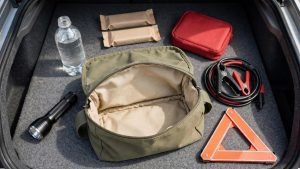
When a storm knocks out power, a phone becomes a lifeline to weather alerts, family group chats, and local authority updates. A charged power bank kept in the storm kit is one simple layer of preparation, alongside flashlights, bottled water, and a battery weather radio.
The five banks below cover very different jobs. One is small enough to ride in a coat pocket every day. One is a heavy home backup unit with its own light. The others sit between those poles: a built-in cable, a family-size capacity, and a card-thin body.
As an Amazon Associate, we earn from qualifying purchases.
Quick answer
For most households, the Anker PowerCore 10000 is the emergency bank to buy first: 10,000mAh in a body smaller than a deck of cards. Homes that lose power for days at a time should look at the Anker 548 PowerCore Reserve instead, while the Anker Nano removes the forgotten-cable problem entirely.
How to choose
Capacity comes first. A 10,000mAh bank is the common middle ground for phone duty: enough to refill a drained phone and still leave reserve for alerts the next day. A 5,000mAh card-size bank is a top-up tool, handy for hours of calls and messages, not a full weekend. At the other end, banks in the 24,000mAh to 60,000mAh range suit multi-day outages and several phones at once.
Ports and cables come next. Check what your phone actually uses before ordering. Older banks may offer a single USB-A port, which needs a cable kept in the kit. Newer banks add USB-C ports that can both send power out and take power in, which shortens the bank’s own recharge time. A built-in cable removes the most common failure in an emergency kit: a charged bank whose cable sits in another room.
Recharge time matters. A bank that needs most of a day to refill is a poor fit for rolling outages, where wall power may return for only a few hours. Charge every bank in the kit when a storm enters the forecast, then top them off again every few months, since stored batteries slowly lose charge on the shelf.
Anker PowerCore 10000
The PowerCore 10000 earns its place in a storm kit through size alone. Anker lists it at 3.6 x 2.3 x 0.9 inches and 6.4 ounces, smaller than a deck of cards, so it fits a coat pocket or a glove box. Its 10,000mAh capacity is the practical middle ground for one phone through a day or two of outage use.
Charging is simple: one USB-A port with Anker’s PowerIQ technology, which adjusts output to the connected phone. The listing gives a recharge time of about 4.7 hours for the bank itself, so an evening on a wall adapter brings it back to full. Anker also lists its MultiProtect system of 11 safety features and notes the bank is flight-approved.
The limits are plain. One port means one device at a time, and there is no USB-C output, so newer phones need a USB-A to USB-C cable kept with the bank. Add a short spare cable in the same pouch, and this remains the easiest recommendation for a single phone.
Specs:
– Capacity: 10,000mAh as listed
– Output: 1 USB-A port with PowerIQ
– Size: 3.6 x 2.3 x 0.9 inches as listed
– Weight: 6.4 ounces as listed
– Recharge time: about 4.7 hours as listed
– Model: A1263
Anker 737 Power Bank (PowerCore 24K)
The 737 is the family-size step up. Its 24,000mAh capacity suits households where two or three phones all need to stay alive through an outage. Three ports, two USB-C and one USB-A, let several devices charge at once, and the listing gives a maximum output of 140W, which also covers many laptops that charge over USB-C.
A smart digital display shows the remaining charge as a figure rather than a row of dots, which helps when rationing power across a long evening. The box includes a 140W USB-C to USB-C cable and a travel pouch, per the listing.
This is a brick, not a pocket bank, and far more than one phone needs on a one-night outage. Treat it as the household hub: it lives in one known place, and it comes out when the lights go out.
Specs:
– Capacity: 24,000mAh as listed
– Output: 140W maximum as listed
– Ports: 2 USB-C and 1 USB-A
– Display: smart digital display
– Included: 140W USB-C to USB-C cable and travel pouch
– Model: A1289
Anker Nano Power Bank (30W, Built-In USB-C Cable)
The Nano solves the most ordinary emergency failure: a charged bank and no cable. Its USB-C cable is built into the body, so it cannot be left behind or lost in a drawer. The same cable also recharges the bank itself, keeping the whole kit to one piece. Capacity is 10,000mAh, in line with the pocket pick above.
Beyond the built-in cable, the listing shows one USB-C port and one USB-A port, with 30W maximum output: charge one phone from the attached cable and a second device from a port at the same time. Anker lists the body at 10.4 x 5.2 x 2.6 cm and 215 grams, small enough for a jacket pocket.
Compatibility needs one check. The built-in cable ends in USB-C, which suits recent iPhone models and most Android phones, exactly as the listing describes. A household with older Lightning-port iPhones can still use the Nano through its ports with a separate cable, but then the main advantage shrinks.
Specs:
– Capacity: 10,000mAh as listed
– Cable: built-in USB-C cable, also used to recharge the bank
– Output: 30W maximum as listed
– Ports: 1 USB-C and 1 USB-A, plus the built-in cable
– Size: 10.4 x 5.2 x 2.6 cm as listed
– Model: A1259
Anker 548 Power Bank (PowerCore Reserve 192Wh)
The 548 is a home backup unit. Anker lists 60,000mAh, or 192Wh, of capacity and 87W of output, aimed at keeping phones and small devices running across a long outage. A smart digital display reports the remaining charge, and the box includes a 60 cm USB-C to USB-C cable; a wall charger is not included.
Its standout feature for storm duty is the retractable light built into the top. Pull it up and it gives two levels of brightness for moving around a dark house, plus an SOS mode. The listing describes auto lighting that helps you find the unit itself when power drops. One device then covers two kit jobs, phone power and a steady room light, without open flames.
The trade-offs follow from the size. This bank belongs on a shelf at home, not in a bag you carry daily, and its capacity is far beyond what a short outage demands. For a house that loses power for days, that reserve is the point. Keep it in one fixed spot, charged, and check it when you check the rest of the kit.
Specs:
– Capacity: 60,000mAh (192Wh) as listed
– Output: 87W as listed
– Light: retractable light with two brightness levels and SOS mode
– Display: smart digital display
– Included: 60 cm USB-C to USB-C cable; wall charger not included
– Model: A1294
Miady Mini MagSafe-Compatible Portable Charger
The Miady Mini is the smallest bank in this roundup, built for the glove box or a coat that already has too much in its pockets. Miady lists it at 5,000mAh, 0.55 inches thick, about the size of a credit card, and 0.24 pounds. Five small indicator lights show the remaining charge in quarters.
It attaches magnetically to the back of MagSafe iPhones, listed for the iPhone 12 through 16 series, and charges wirelessly at 5W. That gentle output suits keeping a phone alive for calls, texts, and weather alerts rather than refilling it in a hurry. A USB-C port handles wired charging at up to 12W and recharges the bank itself in about 4 hours with a 5V 2A adapter, per the listing.
Read the limits before relying on it. Wireless charging needs a MagSafe phone or a magnetic case, exactly as the listing states, and 5,000mAh is a partial refill, not a weekend supply. As a second bank that is always with you, it fills a real gap in the kit.
Specs:
– Capacity: 5,000mAh as listed
– Size: 0.55 inches thick, about credit card size, as listed
– Weight: 0.24 pounds as listed
– Wireless output: 5W magnetic, for MagSafe iPhone 12 to 16 series as listed
– Wired output: USB-C up to 12W as listed
– Indicators: five lights showing charge in quarters
Who should skip
Skip the pocket-size banks if your household regularly faces outages lasting several days; the 548 fits that pattern better. Skip the Miady Mini as your only bank, since 5,000mAh and 5W wireless output are a top-up, not a full supply. Skip the Nano if every phone in the house uses a Lightning port and you do not want a separate cable. And skip any bank you will not keep charged; an empty bank in a drawer helps no one.
FAQ
How often should a power bank in a storm kit be recharged?
Top it off every few months, and again whenever a storm enters your local forecast. Stored batteries lose charge slowly, so a bank put away full may hold noticeably less after a season on the shelf.
Can a power bank run things besides a phone?
These banks are built for phones and other small USB devices such as tablets, earbuds, and rechargeable lights. They are not made for appliances, medical equipment, or anything that plugs into a wall outlet. Keep expectations to small electronics, and follow official guidance for anything safety related.
Is a bigger bank always better for emergencies?
Not always. Capacity only helps if the bank is charged, findable, and matched to your phones and cables. A 10,000mAh bank that lives in your coat may serve you better than a huge unit buried in a closet. Many households do well with one large home bank plus one small bank per car.
What should I check before a storm arrives?
Charge every bank to full, gather the cables each phone needs, and place the kit where everyone can find it in the dark. Confirm each phone charges from its assigned bank. Then follow your local weather and authority updates.
Final verdict
For a single phone and short outages, the Anker PowerCore 10000 is the straightforward pick: small, simple, and easy to keep charged. The Nano adds a built-in cable for households that keep losing theirs, and the 737 covers several phones at once. The 548 is the long-outage anchor with its own light, while the Miady Mini earns a spot as the always-carried backup. Pick the size that matches your longest realistic outage, charge it, and store it where the household knows to look.
More from Amazon
Programs that pair well with the guide above. Offers and eligibility are set by Amazon and may change.
Free shipping on eligible items, Prime Video and more. Eligible new members can start with a free trial.
Start a Prime free trialAudiobooks and podcasts to listen to on the go. Eligible new members can start with a free trial.
Try Audible freeAd-free music streaming. Eligible new subscribers can start with a free trial.
Try Music Unlimited freeA free business account with business pricing and bulk-buying tools for work, shop or home office.
Create a business accountAs an Amazon Associate we earn from qualifying purchases.