Our Short List of 3
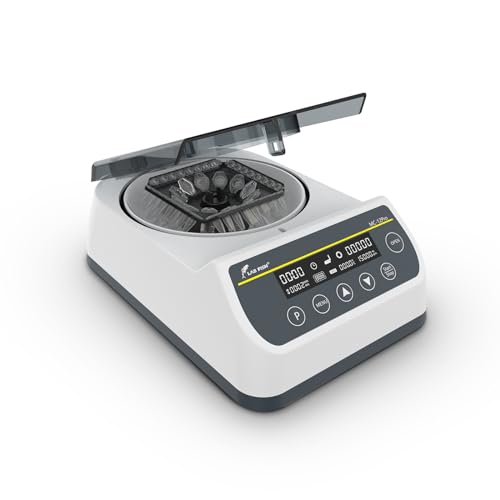
- Best for: Shared benches repeating one protocol many times a day
- Speed range: 1000-12000 RPM with PWM electronic speed control
- Maximum RCF: 9660×g
- Motor: brushless
- Rotor: 3-in-1 rotor for 0.2 ml, 0.5 ml, 1.5 ml and 2 ml microcentrifuge tubes

- Best for: PCR strip work and timed spin-downs on a crowded bench
- Speed range: 100-12000 RPM
- Maximum RCF: 7245×g
- Timer: run time settable from 1 to 99 minutes
- Display: LCD

- Best for: Mixed prep benches that spin glass tubes and microtubes in the same session
- Speed range: 1000-10000 RPM with PWM electronic speed control
- Maximum RCF: 6708×g
- Motor: brushless
- Timer: stated in the listing title, with a digital display
All 3 Picks at a Glance
| Product | Specs | Action |
|---|---|---|
| LAB FISH High Speed Centrifuge |
| Check price on Amazon |
| LACHOI Lab Mini Centrifuge Machine |
| Check price on Amazon |
| LAB FISH MC-10PRO Microcentrifuge |
| Check price on Amazon |
Key takeaways
- Compare three benchtop microcentrifuges with settable timers on RCF, rotor capacity and footprint, for sample preparation that repeats the same spin.
Sample preparation lives or dies on repeatability. A protocol that calls for a two-minute spin at a set force only gives the same pellet when every run lasts exactly that long, which is why a settable timer matters more on a microcentrifuge than almost any convenience feature. The real decision is which class of machine fits the work: a compact mini unit for quick spins at the bench, or a wider-range benchtop model whose maximum RCF and rotor capacity can carry heavier separation steps without a second instrument.
This shortlist serves three groups: teaching and training labs running the same prep many times a day, small research benches that mix microtubes with PCR strips, and prep corners that need one stored protocol recalled without re-entry. Every model below was chosen from its Amazon listing name and specifications, and only machines whose listings state a timer or timed run time, and whose rotors take standard microcentrifuge tubes, were kept.
Quick Picks
As an Amazon Associate we earn from qualifying purchases
| Product | Best for | Key spec from title |
|---|---|---|
| LAB FISH High Speed Centrifuge | Repeating one stored protocol across a full day of prep | Max RCF 9660×g |
| LACHOI Lab Mini Centrifuge Machine | PCR strip work on a crowded bench | 99-minute timer |
| LAB FISH MC-10PRO Microcentrifuge | Benches that spin small glass tubes beside microtubes | Max speed 10000 RPM |
How to Choose
Speed Range and RCF for Your Samples
Start with the force your protocol actually names, not the headline speed. RPM only turns into separation through the rotor radius, so two machines at 12,000 RPM can deliver very different RCF values; in this shortlist the widest-range model reaches 9,660×g while the compact mini tops out at 7,245×g. Gentle work such as spinning down PCR reactions needs only a few hundred g, while pelleting nucleic acid precipitates asks for forces near the top of these ranges. Match the maximum RCF to the hardest step in your prep, then check that the low end of the speed range still covers delicate samples without overshooting.
Timer Range and Programming
A timed cycle is only useful when its range brackets your protocols at both ends. Short spin-downs last seconds, so a timer that starts at whole minutes forces awkward workarounds; longer precipitations may need twenty minutes or more. One model here sets run time from 1 to 99 minutes on its display, which covers nearly any routine prep, while another stores speed and time in a memory mode so a shared protocol is recalled rather than re-entered. Decide which pattern your bench needs: a wide manual range for varied work, or stored settings where several people repeat identical steps.
Rotor and Tube Capacity
Count the formats you actually load before comparing capacities. All three rotors here accept the standard 0.2, 0.5, 1.5 and 2 ml microcentrifuge tubes, but they differ in how: one uses a single 3-in-1 rotor so nothing is swapped between formats, another pairs an 8-place round rotor with a 16-place strip rotor for PCR work, and the third adds a 12-position rotor for small glass tubes next to its microtube adapter rotor. If your prep alternates between strips and single tubes all day, rotor changes become the hidden cost; pick the arrangement that matches your dominant format.
Noise and Footprint on the Bench
Benchtop space and bench noise decide where a microcentrifuge can live. The smallest unit here measures 6.7 by 5.7 by 4.7 inches, small enough to sit beside a thermal cycler, while wider-range benchtop models trade that compactness for larger rotors and heavier housings. Brushless motors in all three avoid brush wear and keep running sound down, and rubber damping feet on the compact model limit vibration walking across the bench. Measure the shelf or bench run you actually have, leave room to open the lid fully, and keep the unit away from balances if your prep shares space with weighing.
The 3 Best Options
LAB FISH High Speed Centrifuge
- Best for: Shared benches repeating one protocol many times a day
- Speed range: 1000-12000 RPM with PWM electronic speed control
- Maximum RCF: 9660×g
- Motor: brushless
- Rotor: 3-in-1 rotor for 0.2 ml, 0.5 ml, 1.5 ml and 2 ml microcentrifuge tubes
Shared benches repeating one protocol many times a day
Confirm the low-voltage input and adapter arrangement in the listing suits your bench outlets before ordering.
This is the pick for a bench whose prep repeats all day. Its memory mode records the speed, time and temperature a protocol needs, so the next run starts from stored settings instead of fresh button presses, and the wide 1,000 to 12,000 RPM range with 9,660×g at the top covers both gentle spin-downs and firmer pelleting. The single 3-in-1 rotor takes every common microtube size without a swap, which suits shared labs where several people load different formats back to back and nobody wants to hunt for a second rotor.
LACHOI Lab Mini Centrifuge Machine
- Best for: PCR strip work and timed spin-downs on a crowded bench
- Speed range: 100-12000 RPM
- Maximum RCF: 7245×g
- Timer: run time settable from 1 to 99 minutes
- Display: LCD
PCR strip work and timed spin-downs on a crowded bench
The listing warns against continuous running beyond 30 minutes, so check your longest timed protocol against that guidance before ordering.
Choose this one when bench space is the binding constraint and timed runs still have to be exact. The LCD panel sets speed anywhere from 100 to 12,000 RPM and run time from 1 to 99 minutes, so a two-minute spin-down and a longer timed precipitation are dialed in rather than estimated. Two rotors are included: an 8-place round rotor for single microtubes and a 16-place strip rotor for PCR strips. Its footprint is closer to a paperback book than a benchtop instrument, which makes it a natural fit beside a cycler in a small prep corner.
LAB FISH MC-10PRO Microcentrifuge
- Best for: Mixed prep benches that spin glass tubes and microtubes in the same session
- Speed range: 1000-10000 RPM with PWM electronic speed control
- Maximum RCF: 6708×g
- Motor: brushless
- Timer: stated in the listing title, with a digital display
Mixed prep benches that spin glass tubes and microtubes in the same session
Check that your glass tubes match the 40 mm by 1.5 mm size the micro rotor is built for before ordering.
This model suits a bench that handles small glass tubes alongside standard microtubes. Alongside its universal adapter rotor for 0.2, 0.5, 1.5 and 2 ml microcentrifuge tubes, it carries a 12-position micro rotor sized for 40 mm glass tubes, and 200 of those tubes are included in the box. The listing title states a timer, the display is digital, and speed is electronically controlled from 1,000 to 10,000 RPM with a maximum force of 6,708×g. Labs doing mixed prep, where one rack is plastic microtubes and the next is glass, avoid a second machine entirely.
Which One Fits Your Situation
You Repeat the Same Protocol All Day
Pick the LAB FISH High Speed Centrifuge. Its memory mode stores the speed and time a protocol needs, so a morning of identical preps runs from recalled settings instead of repeated setup. The 3-in-1 rotor also removes changeovers when tube sizes vary between batches, and the 9,660×g ceiling leaves headroom for the firmest step in the sequence.
Your Bench Is Crowded and PCR Strips Are Constant
Pick the LACHOI Lab Mini Centrifuge Machine. At 6.7 by 5.7 by 4.7 inches it fits where a full-size benchtop unit cannot, and the included strip rotor handles two 8-tube PCR strips per run. Timed runs from 1 to 99 minutes cover both quick spin-downs before cycling and longer holds, all set on the LCD panel.
You Spin Glass Tubes Beside Microtubes
Pick the LAB FISH MC-10PRO Microcentrifuge. Its 12-position micro rotor is sized for 40 mm glass tubes and 200 are included, while the adapter rotor covers the standard microtube sizes, so one session can move between formats without a second instrument. The stated timer and digital display keep run lengths consistent across both kinds of tube.
You Need the Most Force in a Compact Footprint
Pick the LAB FISH High Speed Centrifuge if force is the deciding factor. Its 9,660×g maximum is the highest in this shortlist, ahead of the LACHOI at 7,245×g and the MC-10PRO at 6,708×g, which matters for precipitates that refuse to pellet at lower force. Stored settings then keep that high-force step identical from run to run.
Common Mistakes
- Comparing machines by RPM alone, when RCF is the number a protocol actually specifies and rotor radius changes what a given speed delivers.
- Loading tubes unevenly or skipping a balance tube, which strains the rotor and can end a timed run early.
- Setting a long timer without checking the maker’s continuous-run guidance, since at least one compact model here warns against running beyond 30 minutes at a stretch.
- Assuming a strip rotor also takes full plates, or that every microtube size fits every rotor without adapters.
- Placing the unit where the lid cannot open fully or where vibration reaches a nearby balance, then blaming the machine for poor results.
Frequently Asked Questions
Why does a timer matter for sample preparation?
A timer turns a spin from an estimate into a protocol step. Pellet formation depends on force multiplied by time, so two runs at the same speed but different lengths give different results. Setting the run time, and letting the machine stop itself, keeps every batch in a series directly comparable and frees the operator to prepare the next samples.
Should a protocol be matched by RPM or by RCF?
Match it by RCF whenever the protocol states a force, because RCF already accounts for rotor radius. The same RPM produces different force in rotors of different sizes, which is why the machines here reach different maximum RCF values despite similar top speeds. If a protocol gives only RPM, it was written for one specific rotor; convert before running it on another.
Can these microcentrifuges spin PCR strips as well as single tubes?
The LACHOI includes a dedicated 16-place strip rotor beside its round rotor, and the LAB FISH High Speed Centrifuge accepts 0.2 ml tubes in its 3-in-1 rotor. Check the exact strip format against the rotor description before ordering, because strip spacing and tube height vary between brands, and a strip that sits too tall will foul the lid.
What should be checked before the first timed run?
Confirm three things. First, that every tube sits opposite an identical filled tube, or a water balance tube, so the rotor runs true. Second, that the set time matches the protocol rather than a leftover setting from a previous user. Third, that the lid closes and latches fully, since these machines brake or pause when the lid opens, which silently changes the effective spin time.
More from Amazon
Programs that pair well with the guide above. Offers and eligibility are set by Amazon and may change.
Free shipping on eligible items, Prime Video and more. Eligible new members can start with a free trial.
Start a Prime free trialAudiobooks and podcasts to listen to on the go. Eligible new members can start with a free trial.
Try Audible freeAd-free music streaming. Eligible new subscribers can start with a free trial.
Try Music Unlimited freeA free business account with business pricing and bulk-buying tools for work, shop or home office.
Create a business accountAs an Amazon Associate we earn from qualifying purchases.