Our Top Picks
Pros & cons
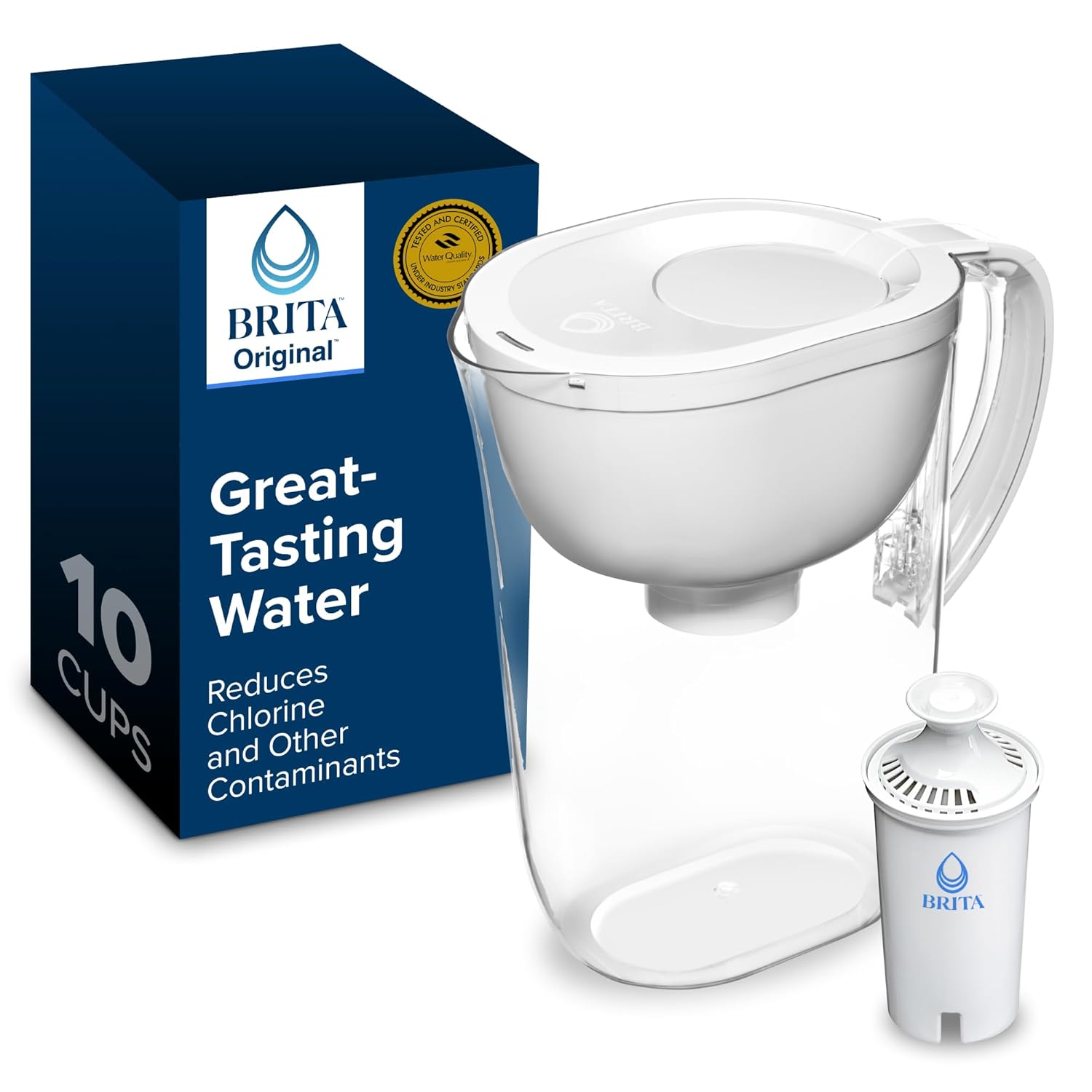
- Holds 10 cups, enough for three 24-ounce bottles
- Easy-fill locking lid simplifies refilling and pouring
- Compatible with both Longlast and Standard filters
- Standard filter needs replacing about every two months
- Manual pour-through filtering requires waiting for water to pass through
- Top Pick: LifeStraw Personal Water Filter
- Runner-up: Platypus GravityWorks 4.0L Water Filter System
- Also consider: Brita Large Water Filter Pitcher, 10-Cup
When a storm rolls through, the tap can slow to a trickle, pipes can break, and local officials can issue a boil notice while crews work. Shops empty quickly in those first hours, so a filter bought calmly in advance is worth far more than one hunted for in a panic. A home filter will not repair a broken main, and it never replaces official guidance, but the right one gives a household another way to handle drinking water.
This guide compares five filters sold on Amazon.com: a personal straw, two squeeze filters, a gravity system, and a countertop pitcher. Each suits a different household size and water source, from a rain barrel or creek to treated tap water that tastes off after a storm. Every figure below is a maker figure from that product’s own listing. Read them as one layer of readiness alongside stored water, not as a promise that any filter makes any water safe.
As an Amazon Associate, we earn from qualifying purchases.
Quick answer
For most homes, the Sawyer Squeeze SP131 kit is the flexible middle ground: it fills bottles and pots, works with its own pouches, and carries a long maker-rated life. Add a LifeStraw for each go bag, pick the Platypus gravity system for families, and keep a Brita pitcher for treated tap water only.
How to choose
Begin with the water you expect to use. Treated tap water that is still running, but cloudy or odd tasting after a storm, calls for a different tool than untreated water from a rain barrel, a pond, or a creek. The pitcher in this guide belongs to the first job only. The straw, squeeze, and gravity filters belong to the second, and even then they work within the scope each maker states.
Next, follow official guidance before any product page. Boil notices come from local authorities, and they override everything in this article. If officials say to boil, boil. If they say not to use the water at all, do not use it. A filter is one layer of a wider plan that also holds stored water and a way to heat water.
Match the format to your household. A straw serves one person on the move. A squeeze filter fills bottles and cooking pots for a small household. A gravity system works through several liters at a time for a family. Pick the format that still sounds manageable on day three.
Look at maker-rated capacity and upkeep together. Hollow fiber filters need backflushing with clean water to keep flowing, and each maker gives its own routine. Follow that routine exactly, and check that a spare filter can be ordered before storm season. Store filters the way the maker directs; several makers warn against letting a wet hollow fiber filter freeze, because ice can damage the fibers.
Finally, know the limits on every listing here. Most straw and squeeze filters are described by their makers as tools for bacteria and protozoa, not for viruses or dissolved chemicals. None of them turns floodwater into a wise choice. When in doubt, use stored water first and save the filter for clearer sources.
LifeStraw Personal Water Filter
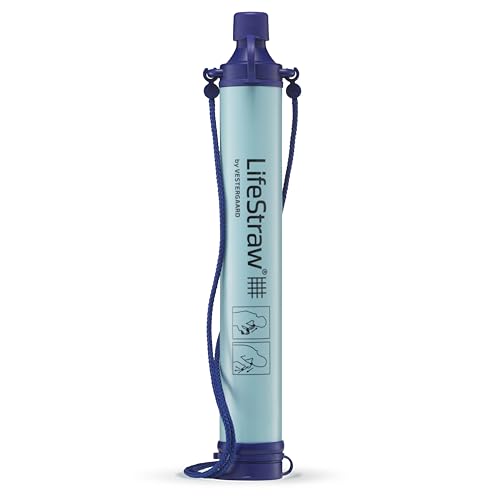
The LifeStraw Personal is the simplest tool in this guide: a sealed straw with a membrane inside and nothing to assemble. You drink through it straight from a cup, a bottle, or a water source, which makes it a calm fit for a go bag, a car kit, or a drawer by the front door. Because it serves one person at a time and cannot fill a pot, it works best as a personal backup layered under a household filter.
LifeStraw lists a 0.2 micron membrane and a maker-rated capacity of up to 4,000 liters, and the maker notes that the straw stops allowing water through at the end of its working life, which removes the guesswork about when to retire it. There are no parts to backflush and no batteries or chemicals involved.
Specs:
- Brand: LifeStraw
- Model number: LSPHF038, as listed
- Format: Personal straw filter
- Membrane pore size: 0.2 micron, as listed
- Maker-rated capacity: Up to 4,000 liters (1,000 gallons)
- Included: 1 LifeStraw Personal Water Filter
Sawyer MINI Water Filtration System
The Sawyer MINI, model SP128 in the single blue version, is a small hollow fiber filter that screws onto its included squeeze pouch or a standard bottle thread, and it can also sip through the included drinking straw. Sawyer lists 0.1 micron absolute filtration and a maker-rated capacity of up to 100,000 gallons. It fills a bottle slowly compared with its bigger sibling, but it asks for almost no room in a drawer.
Upkeep is part of the bargain. Sawyer includes a cleaning plunger for backflushing, and the maker directs owners to backflush with clean water to restore flow after use in silty water. Build that habit after every outing or outage and the MINI keeps pace. For one person or a couple, it is an easy layer to add.
Specs:
- Brand: Sawyer Products
- Model: SP128, single, blue
- Filtration: 0.1 micron absolute, as listed
- Maker-rated capacity: Up to 100,000 gallons
- Includes: MINI filter, 16-ounce squeeze pouch, drinking straw, and cleaning plunger, as listed
Sawyer Squeeze Water Filtration System SP131
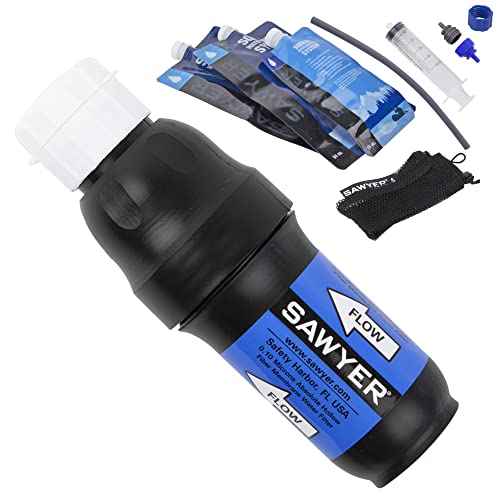
The SP131 is the full-size Sawyer Squeeze kit, and it is the filter we would hand to a household that wants one tool for most jobs. The listing bundles the filter with three pouches, one 16-ounce and two 32-ounce, so you can carry untreated water home and squeeze it into bottles, pots, or a cooking pan. Sawyer lists the same 0.1 micron absolute filtration as the MINI and a maker-rated capacity of up to 100,000 gallons.
Flow is the reason to pick it over the MINI. A larger membrane area means less hand fatigue when a family needs several liters for drinking and cooking, and the filter also threads onto standard bottles and can sit inline on a hydration reservoir per the maker’s directions. It still needs backflushing with the included syringe, and the pouches reward gentle handling rather than a full bodyweight squeeze.
Specs:
- Brand: Sawyer Products
- Model: SP131
- Filtration: 0.1 micron absolute, as listed
- Maker-rated capacity: Up to 100,000 gallons
- Includes: Squeeze filter with three pouches, one 16-ounce and two 32-ounce, as listed
Platypus GravityWorks 4.0L Water Filter System

The GravityWorks 4.0L takes work off your hands entirely. Fill the dirty reservoir, hang it above the clean reservoir, open the clamp, and gravity pulls water through the hollow fiber microfilter while you do something else. Platypus lists a flow that delivers four liters in about 2.5 minutes, up to 1.75 liters per minute, which suits a family filling bottles for a day or a pot for dinner. The two-reservoir layout also keeps untreated and filtered water clearly apart.
The listed kit holds 4.0 liters on each side and weighs 11.5 ounces in this configuration, with a cartridge the maker rates at up to 1,500 liters before replacement. It needs a branch or hook at the right height, and the reservoirs deserve care around sharp edges. Backflush the cartridge the way Platypus directs and let everything dry before storage.
Specs:
- Brand: Platypus, by Cascade Designs
- System capacity: 4.0L dirty reservoir plus 4.0L clean reservoir, as listed
- Filter type: Hollow fiber microfilter, 0.2 micron, as listed
- Maker-rated flow: 4 liters in about 2.5 minutes, up to 1.75 liters per minute
- Maker-rated cartridge life: Up to 1,500 liters
- Weight: 11.5 ounces in the 4.0L configuration, as listed
- Includes: Dirty reservoir, clean reservoir, microfilter, hoses, shutoff clamp, and storage sack, as listed
Brita Large Water Filter Pitcher, 10-Cup

The Brita pitcher earns its place in a storm season kitchen for one narrow job: making treated tap water taste better while the supply is running. After a storm, municipal water can carry a heavy chlorine note or sediment from stirred-up lines, and a 10-cup pitcher in the fridge keeps palatable drinking water ready. The listing includes one Standard filter, changed every 40 gallons or about two months per Brita.
Be plain about the boundary, because Brita is plain about it too: pitcher filters are made for treated tap water and are not intended to purify water. Never fill this pitcher from a pond, a rain barrel, or a flooded well and call it safe. Under a boil notice, boil first and let officials guide you.
Specs:
- Brand: Brita
- Capacity: 10 cups, as listed
- Material: BPA-free, as listed
- Includes: Pitcher and 1 Standard filter
- Maker guidance: Change the filter every 40 gallons or about 2 months, as listed
Who should skip
Skip the pitcher entirely if your plan involves untreated sources; it is a taste tool for treated tap water, full stop. Skip every filter here if you expect it to handle viruses, fuel, or chemical spills, because the makers do not claim that scope, and official guidance matters more than gear then. Skip the straw-only setup if you cook for a family, since nobody can fill a soup pot through a straw. And skip any filter you are unwilling to clean and store as its maker directs.
FAQ
Does a filter cancel out a boil notice?
No. Boil notices come from local authorities, and they stand until officials lift them. Boil when told to boil, and use a filter only within the scope its maker states, as one layer alongside stored water.
How long will each filter keep working?
Each maker states its own figure: up to 4,000 liters for the LifeStraw straw, up to 100,000 gallons for the two Sawyer filters, and up to 1,500 liters for the GravityWorks cartridge. Cloudy water shortens real life, so backflush as directed and keep a spare.
Can I run pond or rain barrel water through the Brita pitcher?
No. Brita describes its pitcher filters as tools for treated tap water, not as purifiers. Save the pitcher for the tap, and use a filter whose maker states a scope for untreated sources, while still following official guidance.
How should I store filters between storms?
Clean or backflush each filter as its maker directs, let it dry, and store it indoors where it will not freeze; makers of hollow fiber filters warn that freezing a wet filter can harm the fibers. Check your kit before storm season.
Final verdict
Build the plan in layers. Give every go bag a LifeStraw, let the Sawyer Squeeze SP131 carry the household’s main filtering work, and step up to the GravityWorks 4.0L when a family needs liters without squeezing. Keep the MINI as the compact spare, and let the Brita pitcher do its one honest job on treated tap water. None of these tools replaces stored water, a way to boil, or the word of local officials.

More from Amazon
Programs that pair well with the guide above. Offers and eligibility are set by Amazon and may change.
Free shipping on eligible items, Prime Video and more. Eligible new members can start with a free trial.
Start a Prime free trialAudiobooks and podcasts to listen to on the go. Eligible new members can start with a free trial.
Try Audible freeAd-free music streaming. Eligible new subscribers can start with a free trial.
Try Music Unlimited freeA free business account with business pricing and bulk-buying tools for work, shop or home office.
Create a business accountAs an Amazon Associate we earn from qualifying purchases.