Key takeaways
- Inventory: Download or photograph the manufacturer’s pack list and count every item on arrival.
- People count: Divide total food calories and water by the number of household members, not the marketing label alone.
- Expiration dates: Record the earliest date for food bars, water pouches, batteries, medications, filters, chemical light sticks, and sanitation products.
- Medical fit: Add prescriptions, glasses, hearing-aid batteries, allergy products, menstrual supplies, and medically appropriate items after consulting a qualified professional.
- Tool quality: Open the can opener, test the flashlight, tune the radio, inflate or inspect shelter items, and check that gloves fit.
- Storage: Keep the kit accessible, away from flood-prone floors and excessive heat. A kit locked in a garage may be unreachable after a storm.
- Personalization: Add identification, local maps, chargers, cash in small denominations, copies of documents, masks, sturdy footwear, and pet or infant supplies.
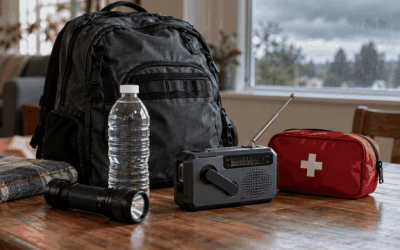
The best emergency survival kits are the ones whose food, water, medical supplies, tools, and replacement dates match the number of people and the emergency you are preparing for. For most households, a packaged 72-hour kit such as the Ready America Deluxe Emergency Kit is the practical starting point; the Uncharted Supply Co. Seventy2 Pro is better for evacuation and portability; and a food-focused package from Augason Farms or a similar supplier works best as a supplement rather than a complete emergency kit.
Our top picks


As an Amazon Associate we earn from qualifying purchases at no extra cost to you. Ratings are shown as listed on Amazon.
Best emergency survival kits at a glance
| Kit or kit type | Best for | People and duration claimed | Water provision | Food provision | Main limitation |
|---|---|---|---|---|---|
| Ready America Deluxe Emergency Kit | Budget-conscious home storage | Commonly sold in 2- or 4-person, 3-day versions | Usually packaged water pouches or water-related supplies; verify the exact SKU | Emergency food bars in many versions | Basic tools and first aid; contents differ by package |
| Uncharted Supply Co. Seventy2 Pro | Evacuation by car or on foot | Designed as a personal evacuation pack, not a whole-house supply | Filtration and water-carrying equipment rather than three days of drinking water | Limited ready-to-eat food; add calories separately | Higher price and insufficient food or water for a family |
| Commercial freeze-dried food kit, such as Augason Farms packages | Long-term pantry backup | Claims vary from several days to many months of servings | Generally no complete drinking-water solution | Large serving count, usually requiring water and cooking | Not a medical, communications, or evacuation kit |
| Build-your-own household kit | Specific diets, medications, pets, and large families | Scaled precisely to the household | Can meet the full storage target | Can combine familiar shelf-stable foods with emergency rations | Requires more planning and date tracking |
Our buying decision: which kit fits your situation?
| Your situation | Most suitable choice | Why |
|---|---|---|
| One or two adults, limited budget, apartment storage | Two-person 72-hour packaged kit plus separate water | Compact and inexpensive; water is usually the heaviest missing piece |
| Family of four sheltering at home | Four-person 72-hour kit plus a 12-gallon or larger water reserve | Provides a usable baseline without pretending the kit covers every household need |
| Frequent evacuation, wildfire, or hurricane zone | Portable evacuation pack plus car supplies and separate food | A backpack is easier to move than a plastic storage tub, but normally supports fewer people |
| Experienced prepper with pantry space | Bulk freeze-dried food plus a separately audited equipment bin | Better cost per serving and longer food coverage, but requires cooking, water, and inventory management |
| Children, allergies, pets, or daily prescriptions | Build-your-own kit or customized add-on system | Generic kits rarely contain suitable food, medication, infant supplies, or pet supplies |
Ready America Deluxe Emergency Kit: best low-cost household baseline
Ready America’s Deluxe Emergency Kit line is aimed at households that want a preassembled 72-hour package. The useful feature is not the label; it is the consolidation of several basics into one container: emergency food bars, drinking-water supplies in some configurations, a flashlight, radio or communications items, first-aid materials, sanitation products, light sticks, and basic tools.
Audit the exact box before counting it as complete. The product family includes different person counts and configurations, so a two-person version cannot be treated as a four-person supply simply because both are described as “three-day kits.” Check whether your selected package contains sealed water, water-treatment supplies, or only an empty container or water pouch. Those are very different levels of coverage.
Food and water coverage
A 72-hour claim commonly refers to emergency food bars rather than normal meals. A useful planning calculation is:
Adults × 2,000 calories × 3 days = approximate adult calorie target.
Two adults therefore need about 12,000 calories for three days if normal activity and cold-weather demands are considered. A box containing a few emergency bars may provide survival calories but not comfortable meal coverage. Add familiar shelf-stable foods, a manual can opener, and at least one gallon of drinking water per person per day where storage allows. Water weighs about 8.3 pounds per gallon, so a four-person, three-day reserve weighs roughly 100 pounds before containers are included.
Medical supplies and tools
Expect a compact first-aid assortment, not a replacement for prescription medicine or a fully stocked trauma kit. Inspect bandage sizes, antiseptic products, gloves, pain-relief products, and any medication expiration dates. Basic flashlights and radios are valuable, but test batteries and confirm whether the radio uses replaceable batteries, hand cranking, or both. Plastic tools and thin multi-tools are adequate for light household tasks; they should not be counted on for cutting heavy branches, breaking glass, or extended outdoor use.
Uncharted Supply Co. Seventy2 Pro: best for evacuation mobility
The Seventy2 Pro is designed around a backpack format, making it more useful when a person must leave quickly and carry supplies through streets, a shelter, or a vehicle transfer. Its pack-list emphasis is on water filtration, lighting, warmth, shelter, navigation, first aid, and compact tools.
Its most important limitation is coverage. A personal evacuation pack is not the same as a three-day family kit. Water filtration equipment helps only when an appropriate water source is available, and it does not eliminate the need to carry drinking water during the first part of an evacuation. The food component is also not a substitute for a household pantry. Add sealed water, high-calorie food bars, prescription supplies, phone charging equipment, copies of documents, and child or pet essentials.
Durability and ownership realities
Backpack systems experience more wear than a home kit. Zippers, shoulder straps, buckles, water-filter seals, and battery contacts are the first areas to inspect. Run water through the filter according to the manufacturer’s instructions before storage, then follow its drying and replacement guidance. Do not leave lithium or alkaline batteries loose against metal tools. Weigh the loaded pack: a nominally portable kit becomes difficult to evacuate with when water, clothing, food, and documents are added.
Augason Farms and other freeze-dried food kits: best for calories, not completeness
Large freeze-dried food packages from Augason Farms and comparable suppliers are useful when the real requirement is extended food storage. They often provide far more servings than a small 72-hour kit and can be less expensive per serving at larger sizes. Their weaknesses are equally important: most servings require water, some require cooking, and serving counts are not the same as full adult daily calories.
Read the nutrition panel rather than relying on the serving number. For example, a container with 100 servings at 200 calories each provides 20,000 calories, or roughly 6,667 calories per day for a three-day period. That would cover two adults for three days only at about 1,111 calories per person per day—well below a typical adult maintenance target. A kit may therefore sound large while providing less practical coverage than expected.
Store these foods cool and dry, rotate opened packages, and retain the oxygen absorbers and preparation instructions. Include a stove suitable for the setting, fuel stored according to local rules, cookware, utensils, and extra water. Never use combustion stoves indoors or in an enclosed area because of carbon-monoxide risk.
What to inspect before buying or storing a kit
- Inventory: Download or photograph the manufacturer’s pack list and count every item on arrival.
- People count: Divide total food calories and water by the number of household members, not the marketing label alone.
- Expiration dates: Record the earliest date for food bars, water pouches, batteries, medications, filters, chemical light sticks, and sanitation products.
- Medical fit: Add prescriptions, glasses, hearing-aid batteries, allergy products, menstrual supplies, and medically appropriate items after consulting a qualified professional.
- Tool quality: Open the can opener, test the flashlight, tune the radio, inflate or inspect shelter items, and check that gloves fit.
- Storage: Keep the kit accessible, away from flood-prone floors and excessive heat. A kit locked in a garage may be unreachable after a storm.
- Personalization: Add identification, local maps, chargers, cash in small denominations, copies of documents, masks, sturdy footwear, and pet or infant supplies.
How often to maintain an emergency kit
Perform a quick inspection every six months, ideally when clocks change. Replace anything expired, leaking, swollen, corroded, moldy, or damaged. Test electronics and recharge power banks. Recalculate food and water whenever someone joins or leaves the household. After one year, open the bag and confirm that the inventory still matches the contents; after a move, update maps, documents, clothing, and evacuation routes.
The strongest purchase is usually a hybrid: a modest preassembled kit for speed, enough water for the household, a separate food reserve for the intended number of days, and personalized medical and communication supplies. That approach costs more than accepting a package’s headline claim, but it gives you coverage you can actually calculate.
FAQ
Are emergency survival kits worth buying?
Yes, when they provide a starting inventory and are audited afterward. No packaged kit should be assumed to include enough water, calories, medication, or supplies for every household.
Should I buy a three-day kit or a larger food package?
Choose a three-day kit for immediate readiness and evacuation basics. Choose a larger food package when you already have water, cooking equipment, sanitation supplies, lighting, first aid, and a plan for longer shelter-in-place periods.
Can emergency food be used after its printed date?
Do not assume it is safe or suitable solely because it looks normal. Follow the manufacturer’s storage and date guidance, and replace products with damaged packaging, off odors, moisture, or other signs of deterioration.