Key takeaways
- Find the best compact thrower flashlight for a pocketable long-distance beam. Compare throw, battery, and charging across three small lights.
Choosing a compact thrower means settling one trade-off before anything else: how much reach you are willing to carry. A light that throws 500 metres or more used to mean a long body and a heavy cell, but the three lights in this roundup squeeze that kind of beam into a package that fits a jacket pocket or a glovebox. The decision is not about finding the brightest light on the shelf. It is about matching throw distance, battery size, and handling to the distances you actually need to light up, whether that is a trail marker, a fence line, or a far bank across a field.

This roundup is for campers, hikers, and anyone who keeps a light for emergencies, search work, or night walks on open ground. Each light below was chosen from the name and specifications on its Amazon product page, so the throw, output, and battery figures are the ones the listing itself states.
Quick Picks
As an Amazon Associate we earn from qualifying purchases
| Product | Best for | Key spec from title |
|---|---|---|
| Thrunite Catapult Mini | Smallest pocket thrower for trails and kits | 680 lumens, 598 m throw |
| Wurkkos TS11 | Brightest pocket thrower with a customisable interface | 2,000 lumens, 616 m throw |
| Acebeam L17 | Longest runtime and duty-style build | Up to 820 m throw, 18650 cell |
How to Choose
Throw distance and beam shape
Throw distance is the number that matters most here, and it comes from candela, not lumens. A tight beam with high candela reaches far with modest output, while a floody beam with the same lumens lights up a wide area and fades quickly at distance. All three lights below use a TIR optic or a deep reflector to concentrate the beam into a narrow spot with very little spill, which is what makes them throwers rather than general-purpose lights. Check the claimed throw in metres and the candela figure together, and remember that the rated distance is measured to a dim threshold, so the distance at which you can identify an object is roughly half the claimed figure.
Battery size and runtime
The cell inside a compact thrower decides how long it can hold its output and how big the light feels in a pocket. The Catapult Mini and the TS11 run on a single 18350 cell, which keeps them short and light but limits total runtime, while the L17 takes a full-size 18650 cell and runs longer between charges. Two of the lights here charge over USB-C with the cell inside, which is convenient on a trip, but a spare cell still needs a separate charger or a second light to stay useful. Watch for proprietary cells, too: the Catapult Mini ships with a cell that has a special positive terminal, so a standard 18350 will not fit.
Output, heat, and step-down
All three lights in this roundup quote their brightest output as a turbo figure, and all of them step down from it within minutes as heat builds. That is normal for a small light pushing a high-output emitter, and it means the turbo number is best read as a burst for identifying something far away, not a mode you can hold. Look instead at the high mode, which is the level the light can sustain, and compare the runtimes the listing gives for high and medium. A light that holds 300 lumens for an hour is more useful on a night walk than one that flashes 2,000 lumens for ninety seconds and then drops to a dim glow.
Size, switch, and weather sealing
A thrower is worth carrying only if it is easy to operate in the dark. The two 18350 lights here are under 95 millimetres long and fit a jacket pocket, while the L17 is a traditional duty size that rides better in a holster or a pack pocket. Side switches are easy to find by touch but can switch on in a bag, so a lockout mode matters; tail switches suit a tactical grip and are harder to press by mistake. All three carry an IPX8 or IP68 rating, so rain and a brief dunk should not end a night out, though the ratings are tested in clean water rather than mud or salt spray.
The 3 Best Options
Thrunite Catapult Mini
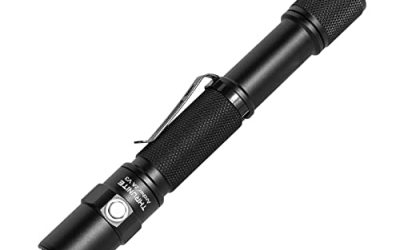
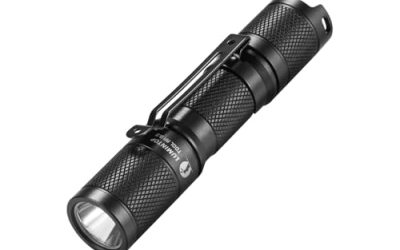
The Catapult Mini is the light this roundup is built around, and it earns that spot by shrinking a long-throw beam into a package shorter than most car keys. Its Osram emitter and TIR optic push a tight, focused spot to a claimed 598 metres, which is the kind of reach that turns a small light into a search tool for a campsite, a trail, or a stretch of road after dark. A single 18350 cell keeps it pocketable, and the USB-C charging means the cell never has to leave the light. Five brightness levels plus strobe, beacon, and SOS cover everything from a low firefly glow to full turbo.
Specs
- LED: Osram KW CSLNM1.TG
- Output: 680 lumens, 598 m throw, 89,600 candela
- Battery: 1 x 18350, 1100mAh, included
- Charging: USB-C, built in
- Optic: TIR
- Waterproof: IPX8
- Size: 80.98 x 40.4 x 26 mm
- Weight: 87.5 g without cell
- Modes: Moonlight, Low, Medium, High, Turbo, Strobe, Beacon, SOS
- Firefly: 0.5 lumens for 106 hours
Best for: Campers and hikers who want the smallest light that still throws several hundred metres.
Watch out for: The included 18350 cell has a proprietary positive terminal, so standard 18350 cells will not fit; confirm the black or Metal Grey colour on the listing before ordering.
Wurkkos TS11
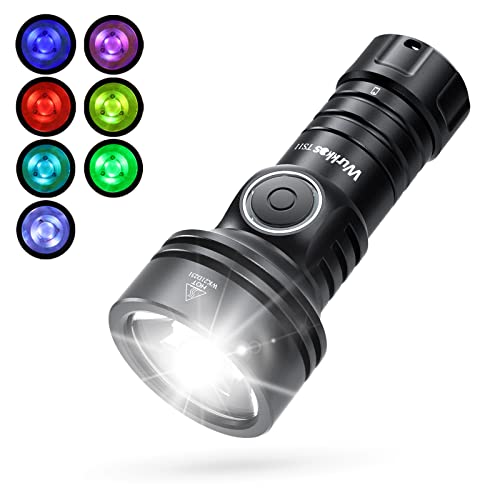
The TS11 is the pick for anyone who wants the brightest pocket thrower of the three and does not mind learning a more advanced interface. Its Luminus SFT40 emitter delivers a claimed 2,000 lumens and a 616-metre beam, out-throwing the Catapult Mini on paper while staying close to the same palm-sized footprint. The Anduril 2.0 interface unlocks ramping, stepped modes, and a set of auxiliary RGB LEDs behind the lens, which give the light a distinct glow on a nightstand or inside a tent. A 18350 cell and USB-C charging keep the whole package self-contained and easy to top up between outings.
Specs
- LED: Luminus SFT40
- Output: 2,000 lumens, 616 m throw, 94,750 candela
- Battery: 1 x 18350, 1100mAh, included
- Charging: USB-C, built in
- Interface: Anduril 2.0 with ramping and stepped modes
- Auxiliary LEDs: RGB, behind the lens
- Waterproof: IP68, to 2 metres
- Size: 90 mm long, 40 mm head diameter
- Weight: 90 g without battery
Best for: Enthusiasts who want maximum output and a customisable interface in a pocket-sized thrower.
Watch out for: The Anduril 2.0 interface takes time to learn, and turbo steps down quickly as the small body heats up.
Acebeam L17
The L17 is the most traditional of the three, built like a compact duty light with an electronic tail switch and a body that takes a full-size 18650 cell. That larger cell is the point: it feeds the Osram emitter for longer sustained output, and the TIR optic concentrates the beam into a pencil-thin spot that reaches a claimed 802 metres in the white-LED version and 820 metres in the green version. The light is rated waterproof to five metres, which suits wet-weather use and handling in a pack or on a belt. It is the longest and heaviest pick here, so it trades pocket comfort for runtime and reach.
Specs
- LED: Osram White Flat (white version); Osram green LED (green version)
- Output: white version 1,400 lumens, 802 m throw, 160,801 candela; green version 2,000 lumens, 820 m throw, 168,100 candela
- Battery: 1 x 18650 or 2 x CR123A
- Optic: TIR
- Waterproof: IP68, to 5 metres
- Size: 140.5 x 40 x 25.4 mm
- Weight: 146 g without battery
- Switch: electronic tail switch
- Modes: Ultra Low, Low, Mid, High, Turbo, Strobe
Best for: Search, farm, and duty use where runtime and maximum throw matter more than pocket size.
Watch out for: Confirm the LED colour on the listing before ordering — the white and green versions have different output and throw figures — and check that a battery is included with the listing you choose.
Which One Fits Your Situation
You want the smallest light that still throws far
Pick the Catapult Mini. It is the shortest and lightest light here, it charges over USB-C, and its firefly mode runs for days, which makes it easy to keep in a jacket pocket or a glovebox as an always-there emergency light. The trade-off is runtime: the 18350 cell empties faster than the L17’s 18650, so carry a spare plan for long nights.
You want maximum brightness and a customisable light
Pick the TS11. It is the brightest of the three on paper, and the Anduril interface lets you shape the output with ramping, stepped levels, and auxiliary LEDs that the other two do not offer. It suits enthusiasts who enjoy tuning a light to their habits. The trade-off is complexity: the interface takes an evening to learn, and the small body heats up fast on turbo.
You want the longest runtime and a duty-style build
Pick the L17. The 18650 cell and constant-current driver hold output longer than either 18350 light, the tail switch suits a firm grip with gloves, and the five-metre waterproof rating handles the worst weather of the three. It is the pick for search work, farm rounds, and anyone who treats a flashlight as a tool rather than a gadget.
You need a light for wet weather and rough handling
Pick the L17 if size is not a constraint, since its five-metre waterproof rating is the deepest here and its larger body survives knocks better than the two pocket lights. If you need something that rides in a pocket through rain instead, the Catapult Mini is the fallback: it is rated IPX8, it is small enough to keep on you at all times, and its lockout mode stops it switching on inside a wet jacket.
Common Mistakes
- Judging a thrower by lumens alone — candela decides how far the beam reaches, so a 680-lumen light with a tight optic can out-throw a 2,000-lumen flooder.
- Buying a light with a proprietary cell without checking spares — the Catapult Mini’s cell has a special positive terminal, so standard 18350 cells will not fit it.
- Treating the turbo figure as the everyday output — every small thrower steps down within minutes, so compare the high mode and its runtime instead.
- Choosing a flood beam for distance work — a wide beam wastes output on nearby ground and fades fast at range, while a TIR thrower keeps the light in a tight spot.
- Carrying a side-switch light unlocked in a bag — without lockout, an accidental press can drain the cell before you need it.
Frequently Asked Questions
How far can a compact thrower actually reach?
Further than its size suggests, but less than the headline number. The claimed throw is measured to a very dim threshold, so the distance at which you can clearly identify a person or an animal is roughly half the rated figure. A light rated at 600 metres is still genuinely useful at 200 to 300 metres, which covers most trail, campsite, and search needs.
Is a single 18350 battery enough for a thrower?
Yes, for short bursts and occasional use. A 18350 cell stores far less energy than an 18650, so a compact thrower will run its brightest modes for minutes rather than hours and then step down. If you use a light nightly or for long searches, the L17’s 18650 cell is the better fit; if you use it in short bursts, an 18350 light is plenty.
Do I need a separate charger for these lights?
No, not to start. The Catapult Mini and the TS11 both charge over USB-C with the cell inside the light, so a phone charger and the included cable are enough. The L17 has no charging port on the body, so it relies on a USB-rechargeable 18650 cell or a separate charger — check what the listing includes before you order.
What does a TIR optic do?
A TIR optic is a moulded lens that collects almost all of the LED’s light and focuses it into a tight beam with very little spill. That is why throwers built around a TIR optic can reach several hundred metres from a small head: the light is concentrated into a narrow spot instead of spreading across a wide area. The trade-off is a narrow field of view up close.
More from Amazon
Programs that pair well with the guide above. Offers and eligibility are set by Amazon and may change.
Free shipping on eligible items, Prime Video and more. Eligible new members can start with a free trial.
Start a Prime free trialAudiobooks and podcasts to listen to on the go. Eligible new members can start with a free trial.
Try Audible freeAd-free music streaming. Eligible new subscribers can start with a free trial.
Try Music Unlimited freeA free business account with business pricing and bulk-buying tools for work, shop or home office.
Create a business accountAs an Amazon Associate we earn from qualifying purchases.