Key takeaways
- Compare AA tactical flashlights that run on easy-to-find batteries, with output, modes, waterproofing, and carry details for storm kits and daily use.
When the power goes out during a storm, the flashlight that matters most is the one that still works. A tactical flashlight that runs on AA batteries has a simple advantage in that situation: AA cells are sold in grocery stores, gas stations, pharmacies, and hardware stores, and many households already keep a drawer or a storage bin full of them. There is no special charger to find, no proprietary pack to keep topped off, and no waiting for a recharge before the light can be used again. Swapping in a fresh set of cells takes seconds, even in the dark, and spent cells can be replaced one room or one task at a time.


That convenience comes with trade-offs. A single AA cell or a pair of AA cells cannot deliver the same peak output as a larger lithium-ion light, so expectations should focus on useful brightness, dependable switching, solid waterproofing, and a body that survives drops onto concrete, gravel, or a flooded porch step. This guide compares three AA-powered tactical-style flashlights that take different approaches to that balance. One is a very small single-cell light with a tail switch and mode memory, one is a compact single-cell light with an advanced ramping interface and a high color rendering LED, and one is a longer two-cell light with dual switches and a straightforward mode set built around everyday AA power.
As an Amazon Associate, we earn from qualifying purchases.
How to Choose an AA Tactical Flashlight
Start with the battery format, not the headline brightness
Headline brightness figures for dual-fuel flashlights are almost always quoted with a 14500 lithium-ion cell installed, because that cell runs at a higher voltage than an AA battery. The same light will produce noticeably less output on an alkaline or NiMH AA cell. That does not make the AA figures disappointing; it makes them the numbers that matter for this kind of purchase. A buyer who plans to run a light only on AA batteries should compare the AA output, AA runtime, and AA beam distance first, and treat any higher lithium-ion figure as a bonus for a different power setup rather than as the everyday expectation.
Battery chemistry also matters. Alkaline cells suit kits where a light may sit unused for months, while NiMH rechargeable cells hold up better under higher drain for weekly use. Follow the battery types each maker lists for that exact model.
Look for a switch that works under stress
Tactical-style lights earn that label in large part through their controls. A tail switch pressed with a gloved thumb, a side switch that changes modes without repositioning the hand, or a dual-switch layout that separates on and off from mode changes all help when hands are wet, cold, or busy. What matters is whether the pattern fits the intended job, and whether strobe, if present, stays hidden behind a deliberate action rather than appearing during normal mode cycling.
Match output levels to real tasks
A useful AA flashlight needs more than a strong high mode. A low or moonlight level preserves night vision, stretches cells through a long outage, and suits reading a breaker panel label indoors. A middle level handles most walking and yard tasks. High levels are best for short bursts, such as checking a fence line or a flooded street. Reading the full mode table, rather than a single maximum number, gives a clearer picture of daily usefulness.
Check waterproofing, impact resistance, and body material
Storm use means rain, puddles, and the occasional drop. An IP68 or IPX8 rating indicates protection against immersion under the conditions the maker states, while lower ratings generally cover splashing or rain only. Hard-anodized aluminum bodies resist scratches and corrosion and tend to survive drops better than plastic housings. Knurling improves grip when hands are wet, and a reversible pocket clip may allow the light to be attached to a cap brim for short hands-free tasks.
Consider size, carry, and where the light will live
A single-AA light fits a pocket or glove box but can feel cramped for larger hands. A two-AA light is easier to grip and usually delivers stronger sustained AA output, at the cost of more space and a second cell to replace. Either way, spare AA cells stored with the light, rotated regularly, are part of the purchase decision.
LUMINTOP Tool AA 2.0
The LUMINTOP Tool AA 2.0 is the smallest light in this guide, built around a single cell in a short aluminum tube with a tail switch and a pocket clip. Its appeal is restraint: a compact body, a simple set of modes with memory, and compatibility with both a standard AA battery and a 14500 lithium-ion cell. For a storm kit, that flexibility means the light can live on ordinary AA cells for months and still be ready instantly, with no charging routine to maintain. The maker lists a maximum output of 650 lumens, reached with the higher-voltage cell, along with five modes including strobe and an IP68 waterproof rating.
On AA power, output is lower than that headline figure, which is normal for this class and worth planning around rather than treating as a flaw. The lower modes are the ones that carry a light like this through an outage, offering long runtime for indoor tasks, while the higher modes suit short outdoor checks. Mode memory means the light returns to the level last used, which helps when the same task repeats through an evening. Operation can be handled through the tail switch, and the small head and body make the light easy to store in a jacket pocket, a small pouch, or the side pocket of a vehicle console.
The aluminum body and waterproof sealing leave few exposed parts to snag or break, and at well under four inches long, this is the easiest of the three to keep on a person rather than in a bag.
Specs
| Spec | Detail |
|---|---|
| Product | LUMINTOP Tool AA 2.0 |
| Battery | 1 AA battery or 1 14500 lithium-ion cell |
| Maximum output | 650 lumens with a 14500 cell, lower on AA power |
| Modes | 5 modes with mode memory, including strobe |
| Waterproof rating | IP68 |
| Body material | Aluminum |
| Length | About 3.5 inches |
| Weight | About 0.8 ounces without a battery |
| Switch | Tail switch, with twist operation also described by the maker |
| ASIN | B07BLTP9ZD |
Who It Suits
The Tool AA 2.0 suits buyers who want the smallest practical AA tactical-style light for a pocket, glove box, or compact emergency kit. It is a strong fit for apartment kits, commuter bags, and travel, where space is limited and a single AA cell is the easiest power source to replace on the road. Buyers who want the strongest sustained output on AA power alone, or a larger switch for heavy gloves, should look at the two-cell option in this guide instead. Buyers who mainly need a simple, familiar control pattern without a complex interface will likely find this the most approachable of the three.
Sofirn SP10 Pro
The Sofirn SP10 Pro takes a different route. It is also a single-cell light that runs on one AA battery or one 14500 lithium-ion cell, but it pairs that format with the Anduril 2 interface and a Samsung LH351D LED noted for high color rendering. In plain terms, the beam is designed to show colors more naturally than a typical cool white LED, which helps when identifying wire colors in a panel, reading labels, checking a first aid kit, or sorting gear by color in low light. The maker lists a maximum of 900 lumens on a 14500 cell and 350 lumens on an AA or NiMH cell, with a beam distance of 119 meters on the higher-voltage cell and 77 meters on AA power.
The Anduril 2 interface is the deciding factor for this model. In its simple mode it covers everyday on, off, and brightness changes. Its advanced mode adds smooth ramping, stepped levels, and a wide range of configurable features that appeal to flashlight enthusiasts. That depth is a genuine strength for a buyer who enjoys setting a light up exactly as wanted, and a genuine complication for a buyer who wants a light that anyone in a household can pick up without explanation. For a shared family storm kit, the simple mode is the sensible default. For a personal carry light, the advanced options become the main reason to choose this model over simpler rivals.
The SP10 Pro is built from aerospace grade 6061 aluminum alloy with a hard-anodized finish, measures 88 millimeters long with a 20.5 millimeter head diameter, and weighs about 40 grams without a battery. The maker lists IP68 waterproof protection, a pocket clip, advanced temperature regulation that steps output down as the light heats up, and reverse polarity protection if a cell is inserted the wrong way. Moonlight output of 1 lumen supports very long runtimes on the lowest settings, which is valuable during extended outages when conserving cells matters more than maximum brightness.
Specs
| Spec | Detail |
|---|---|
| Product | Sofirn SP10 Pro |
| Battery | 1 AA alkaline, 1 AA NiMH, or 1 14500 lithium-ion cell |
| LED | Samsung LH351D, high color rendering |
| Maximum output | 900 lumens with a 14500 cell, 350 lumens on AA power |
| Beam distance | 119 meters with a 14500 cell, 77 meters on AA power |
| Interface | Anduril 2, with simple and advanced modes |
| Waterproof rating | IP68 |
| Body material | 6061 aluminum alloy, hard-anodized finish |
| Dimensions | 88 millimeters long, 20.5 millimeter head diameter |
| Weight | About 40 grams without a battery |
| ASIN | B0B2CWV6PL |
Who It Suits
The SP10 Pro suits buyers who want a single AA light with natural color rendering and an interface that can be customized in depth. It fits a personal everyday carry role, a work bag, or a storm kit maintained by one person who will set the light up in advance for everyone else. Households that want identical, simple controls for several users may prefer the Tool AA 2.0 or the Archer 2A V3. Buyers who value a very low moonlight level and smooth brightness control for indoor outage use will find this model the most flexible in the group.
ThruNite Archer 2A V3
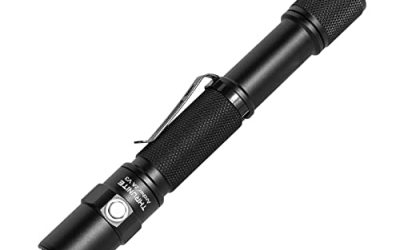
The ThruNite Archer 2A V3 is the most traditional tactical-style light in this guide, and the only one here designed purely around AA batteries rather than a dual-fuel setup. It runs on two AA cells in a longer body, with a dual-switch layout that separates the main on and off control from mode selection. The maker lists a maximum output of 500 lumens in the cool white version, a beam distance of 93 meters, five lighting modes including strobe, and an IPX8 waterproof rating. Because there is no higher-voltage cell in the specification, the published output is the AA output, which makes comparisons simpler for buyers who never intend to use lithium-ion cells at all.
The longer body changes handling in useful ways. There is more surface to grip, the switches are easier to locate by touch, and the light feels more secure with gloves or wet hands than a short single-cell tube. That size also suits a household emergency role: the Archer 2A V3 is easy to find in a drawer, easy to aim, and large enough that it is less likely to be misplaced between uses. The trade-off is pocket carry, where its length is noticeable, and the need to replace two cells at a time instead of one. Keeping matched pairs of fresh AA cells together in storage avoids mixing a fresh cell with a partly used one.
Mode choice runs from a very low firefly level, suited to preserving night vision across many nights, through middle levels for walking and household tasks, up to full output for outdoor checks. A pocket clip, lanyard, and spare O-rings are listed among the accessories. For buyers who want a conventional flashlight with no advanced interface to configure, this is the most straightforward recommendation in the guide.
Specs
| Spec | Detail |
|---|---|
| Product | ThruNite Archer 2A V3 |
| Battery | 2 AA batteries |
| Maximum output | 500 lumens, cool white version |
| Beam distance | 93 meters |
| Modes | 5 modes, including firefly and strobe |
| Waterproof rating | IPX8 |
| Impact resistance | 1 meter, as listed by the maker |
| Body material | Aluminum alloy |
| Switch | Dual switch, tail and side |
| Included accessories | Pocket clip, lanyard, and spare O-rings |
| ASIN | B08H1NTK82 |
Who It Suits
The Archer 2A V3 suits buyers who want the clearest AA-only proposition: two common cells, a familiar dual-switch layout, and output figures that describe AA performance directly. It is a strong choice for a home storm kit, a vehicle kit, or a workbench drawer, and for users who wear gloves or prefer a larger grip. Buyers focused on the smallest possible pocket light should choose one of the single-cell models instead. Buyers who want advanced interface features or high color rendering should look at the SP10 Pro, while buyers who want a shared household light that needs no setup at all will likely land here.
FAQ
Can an AA tactical flashlight be bright enough for outdoor use?
Yes, within realistic limits. These models produce enough AA output for walking, yard checks, campsite tasks, and scanning a driveway or fence line. AA power does not match the sustained output and long throw of larger lithium-ion lights, but for storm and household tasks at short and medium range it is generally sufficient, especially when a middle mode handles most work and high mode is kept for short checks.
Is it better to use alkaline or rechargeable NiMH AA batteries?
It depends on how often the light is used. Alkaline AA cells are inexpensive to stock, widely available during emergencies, and well suited to a kit light that sits unused for long periods, provided they are checked and rotated regularly. NiMH rechargeable AA cells handle higher drain more steadily, can be recharged for repeated weekly use, and reduce waste over time. Many households use both: rechargeable cells in the light that gets daily use, and a sealed pack of fresh alkaline cells stored beside each emergency light.
What does an IP68 or IPX8 rating actually cover?
These ratings describe water protection under the controlled test conditions stated by the maker. A light rated IP68 or IPX8 is built to withstand immersion at the depth and duration in its specification, which covers heavy rain, puddles, and brief drops into water. The rating depends on seals and O-rings staying clean and intact, so rinsing, drying, and checking the seals after mud or salt water exposure helps keep that protection working.
How many spare AA batteries should be kept with each flashlight?
A practical minimum is one full replacement set stored with each light, plus a shared household reserve for a long outage. Spares should be kept in their packaging or a battery case, and rotated into household use before they age out. Running a light on a low or middle mode during an outage stretches each set far longer than leaving it on high.
Final Verdict
There is no single winner here, because the three lights solve the same problem in different ways. The LUMINTOP Tool AA 2.0 is the pick for buyers who value the smallest body and a simple tail-switch pattern that returns to the last mode used. The Sofirn SP10 Pro is the pick for buyers who want natural color rendering, a very low moonlight level, and an interface that can be adjusted in unusual depth, and who are willing to set it up before sharing it. The ThruNite Archer 2A V3 is the pick for buyers who want an AA-only light with a larger grip, dual switches, and published figures that describe AA performance without any conversion.
For a reader building or refreshing a storm kit, the deciding questions are practical: will the light live in a pocket or a drawer, will one person use it or the whole household, and will spares be alkaline, rechargeable, or both? The kit is only complete when fresh AA batteries are stored with the light and the controls have been learned before an outage. A modest AA flashlight that is ready on the night it is needed is worth far more than a stronger light with no working cells beside it.
Product and ASIN Reference
| Product | ASIN |
|---|---|
| LUMINTOP Tool AA 2.0 | B07BLTP9ZD |
| Sofirn SP10 Pro | B0B2CWV6PL |
| ThruNite Archer 2A V3 | B08H1NTK82 |
More from Amazon
Programs that pair well with the guide above. Offers and eligibility are set by Amazon and may change.
Free shipping on eligible items, Prime Video and more. Eligible new members can start with a free trial.
Start a Prime free trialAudiobooks and podcasts to listen to on the go. Eligible new members can start with a free trial.
Try Audible freeAd-free music streaming. Eligible new subscribers can start with a free trial.
Try Music Unlimited freeA free business account with business pricing and bulk-buying tools for work, shop or home office.
Create a business accountAs an Amazon Associate we earn from qualifying purchases.