Key takeaways
- Compare the best flashlights for hiking — handheld, rechargeable trail lights from Fenix, Nitecore and Wurkkos with beam distance, runtime and weather sealing explained.
As an Amazon Associate we earn from qualifying purchases.
A hike that starts in daylight does not always end in daylight. A slow descent, a wrong turn at a trail junction, a twisted ankle that turns a two-hour walk into a four-hour one — any of these can leave you finishing the route by flashlight. A handheld flashlight earns its place in a hiking pack because it does jobs a phone light cannot: it throws a beam far enough to find the next trail marker, it runs for hours at a useful brightness without draining the phone you need for navigation and emergencies, and it keeps working in rain that would send a phone back into a dry pocket.

This guide covers handheld flashlights only, all of the same type, chosen for hiking rather than for duty use, hunting, or home emergencies. Every pick below is rechargeable, weather-sealed, and sized to ride in a hip-belt pocket, a side pocket, or a jacket. The guide explains how much brightness and beam distance hiking actually calls for, how to read runtime figures honestly, and which of the three lights fits day hikes, multi-day trips, and weight-conscious packs best.
Disclosure: This article contains affiliate links. If you buy through a link on this page, we may earn a commission at no extra cost to you.
Quick Comparison
| Flashlight | Max output | Beam distance | Battery | Charging | Best for |
|---|---|---|---|---|---|
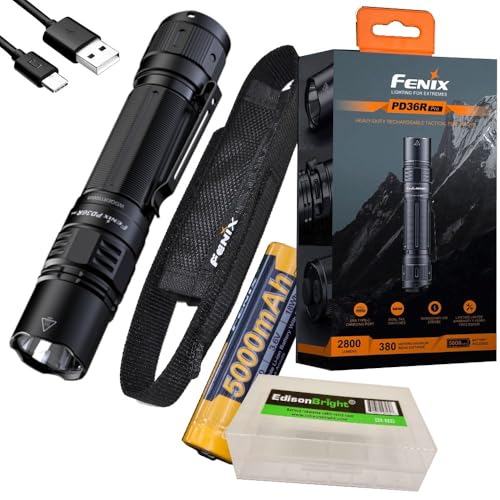
| Fenix PD36R Pro | 2,800 lumens | 380 meters | 5,000 mAh 21700, included | USB-C | Most hikers, long descents |
| Nitecore MH12 Pro | 3,300 lumens | 505 meters | 5,300 mAh 21700, included | USB-C | Route finding at distance |
| Wurkkos FC11C | 1,200 lumens | 155 meters | 18650, included | USB-C | Lightweight day hikes |
All output and beam figures in this table and throughout the article are the manufacturers’ published ratings from the product listings, not independent measurements.
How We Chose These Hiking Flashlights
Hiking makes specific demands that a general flashlight roundup can miss. Weight matters because the light rides in the pack all day for a job it may only do for the last hour. Runtime at a moderate setting matters more than a headline maximum, because walking a trail calls for steady, moderate light rather than short bursts of full power. Weather sealing matters because the hike that runs late is often the hike that also ran into weather. And simple controls matter because you will operate the light with cold hands, possibly with gloves on, while standing on uneven ground.
With those demands in mind, each light here had to meet a short list of requirements. It had to be a handheld flashlight — not a headlamp, lantern, or keychain light — so the set stays one consistent type. It had to be rechargeable over USB-C, so a single cable and power bank can serve the light and a phone on a multi-day trip. It had to carry a published waterproof rating suited to rain. It had to offer a low or eco mode with a long rated runtime for extended walks out. And it had to come from a maker with a track record in outdoor lighting, with a current listing on Amazon US.
1. Fenix PD36R Pro — Best Overall Flashlight for Hiking
Check the Fenix PD36R Pro on Amazon
The Fenix PD36R Pro is the most balanced hiking light in this guide. Fenix rates it at a maximum of 2,800 lumens with a beam distance of 380 meters, driven by a Luminus SFT70 LED. That reach is well beyond what trail walking needs moment to moment, and that is the point: on high or turbo, the PD36R Pro lets you pick out a trail marker, a gate, or the far side of a stream crossing long before you reach it, then step back down to a walking mode for the ground in front of your boots.
The walking modes are where this light suits hiking best. Fenix publishes five brightness levels, including a 150-lumen low rated for 19 hours and a 30-lumen eco mode rated for 42 hours from the included 5,000 mAh 21700 battery. A hiker caught out after dark rarely needs more than the low setting on a formed trail, which means a single charge covers many evenings of late finishes rather than one. Because the 21700 cell is removable, you can also carry a spare and swap it in seconds instead of waiting on a charge — a practical option on multi-day routes.
Charging is through a covered USB-C port on the light itself, so the same cable that tops up a phone or a power bank tops up the flashlight. The body is aluminum with an IP68 rating, which covers heavy rain and brief submersion, and dual tail switches separate the jobs of turning the light on and changing brightness, with a dedicated strobe available from the smaller switch. At roughly six ounces including the battery, it is not the lightest light here, but it is light enough to forget in a pack pocket until it is needed.
Choose the PD36R Pro if you want one handheld light that handles day-hike insurance, long autumn descents, and multi-day trips without a second thought about runtime. Skip it only if shaving every ounce is the priority, in which case the Wurkkos below is the smaller carry.
2. Nitecore MH12 Pro — Best for Long-Range Route Finding
Check the Nitecore MH12 Pro on Amazon
The Nitecore MH12 Pro is the long-throw pick. Nitecore rates it at 3,300 lumens with a beam distance of 505 meters from its UHi 40 LED — the longest reach in this guide. On open ridges, across farmland, or on unfamiliar routes where the path fades and the next marker could be in any of several directions, that reach turns a slow, uncertain search into a single sweep of the beam. It is also the light to reach for when you need to check what is moving at the edge of a field or read terrain far below a descent route before committing to it.
Reach usually costs runtime, but the MH12 Pro answers that with a large included 5,300 mAh 21700 battery and a genuinely useful low end. Nitecore rates its 50-lumen level for 50 hours, which is a sensible walking brightness for a formed path and enough endurance for a week of late finishes on one charge. Higher levels are there when the route demands them, and the light steps through its modes with a tail switch paired with a side control, a layout that stays workable with gloves.
Like the Fenix, the MH12 Pro charges over USB-C, carries an IP68 rating against rain and submersion, and is built in an aluminum body with a hard-anodized finish. It ships with a holster and pocket clip, so it can ride on a belt or a pack strap rather than buried at the bottom of the main compartment — placement that matters, because a light you cannot reach quickly is a light you will walk past the junction without using.
Choose the MH12 Pro for mountain routes, open country, and any hiking where finding the way at a distance is the main job. Its maximum output generates real heat in a compact body, as all small high-output lights do, so treat the top setting as a tool for short checks and walk on a mid or low level, which is how the light is meant to be used on a trail anyway.
3. Wurkkos FC11C — Best Lightweight Pick for Day Hikes
Check the Wurkkos FC11C on Amazon
The Wurkkos FC11C is the compact, carry-it-always option. Wurkkos rates it at 1,200 lumens with a beam distance of 155 meters — modest figures next to the two lights above, and entirely sufficient for the job most day hikers actually face: finishing a known trail, walking a forest path back to the car park, or handling a campsite after a day walk. On a formed trail, a few hundred lumens is comfortable walking light, and the FC11C delivers that in a smaller, lighter body that disappears into a hip-belt pocket.
One feature sets the FC11C apart for trail use: its high color rendering LED, rated at 90 CRI in a neutral 5000K tint on this listing. High-CRI light shows colors closer to how daylight shows them, which makes it easier to judge the ground underfoot — telling wet rock from dry rock, mud from shadow, and reading the colors on trail markers and map symbols accurately. Cool-white beams with lower color rendering can flatten those distinctions, and on a descent at night those distinctions are exactly what you are navigating by.
The FC11C runs on an included rechargeable 18650 battery, charges over USB-C, and includes a magnetic tail cap, which lets it double as a hands-free work light stuck to a car body or gate when you are loading the car after dark. It is water resistant for use in rain, and its simple interface suits hikers who want one button and no menu system to learn.
Choose the FC11C if your hiking is mostly daylight with the flashlight carried as insurance, or if pack weight is the deciding factor. Choose one of the 21700 lights above instead for regular night hiking, winter routes with long hours of darkness, or multi-day trips where runtime headroom is worth more than saved grams.
What Actually Matters in a Hiking Flashlight
Brightness: walking light versus search light
Lumens measure total light output, and hiking needs two different kinds. Walking light is the moderate, wide illumination that shows the trail surface, your footing, and obstacles a few steps ahead; for most trails, a setting somewhere in the low hundreds of lumens or below does this comfortably and runs for many hours. Search light is the brief, high-output burst used to find a marker, check a crossing, or scan a slope. A good hiking flashlight offers both, with several levels between them, and the step between levels matters more than the size of the maximum figure. All three lights here provide that spread, from eco modes rated in tens of lumens up to their headline maximums.
Beam distance and beam shape
Beam distance is the manufacturer’s published figure for how far the beam reaches, and it describes the center hotspot more than the usable light at your feet. A long-distance beam such as the MH12 Pro’s 505-meter rating concentrates light into a tighter spot, which is ideal for searching and less ideal as your only walking light at close range. A shorter-distance beam spreads light wider, which suits trail walking. In practice, hikers use a mid mode for walking — where every light here lights the path well — and reserve the hotspot’s full reach for checks at distance. Judge a hiking light by whether it has a comfortable mid mode, not by its maximum throw alone.
Runtime: read the level, not the headline
The longest runtime on any listing belongs to the lowest mode, and the shortest belongs to turbo. Neither number describes a night’s walking. The useful question is how long the light runs at the level you will actually walk on — roughly the 30- to 350-lumen range for most trails. On that measure, the PD36R Pro’s 150-lumen level rated at 19 hours and the MH12 Pro’s 50-lumen level rated at 50 hours are the figures to plan around. Also note that high-output modes on compact lights step down automatically as the head warms up, so a turbo rating describes a burst, not a sustained level. Plan your battery around mid modes and treat turbo as a bonus.
Battery and charging on the trail
All three lights charge over USB-C, which keeps a multi-day kit simple: one cable and one power bank serve everything. Removable cells, as in the two 21700 lights, add the option of carrying a charged spare — the fastest way to restore a dead light mid-route. Whatever you carry, build the habit of topping the light up before a hike where a late finish is possible, and store it where you can reach it without unpacking: a hip-belt pocket, a lid pocket, or clipped to a strap.
Weather sealing and build
An IP68 rating, carried by the Fenix and the Nitecore here, means the light is sealed against dust and rated for submersion, which is more than enough for hiking rain. For any light, the practical checks are simpler: a covered charging port, intact seals, and a body that tolerates being dropped on rock. Aluminum bodies with hard-anodized finishes, as on all three picks, handle trail knocks well. Rinse mud off after a wet hike and let the light dry before charging.
Weight and carry
A hiking flashlight earns its weight only if it is actually carried. Lights in the size class covered here ride comfortably in a pocket or on a belt, and the difference between the heaviest and lightest pick in this guide is a few ounces — worth weighing against runtime if you hike ultralight, and irrelevant for most day packs. What matters more is access: a light buried under a waterproof layer at the bottom of the pack will not come out for a ten-minute dark stretch, which is precisely when a stumble happens.
Handheld Flashlight or Headlamp for Hiking?
Many hikers walk with a headlamp, and for steady hands-free walking a headlamp is a fine tool. A handheld flashlight still earns its place alongside or instead of one. Held low, a handheld beam throws shadows behind rocks, roots, and steps, which makes the trail surface easier to read than light coming from forehead height, where shadows hide. A handheld light also points where your hand points, not where your head turns, which is better for checking a map, a junction sign, or the far bank of a stream without blinding a companion. And as a backup, a handheld light and a headlamp cover each other’s failure completely. This guide covers handheld lights only, so if you carry one light, carry it where your hand finds it fast.
Frequently Asked Questions
How many lumens do you need for hiking?
For walking a formed trail, a setting in the low hundreds of lumens or below is comfortable and preserves runtime. Higher outputs — the thousands of lumens the Fenix and Nitecore here can produce — are for short searches: finding markers, checking crossings, and scanning terrain. A light with several well-spaced levels covers both jobs better than a single very bright mode.
How long should a hiking flashlight run?
Long enough to walk out from the furthest point of your route at a moderate setting, with margin. In practice, look at the rated runtime at a low or mid mode rather than the maximum runtime figure: ratings such as 19 hours at 150 lumens or 50 hours at 50 lumens mean a single charge covers many late finishes. Carry a spare cell or a power bank on multi-day trips.
Is a waterproof rating necessary for hiking?
Weather resistance is essential, because the hikes that run late often run wet. An IP68-rated light handles heavy rain and brief submersion without concern. Whatever the rating, keep the charging port cover closed on the trail and dry the light before plugging it in.
Should a hiking flashlight be rechargeable?
For most hikers, yes. USB-C rechargeable lights top up from the same power bank as a phone, and removable rechargeable cells allow a charged spare to be carried. That combination is simpler and cheaper to run over time than disposable cells, and all three lights in this guide follow it.
Where should you carry a flashlight while hiking?
Somewhere reachable without stopping to unpack: a hip-belt pocket, a pack lid, or clipped to a strap or belt. A light is safety equipment, and like a whistle or a map, it only helps if it comes to hand the moment conditions change.
Final Verdict
For most hikers, the Fenix PD36R Pro is the right single purchase: strong reach when the route demands it, long runtimes at genuine walking brightness, USB-C charging, a swappable cell, and full weather sealing in a package that still rides in a pocket. The Nitecore MH12 Pro is the pick when distance is the job — open country, high routes, and unfamiliar paths where finding the next marker from far off keeps the hike on track. The Wurkkos FC11C is the light to carry on every day hike as low-weight insurance, with color rendering that makes night footing easier to judge.
Whichever you choose, the habits matter as much as the hardware: charge the light before routes that could run late, carry it within reach, and walk on a mid mode while saving the maximum for the moments that need it. A trail after dark is a manageable place with a dependable light in hand — and an avoidable problem without one.
More from Amazon
Programs that pair well with the guide above. Offers and eligibility are set by Amazon and may change.
Free shipping on eligible items, Prime Video and more. Eligible new members can start with a free trial.
Start a Prime free trialAudiobooks and podcasts to listen to on the go. Eligible new members can start with a free trial.
Try Audible freeAd-free music streaming. Eligible new subscribers can start with a free trial.
Try Music Unlimited freeA free business account with business pricing and bulk-buying tools for work, shop or home office.
Create a business accountAs an Amazon Associate we earn from qualifying purchases.