Key takeaways
- Compare the best kids flashlight exploration kits, with hand-crank torches, binoculars, magnifiers and compasses for backyard and camping adventures.
Buying a flashlight exploration kit for a child is really a decision about how that child will play after dark and outdoors. A bare torch gets waved around for one evening, while a kit that pairs the light with binoculars, a magnifier and a compass turns a backyard, a campsite or a nature trail into a string of small missions. The wrong kit, though, frustrates everyone: pieces sized for older hands, a torch that dies without spare batteries, or a headline piece count padded with stickers.
This roundup is for parents kitting out a first young explorer, grandparents choosing a birthday or holiday gift, and families packing for camping trips with children roughly three and up. Every pick below was chosen from the product names and specifications published on its Amazon page, with the flashlight type, the optics and the full contents list checked line by line.
Quick Picks
As an Amazon Associate we earn from qualifying purchases.
| Product | Best for | Key spec from title |
|---|---|---|
| Kaqinu 24 Pcs Kids Explorer Kit | Bug hunting and collecting | 24 pieces with hand-crank flashlight and butterfly net |
| ESSENSON Kids Explorer Kit | Younger children carrying their own gear | Hand-crank flashlight with hiking backpack included |
| Box O’ Mart Outdoor Adventure Set | Siblings exploring together | Two walkie talkies plus hand-crank flashlight |
| Nature Explorers Outdoor Backyard Adventure Kit | Close-up nature study | Bug container with folding magnifying lens top |
How to Choose
Start With How the Flashlight Is Powered
The flashlight is the heart of an exploration kit, and its power source decides how much preparation each outing needs. Hand-crank torches dominate this category because they never sit dead in a drawer: a minute of cranking restores the light, and there are no loose cells for a parent to track. Battery torches can be brighter, but they add an ongoing errand and a small-parts concern for younger children. Check the listing carefully, because a kit can mix both systems, with a crank torch alongside battery-powered extras such as walkie talkies that still need their own cells.
Read the Contents List, Not the Headline Piece Count
Kit names advertise a number, yet that number counts every last item, from a lanyard to a pair of tweezers. What matters is the spread of real tools: a torch for after-dark play, binoculars for distance, a magnifier for close work, a compass for direction games and something to carry finds in. Two kits with the same count can feel completely different in a child’s hands. Compare the actual contents lists side by side, and favor the set whose tools match the way your child already plays, whether that is catching insects, watching birds or leading pretend expeditions.
Check the Optics Against Your Child’s Age
Binocular and magnifier figures are printed on every listing, and they deserve a skeptical read. Young children manage low magnification best: binoculars around four times magnification with a 30 mm objective lens are easy to hold steady, and soft rubber eyepieces protect the eye area during bumps. Magnifiers offering two strengths, a gentle one for leaves and a stronger one for insects, get more use than a single high-power lens. Where a listing’s description and its own specification table disagree on magnification, treat the lower figure as the honest one and decide whether it still suits your child.
Match the Carry System and Weight to Small Shoulders
An exploration kit only gets used if the child can carry it comfortably. Listings state the packed weight and the carry style, and the difference between a drawstring sack and a proper backpack with straps is real on a trail. A full kit can weigh around a pound and a half before a water bottle joins it, which is plenty for a preschooler. Look for a wrist strap on the torch, a neck strap on the binoculars and one bag that swallows every piece, because scattered tools are the ones that get lost before the second outing.
The 4 Best Options
Kaqinu 24 Pcs Kids Explorer Kit
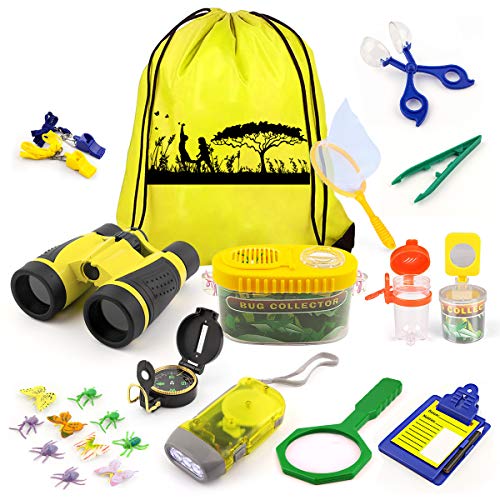
This is the kit for the child who comes home with pockets full of beetles. Alongside the hand-cranked flashlight, the box leans hard into collecting: three sizes of magnifying bug container, an insect clamp, a butterfly net and a dual-strength magnifying glass for examining the catch. The binoculars and lensatic compass round it out for distance spotting and direction games, and everything packs into a drawstring bag. With twenty-four pieces it is the deepest set here, suited to children who will actually use the collecting tools rather than leave them in the bag.
Specs
- Pieces: 24
- Flashlight: hand-cranked, 3 LED, 3.9 x 0.8 in, no batteries required
- Binoculars: 4x magnification, 30 mm objective lens, soft rubber eyepieces
- Magnifying glass: 3x and 10x magnification
- Compass: lensatic, 3 x 2.08 in
- Also included: butterfly net, insect clamp, magnifying bug collectors, whistle with lanyard, drawstring bag
- Material: plastic
- Minimum age: 36 months per the listing
- Item weight: 0.69 kg per the listing
- Item dimensions: 8 x 7.7 x 3.8 in
Best for: children who love catching and studying insects.
Watch out for: the listing marks assembly as required, and the high piece count includes small accessories that younger children can scatter quickly.
ASIN: B07VHPJDTL
ESSENSON Kids Explorer Kit

ESSENSON trims the concept down to the essentials and puts them in a real backpack, which makes this the easiest set for a young child to carry independently. The hand-crank flashlight charges its built-in battery by cranking, so there are no cells to buy or swap, and it wears a wrist strap for drops. Binoculars with flexible rubber eyepieces, a two-times magnifying glass, a compass and a whistle cover the classic explorer jobs without overwhelming a preschooler. At under a pound on the listing, it is the lightest carry in this roundup and a sensible first kit.
Specs
- Model: EK-188
- Flashlight: hand-crank with built-in battery, wrist strap
- Binoculars: 30 mm objective lens, fixed focus, roof prism
- Binocular magnification: 4x maximum per the listing specification table
- Magnifying glass: 2x magnification
- Also included: compass, whistle, hiking backpack
- Age range: 3 years and up per the listing
- Item weight: 0.88 lb
- Water resistance: not water resistant
- Color: orange
Best for: preschoolers and early-grade children carrying their own kit.
Watch out for: the product description calls the binoculars 5×30 while the listing’s own specification table states 4x maximum magnification, so expect the lower figure.
ASIN: B0C8H57XBV
Box O’ Mart Outdoor Adventure Set

Most kits equip one explorer; this camouflage set equips a patrol. Two walkie talkies headline the box, letting siblings or friends split up across a garden or campsite and report back, with twenty-two channels to choose from. The rest of the gear follows the classic pattern: a hand-crank flashlight, binoculars, a magnifier, a lensatic compass and a whistle that carries its own small compass, plus a camouflage cap and drawstring backpack for the full expedition look. It suits children who explore in pairs and treat every outing as a team mission with roles to assign.
Specs
- Model: T_023
- Pieces: 8
- Walkie talkies: 2 included, 22 channels, UHF FRS/GMRS, maximum talking range 6 km per the listing
- Walkie talkie batteries: 4 AAA required
- Flashlight: hand crank
- Also included: binoculars, magnifier glass, lensatic compass, whistle with compass, camouflage baseball cap, drawstring backpack
- Binocular magnification: not stated
- Item weight: 1.5 lb
- Water resistance: not water resistant
- Age range: not stated
Best for: siblings or friends who explore together and want to stay in contact.
Watch out for: the walkie talkies need four AAA batteries even though the flashlight is crank-powered, and the listing does not state a binocular magnification or a minimum age.
ASIN: B08RRNZCW9
Nature Explorers Outdoor Backyard Adventure Kit

Marbolet’s set is built around looking closely at living things. Its bug container carries a folding magnifying lens in the lid and a belt hook, so a captured insect can be inspected hands-free, and two additional bug carriers mean a friend can collect too. The pocket magnifier offers two strengths for leaves, rocks and footprints, the compass is liquid-filled for a steadier needle, and the hand-crank LED flashlight keeps the group going at dusk. A fox whistle, tweezers and a carry bag in green or orange complete a kit aimed squarely at young naturalists.
Specs
- Brand: Marbolet
- Manufacturer part number: STEM06
- Flashlight: LED hand-crank, wrist strap
- Binoculars: 4x magnification, 30 mm lens, adjustable focus, neck strap
- Magnifying glass: 2x and 5x magnification
- Compass: lensatic, liquid-filled, with protective cover and lanyard
- Also included: fox whistle, bug container with folding magnifying lens top, 2 bug carriers, tweezers, carry bag
- Minimum age: 36 months per the listing
- Materials: glass, plastic, rubber
- Item weight: not stated
Best for: budding naturalists who collect, classify and study what they find.
Watch out for: the description mentions batteries included alongside the hand-crank flashlight, which is unusual wording for a crank torch, so confirm how the light is powered before gifting.
ASIN: B07JDRH8B7
Which One Fits Your Situation
You Are Buying a First Kit for a Preschooler
Keep it light and simple. The ESSENSON kit asks the least of a three- or four-year-old: six core tools, a proper backpack, a torch that only needs cranking and the lowest packed weight here. Its stated age range starts at three years, matching the listing guidance, and there are no loose batteries to manage.
Your Children Explore as a Team
Choose the Box O’ Mart set. The two walkie talkies change the dynamic completely, letting one child scout ahead while the other minds base camp, and the shared compass, whistle and camouflage cap reinforce the team theme. Just add the AAA batteries the radios need before the first outing together.
Your Child Is Obsessed With Bugs
The Kaqinu set is the collector’s pick, with three magnifying bug containers, a clamp for picking insects up without fingers, and a butterfly net the other kits leave out. Its stronger ten-times magnifier lens rewards patience. The Nature Explorers kit runs it close, especially if your child prefers a lidded container with its own magnifying top.
You Want One Gift That Works for Birthdays and Camp
Any of these four arrives as a complete, giftable box, but the Nature Explorers kit covers the widest ground: torch, binoculars, two magnifier strengths, a liquid-filled compass and collecting gear in one bag. It moves from backyard to campsite without extra purchases, which suits a gift that has to land first time.
Common Mistakes
- Choosing by headline piece count instead of reading the actual contents list, which is how sticker sheets end up counted as explorer tools.
- Assuming every item in a kit is battery-free when the extras, such as walkie talkies, may still need their own cells.
- Ignoring the minimum age and packed weight, then handing a heavy, complicated set to a child who cannot carry or work it.
- Expecting a toy lensatic compass to teach real navigation on its own, rather than treating it as a prompt for supervised direction games.
- Leaving the kit unpacked between trips, so the small pieces vanish one by one instead of returning to the single carry bag.
Frequently Asked Questions
What age are kids flashlight exploration kits aimed at?
Listings for the kits in this roundup start at thirty-six months or three years and up, and the tools suit roughly the three-to-eight range best. Younger children use the torch, whistle and magnifier with supervision, while older children get more from the compass and binoculars. Always follow the minimum age printed on the listing you choose.
Do these exploration kits need batteries?
The flashlights in all four kits are hand-cranked, so the torches themselves need no replacement batteries. Accessories are a separate question: the Box O’ Mart walkie talkies require four AAA batteries. Before gifting, check the contents list of your chosen kit for any battery-powered extras and add the cells if the listing says they are required.
How is an exploration kit different from a single kids flashlight?
A single torch only provides light. An exploration kit builds a whole activity around it, adding binoculars for distance, a magnifier for close study, a compass for direction play and a bag to carry everything. The extra tools are what turn a five-minute novelty into repeat outdoor play, especially for children who like collecting and examining finds.
Are these kits suitable for camping trips, or just the backyard?
Both. The hand-crank torches work anywhere without charging, and the compasses, whistles and binoculars are standard campsite companions for children. None of the kits here is water resistant per its listing, so pack the bag under cover in wet weather, and keep expectations realistic: these are play and learning tools, not survival equipment.
More from Amazon
Programs that pair well with the guide above. Offers and eligibility are set by Amazon and may change.
Free shipping on eligible items, Prime Video and more. Eligible new members can start with a free trial.
Start a Prime free trialAudiobooks and podcasts to listen to on the go. Eligible new members can start with a free trial.
Try Audible freeAd-free music streaming. Eligible new subscribers can start with a free trial.
Try Music Unlimited freeA free business account with business pricing and bulk-buying tools for work, shop or home office.
Create a business accountAs an Amazon Associate we earn from qualifying purchases.