Key takeaways
- Five boost packs compared for storm season: peak-amp figures, engine sizes as listed, safe connection steps, and who should skip a pack and call a pro.
- Top Pick: NOCO Boost Plus GB40
- Runner-up: NOCO Boost HD GB70
- Also consider: GOOLOO GP4000
Storm season has a way of finding the weakest part of a household plan, and for many families that weak point is a vehicle battery. A car that sat through two days of rain with the lights left on, or a truck battery already near the end of its life, can leave a family stuck at the exact moment they need to reach a relative, a pharmacy, or higher ground. A portable boost pack answers that one problem: it holds a reserve of power in the trunk so a flat 12-volt battery can be coaxed back to life without waiting for another vehicle.
This guide compares five boost packs sold for exactly that job, from a compact lithium unit for a small sedan to a heavy lead-acid pack built for repeated use in a home garage. Every peak-amp figure and engine size below comes from the maker’s own listing and should be read as a maker figure, not a promise. Connection order always follows the vehicle manual and the pack maker’s guidance, and a successful boost is a get-home step, not a repair.
As an Amazon Associate, we earn from qualifying purchases.
Quick answer
For most family cars and crossovers, the NOCO Boost Plus GB40 covers gasoline engines up to 6.0 liters as listed, in a small lithium pack. Drivers of big V8 trucks should look at the NOCO Boost HD GB70 or the Hulkman Alpha85. Every figure here is a maker figure, and a boost is only a get-home step.
How to choose
Begin with the engine in your own vehicle. Makers publish separate figures for gasoline and diesel engines, and the diesel figure is always the lower one, so match the pack to the larger engine in the household. A pack listed for 6.0-liter gasoline engines may only be listed for 3.0-liter diesels, and that gap matters for a diesel truck.
Treat the peak-amp figure with care. Each maker gathers that figure under its own conditions, so a bigger number on one box does not guarantee an easier boost than a smaller number on another. The engine-size figure is the more useful guide, and even that is a ceiling the maker sets, not a promise for your engine on your coldest morning.
Chemistry shapes daily life with the pack. Lithium packs are light enough for a glove box, hold a charge well on a shelf, and double as phone power during an outage. A lead-acid pack is far heavier, lives in the garage, and asks for a regular charging rhythm per its maker’s guidance so its battery stays healthy.
Cold weather trims the output of every pack, whatever the chemistry. Keep the pack indoors during a cold snap rather than in a frozen trunk, and let it warm up before a planned trip. Finally, look at the safety wording on the listing: spark-proof connections and reverse-polarity protection forgive a clamp mix-up, but they never replace the correct connection order, and the charge indicator deserves a check before storm season and after every use.
NOCO Boost Plus GB40

The GB40 is the small-pack benchmark for ordinary family vehicles. NOCO lists it for gasoline engines up to 6.0 liters and diesel engines up to 3.0 liters, which covers most sedans, crossovers, and small SUVs in a typical driveway. Its lithium build keeps it light enough to live in a glove box or a go-bag, and the listing adds a 100-lumen LED flashlight and USB output, both handy during a power outage at home.
The maker gives up to 20 boosts per charge, a figure to treat as a maker figure rather than a daily expectation. For a household with one or two modest vehicles, this pack asks the least storage space and upkeep: check the charge indicator from time to time and recharge per the maker’s guidance.
Specs:
– Peak output: 1,000 amps (maker figure)
– Engine sizes as listed: gasoline up to 6.0L, diesel up to 3.0L
– Battery: lithium-ion
– Voltage: 12 volts
– Boosts per charge: up to 20 (maker figure)
– Flashlight: 100-lumen LED, as listed
NOCO Boost HD GB70

The GB70 is the step up for households running larger vehicles. NOCO lists 2,000 peak amps, gasoline engines up to 8.0 liters, and diesel engines up to 6.0 liters, which reaches full-size pickups and larger SUVs beyond the GB40’s listed range. The maker gives up to 40 boosts per charge, and the flashlight grows to 400 lumens per the listing.
That extra reserve suits a rural household that may boost a truck, a tractor, and a neighbor’s SUV in the same outage week. It is bigger and heavier than the GB40, so it tends to live in the vehicle it serves rather than moving between cars. As with every pack here, the engine figures are maker figures, and a battery that keeps going flat needs a professional, not a bigger pack.
Specs:
– Peak output: 2,000 amps (maker figure)
– Engine sizes as listed: gasoline up to 8.0L, diesel up to 6.0L
– Battery: 56Wh lithium-ion
– Voltage: 12 volts
– Boosts per charge: up to 40 (maker figure)
– Flashlight: 400-lumen LED, as listed
GOOLOO GP4000

GOOLOO lists the GP4000 at 4,000 peak amps, for all gasoline engines and diesel engines up to 10.0 liters. On paper that is the widest engine coverage in this group, and the listing adds USB Quick Charge and a Type-C port for phone charging during an outage.
Peak-amp figures are maker figures, and makers gather them under their own conditions, so the wide diesel figure is best read as headroom rather than a promise for any single engine. Households with a big diesel pickup will still want to hold the listed figure against the truck maker’s own guidance, and to keep a professional in mind for a battery that keeps failing.
Specs:
– Peak output: 4,000 amps (maker figure)
– Engine sizes as listed: all gasoline engines, diesel up to 10.0L
– Battery: lithium
– Voltage: 12 volts
– Ports as listed: USB Quick Charge and Type-C port
Hulkman Alpha85

The Hulkman Alpha85 pairs a 2,000-amp peak figure with a 74 watt-hour battery, the largest energy reserve among the lithium packs here, and lists gasoline engines up to 8.5 liters and diesel engines up to 6.0 liters. A 3.3-inch display on the unit shows charge and status, which helps when a pack comes off a shelf after months in storage.
That reserve also makes it a strong pick when the pack doubles as outage power for phones and lights. It is one of the heavier lithium units, so it suits a vehicle that carries it full time. Charge it over USB-C per the maker’s guidance, and store it away from heat through the summer months.
Specs:
– Peak output: 2,000 amps (maker figure)
– Engine sizes as listed: gasoline up to 8.5L, diesel up to 6.0L
– Battery: 74Wh
– Voltage: 12 volts
– Display: 3.3-inch LED display, as listed
– Charging input: USB-C, as listed
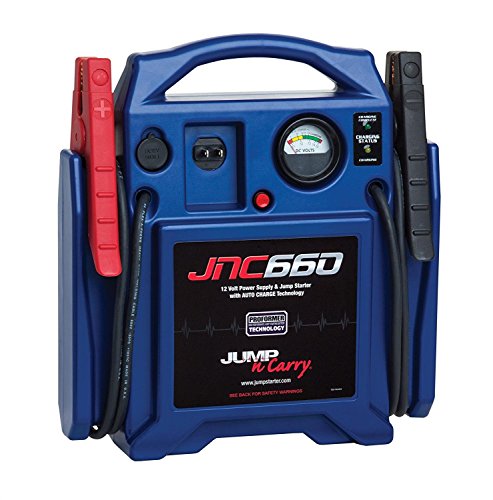
Clore JNC660
The JNC660 takes the older path: a 22 amp-hour lead-acid battery in a carry case, listed at 1,700 peak amps and 425 cranking amps. It is heavy, carries no phone-charging extras, and asks for a regular charging rhythm per Clore’s guidance so its lead-acid battery stays healthy.
What it offers in return is simple, proven hardware that garages have used for years, with clamp leads suited to a home workshop. For a household that boosts vehicles often — a small farm, a shared driveway, a family fleet — that trade can make sense. Everyone else will feel the weight every time the pack moves.
Specs:
– Peak output: 1,700 amps (maker figure)
– Cranking amps: 425, as listed
– Battery: 22Ah Clore Proformer lead-acid
– Voltage: 12 volts
Who should skip
Skip the whole category, for now, if your battery keeps going flat. A battery that needs a boost more than once in a short span is telling you something about its age, the charging system, or a drain somewhere in the vehicle, and the right move is a professional check rather than a larger pack.
Never boost a battery that is cracked, leaking, swollen, or frozen solid; that battery belongs with a professional. These packs serve 12-volt lead-acid vehicle batteries only. They are not for the traction battery of an electric vehicle, and hybrid vehicles follow the vehicle maker’s own procedure and nothing else. And if no driver in the household is willing to learn the clamp order from the manual ahead of time, a roadside assistance plan is the safer layer to lean on.
FAQ
How do I connect a boost pack the safe way?
Follow the connection order printed in the vehicle manual and the pack maker’s guide, in that order, every time. Keep the two clamps from touching each other while the pack is switched on, keep your face away from the battery, and treat eye protection as one useful layer. Once the engine is running, remove the clamps in the reverse order the maker gives, and drive to a professional if the battery was deeply flat.
Will a pack still work on a bitter cold morning?
Output falls as the temperature falls, for every chemistry, so a pack left in a frozen trunk gives less than its listed figure. Keep the pack indoors during a cold snap, let it warm to room temperature before a planned trip, and remember that every figure on the box is a maker figure gathered under the maker’s own conditions.
How often should a stored pack be recharged?
Follow the rhythm in the maker’s guide; many makers call for a check every few months and a recharge whenever the indicator drops. Build the check into the same routine as the smoke alarm batteries before storm season, and always recharge after a boost so the pack is ready for the next outage.
My vehicle needed a boost twice in one week. Is a bigger pack the answer?
No. A repeat flat battery points to the battery itself or the charging system, and a pack of any size only masks that for a day or two. Have the battery and charging system checked by a professional, and keep the pack for the genuine emergency: the one-off flat battery after the lights were left on overnight.
Final verdict
For most households, the NOCO Boost Plus GB40 is the sensible default: listed coverage for the engines most families drive, small enough to keep on hand and store. Step up to the GB70 or the Hulkman Alpha85 for full-size trucks and bigger diesels, look at the GOOLOO GP4000 for the widest listed diesel figure, and keep the Clore JNC660 in mind for garage duty where weight hardly matters. Whichever pack you choose, learn its clamp order before the storm arrives, keep it charged per the maker’s guidance, and treat every boost as a get-home step on the way to a proper repair.
More from Amazon
Programs that pair well with the guide above. Offers and eligibility are set by Amazon and may change.
Free shipping on eligible items, Prime Video and more. Eligible new members can start with a free trial.
Start a Prime free trialAudiobooks and podcasts to listen to on the go. Eligible new members can start with a free trial.
Try Audible freeAd-free music streaming. Eligible new subscribers can start with a free trial.
Try Music Unlimited freeA free business account with business pricing and bulk-buying tools for work, shop or home office.
Create a business accountAs an Amazon Associate we earn from qualifying purchases.