Key takeaways
- Five rechargeable battery and charger picks for home emergency kits, from eneloop pro and EBL NiMH sets to XTAR and POWEROWL smart chargers for AA cells.
Flashlights, weather radios, lanterns and headlamps are the backbone of a home emergency kit, and nearly all of them run on AA or AAA cells. A drawer of single-use batteries works until it does not, usually midway through a long outage. Rechargeable Ni-MH cells and a dependable charger turn that drawer into a rotating supply: cells leave devices, go onto the charger, and return to service while the grid is up, so the kit is ready when the power drops.
This guide covers five ways to build that supply, from matched sets to standalone smart chargers. Every capacity, cycle count and charge time below is a maker figure from the product listing, stated as listed. Rechargeables are one layer of a home kit, not the whole plan, so keep a reserve of primary cells beside them.
As an Amazon Associate, we earn from qualifying purchases.
Quick answer
For most home emergency kits, a matched Ni-MH set with its own charger is the simplest route: the Panasonic eneloop pro pack and the EBL 808 kit both pair AA and AAA cells with individual-slot charging. Homes with loose lithium cells can add the XTAR VC4, while the POWEROWL and Amazon Basics chargers cover AA and AAA spares.
How to choose
Begin with the devices in your kit. Count how many AA and AAA cells your flashlights, radios and lanterns hold, then size the charger to that count with spares left over. A four-bay charger suits a small kit; an eight-bay unit earns its place when several lanterns and headlamps need fresh cells at once.
Next, match chemistry to charger exactly as each listing states it. Ni-MH cells belong in chargers listed for Ni-MH. Some chargers are also listed for Ni-Cd cells, and one model adds lithium-ion sizes, but a charger should only hold the chemistries its own listing names. Never place different chemistries in one charger unless the listing itself allows that mix, and never put single-use alkaline cells in a rechargeable charger.
Individual-slot charging matters more than raw speed. Chargers that monitor each slot on its own let you top up one or two cells at a time and mix AA with AAA cells in one session, while paired-slot designs need cells loaded two at a time.
Finally, think about power input. Wall-plug chargers are simple at home, while USB-powered models can run from a laptop, vehicle adapter or power bank during an outage. Store charged cells cool and dry, away from children and sorted by size, and recycle worn-out cells under local rules.
Panasonic eneloop pro Charger Pack with 4 AA Batteries (K-KJ17KHCA4A)

Panasonic sells this pack as a matched set: four AA eneloop pro Ni-MH cells arrive with the BQ-CC17 charger, so one box puts a working rotation in place. The eneloop pro line is the maker’s high capacity range, aimed at demanding devices such as camera flashes and powerful flashlights.
The BQ-CC17 charges each cell on its own channel. The listing states it accepts one to four AA and/or AAA Ni-MH cells in any mix, so AAA cells from a headlamp can share the charger with AA cells from a lantern. Maker charge times run about nine hours for four of the included AA cells, or about four and a half hours for two.
- Contents: charger pack with 4 AA eneloop pro batteries included
- Cell chemistry: Ni-MH, eneloop pro
- AA capacity: up to 2550mAh, as listed by the maker
- Recharge cycles: up to 500 times, as listed by the maker
- Charger: Panasonic BQ-CC17, individual cell charging for 1 to 4 AA and/or AAA cells
- Charge time, maker figures: AA 2550mAh, about 9 hours for 4 cells and 4.5 hours for 2; AAA 950mAh, about 7 hours for 4 cells and 3.5 hours for 2
EBL Rechargeable Batteries with 8-Bay Smart Charger (EBL-808-AA-AAA)

The EBL 808 kit is built for households that burn through both common sizes. The box pairs four AA cells and four AAA cells with an eight-bay charger, so a full lantern set can cycle through one unit. The AA cells carry the largest capacity figure in this guide, which the maker aims at high-drain household devices.
The charger is an individual design: it can charge any number of AA or AAA cells from one to eight, in any mix of sizes. The listing names Ni-MH and Ni-Cd as the chemistries the charger accepts, and the included cells are Ni-MH. For a family kit, this is the bulk option.
- Contents: 4 AA cells, 4 AAA cells and an 8-bay charger
- AA capacity: 2800mAh, 1.2V Ni-MH, as listed by the maker
- AAA capacity: 1100mAh, 1.2V Ni-MH, as listed by the maker
- Charger bays: 8, with individual charging for any count from 1 to 8 cells
- Charger fit, as listed: AA and AAA Ni-MH and Ni-Cd rechargeable cells
XTAR VC4 Universal Battery Charger

The VC4 is the standalone charger in this guide, sold on its own for homes with loose cells already on hand. Its four independent slots feed an LCD screen that shows charging current, battery voltage and the capacity charged so far, which helps sort healthy cells from tired ones before storm season.
XTAR lists the VC4 for two families of cells. It charges 1.2V Ni-MH and Ni-CD cells in AAAA, AAA, AA, A, SC, C and D sizes, and 3.6V/3.7V lithium-ion cells in sizes from 10440 up to 32650, with the listing noting that protected 20700 and 21700 cells cannot be charged. That breadth suits mixed drawers of flashlight and household cells. The charger runs on USB power, and the maker recommends a 5V/2.1A source.
- Type: standalone charger, cells sold separately
- Slots: 4 independent charging slots
- Display: LCD showing charging current, voltage and charged capacity
- Input: DC 5V by USB; maker recommends a 5V/2.1A source
- Charge current, maker figures: 0.5A across 4 channels or 1.0A across 2 channels
- Ni-MH and Ni-CD fit, as listed: AAAA, AAA, AA, A, SC, C and D sizes
- Lithium-ion fit, as listed: 3.6V/3.7V sizes from 10440 to 32650
POWEROWL 8 Bay AA AAA Battery Charger
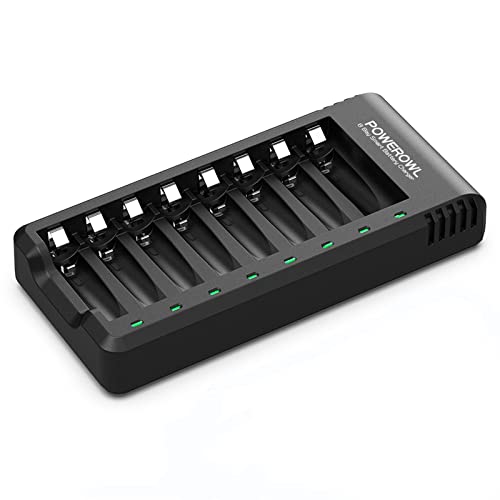
POWEROWL keeps its charger focused on the two sizes home kits use most. Eight independent slots accept any number or mixture of AA and AAA rechargeable cells, and the listing limits the fit to Ni-MH or Ni-Cd cells only. LED lights report the charge state of each slot, and a maker-described smart chip stops charging at full, then trickle charges.
The charger draws power over USB, and POWEROWL recommends a 5V/2A plug. No adapter is included: plan on a wall adapter, laptop port or power bank to run it. That USB input is also the appeal during an outage, since the charger can keep working from stored power while wall outlets are dead. Pair it with Ni-MH cells you already own or add a set from this guide.
- Type: standalone charger, no power adapter included
- Slots: 8 independent slots for any count or mix of cells
- Fit, as listed: AA and AAA Ni-MH or Ni-Cd rechargeable cells only
- Input: USB; maker recommends a 5V/2A plug
- Charge control, as described by the maker: smart chip stops at full charge, then trickle charging
Amazon Basics 4-Bay Battery Charger with 4 AA Batteries

This Amazon Basics bundle is the small, tidy way into rechargeables. It pairs a four-bay Ni-MH charger with four pre-charged AA cells rated by the maker at 2000mAh, so the kit works the day it arrives. Per-slot LED lights report charging, completion and errors, keeping the routine simple.
Maker figures put a full charge at about three and a half hours for two AA cells and seven hours for four, with AAA cells quicker. The included cells are listed for up to 1,000 recharge cycles. Two limits from the listing: the bundle ships with AA cells only, so AAA users need to add cells, and the charger carries a Type A wall plug as listed.
- Contents: 4-bay charger with 4 pre-charged AA Ni-MH cells included
- Included AA capacity: 2000mAh, as listed by the maker
- Recharge cycles: up to 1,000 for the included cells, as listed by the maker
- Charge time, maker figures: about 3.5 hours for 2 AA, 7 hours for 4 AA, 2 hours for 2 AAA, 4 hours for 4 AAA
- Indicators: per-slot LED for charging, completion and errors
- Plug: Type A wall plug, as listed
Who should skip
Skip rechargeables if your emergency plan leans on gear stored untouched for years and nobody will rotate or top up cells; a reserve of long-storage primary cells fits that habit better. Skip the XTAR VC4 if your kit holds only AA and AAA Ni-MH cells and you want a bundled set rather than a separate charger. Skip the POWEROWL if you have no spare USB power source, since its adapter is not included. And skip any charger whose listing does not name the chemistry of the cells you own.
FAQ
Do rechargeable Ni-MH cells work in every AA and AAA device?
No. Most flashlights, radios and lanterns accept 1.2V Ni-MH cells, but a few devices are picky about voltage or cell length. Check the device manual, and match cell size and chemistry to what the device maker names rather than assuming a fit.
How long do charged cells hold their charge in the drawer?
It varies by cell line, and makers state shelf figures on each listing. A practical routine is to top up kit cells every few months and after every outage, so the drawer is never far from full when a storm warning arrives.
Can one charger handle AA and AAA cells at the same time?
The individual-slot chargers in this guide can, as their listings state: the Panasonic, EBL and POWEROWL units each accept a mix of AA and AAA cells in one session. Paired-slot designs are more limited, so read the listing for the model you choose.
What should happen to cells that no longer hold a charge?
Retire them from the kit and recycle them. Local rules govern battery recycling, and many hardware stores run collection points. Keep retired cells apart from charged stock so a weak cell never ends up in a lantern during an outage.
Final verdict
For a first rechargeable setup, the Panasonic eneloop pro pack and the Amazon Basics bundle are the calmest routes: matched cells, a charger in the box, and clearly reported charging. Households that cycle many cells should look at the EBL 808 kit or the eight POWEROWL slots, while anyone with loose lithium flashlight cells alongside Ni-MH spares gets the most from the XTAR VC4. Treat listing figures as maker figures, store cells cool and dry, and keep a small primary-cell reserve beside the rechargeables.
More from Amazon
Programs that pair well with the guide above. Offers and eligibility are set by Amazon and may change.
Free shipping on eligible items, Prime Video and more. Eligible new members can start with a free trial.
Start a Prime free trialAudiobooks and podcasts to listen to on the go. Eligible new members can start with a free trial.
Try Audible freeAd-free music streaming. Eligible new subscribers can start with a free trial.
Try Music Unlimited freeA free business account with business pricing and bulk-buying tools for work, shop or home office.
Create a business accountAs an Amazon Associate we earn from qualifying purchases.